


























Views
Downloads

Essential Increasing Order Worksheet | Grade 1-2 Math
Paste this activity's link or code into your existing LMS (Google Classroom, Canvas, Teams, Schoology, Moodle, etc.).
Students can open and work on the activity right away, with no student login required.
You'll still be able to track student progress and results from your teacher account.
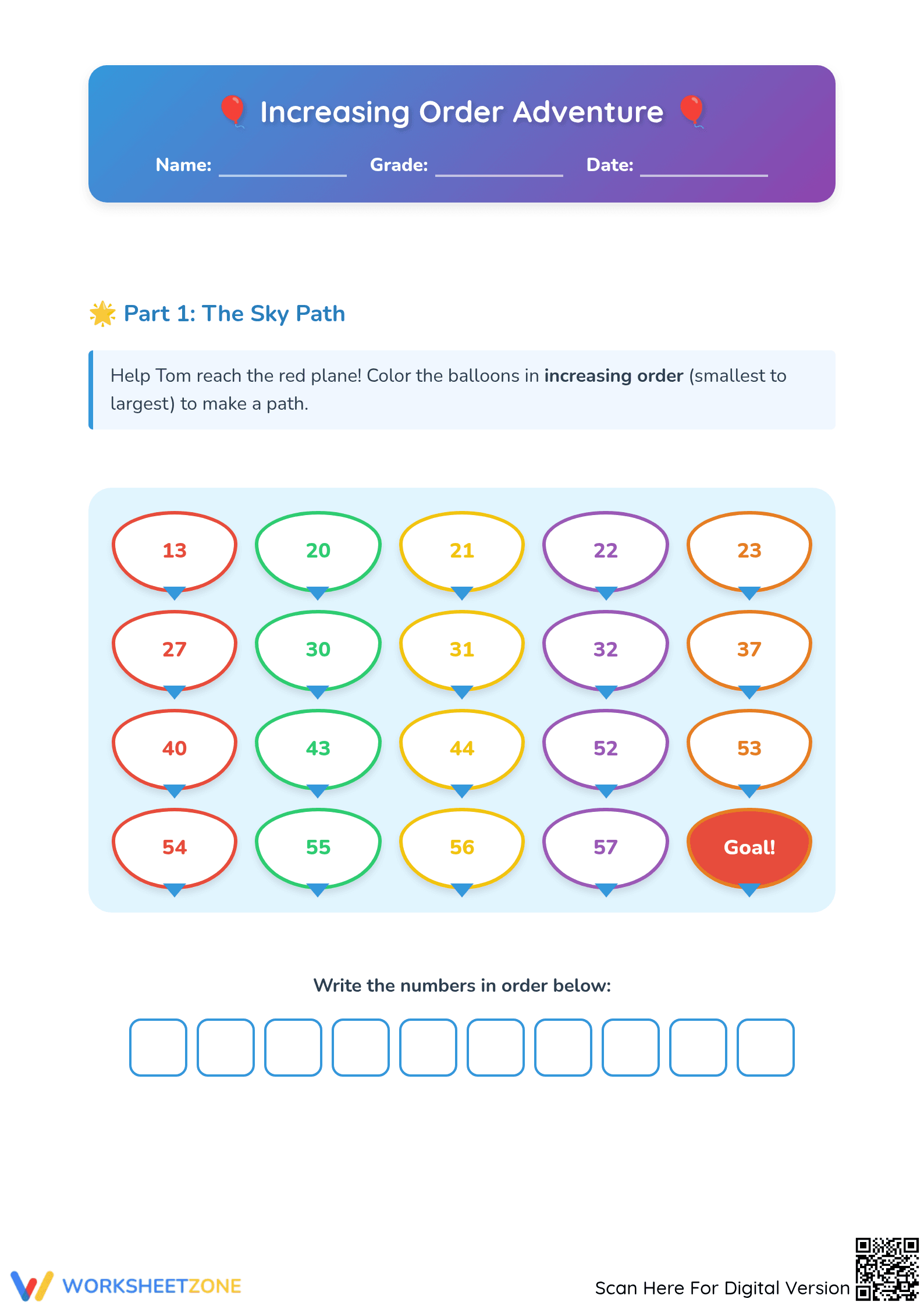
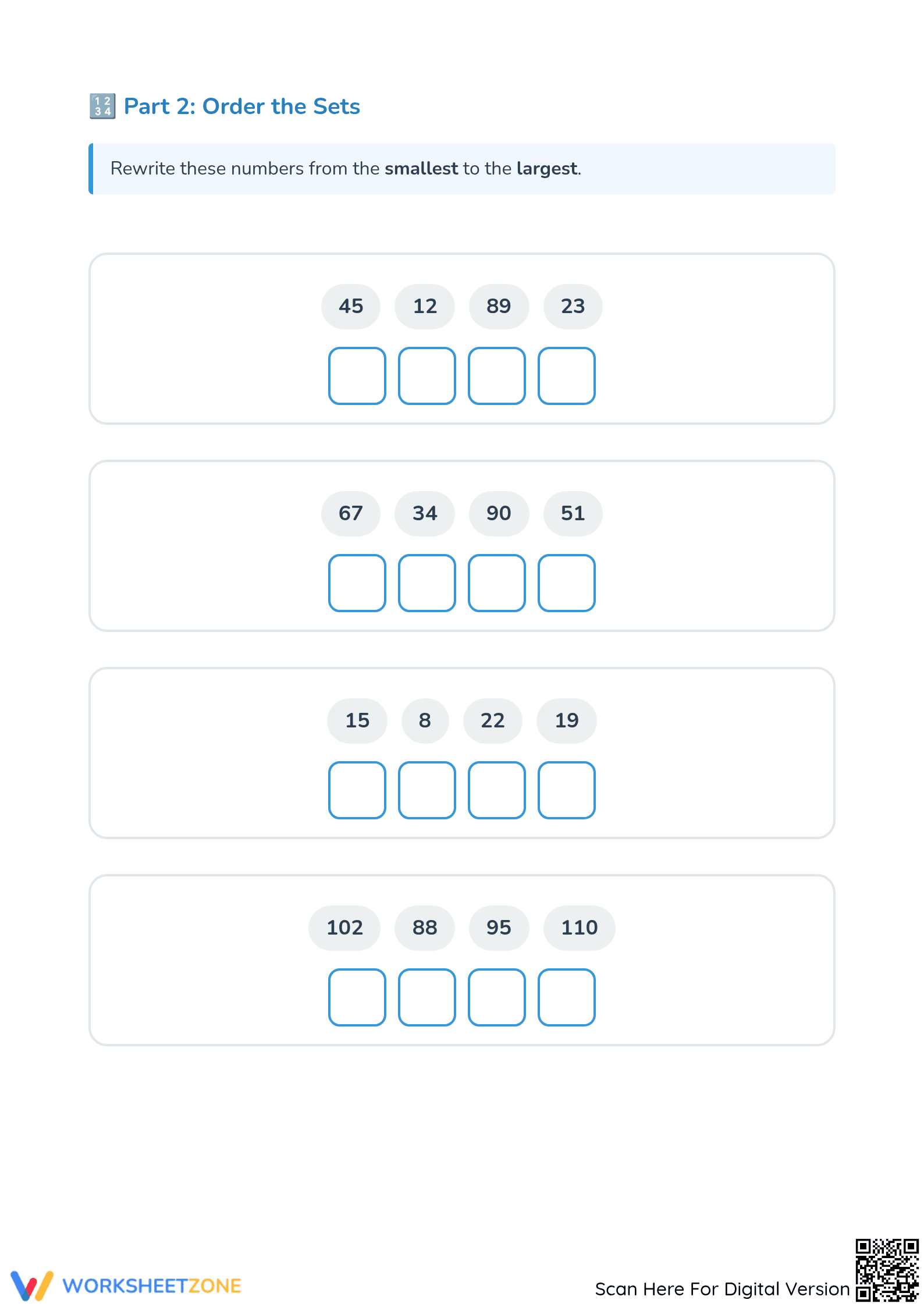
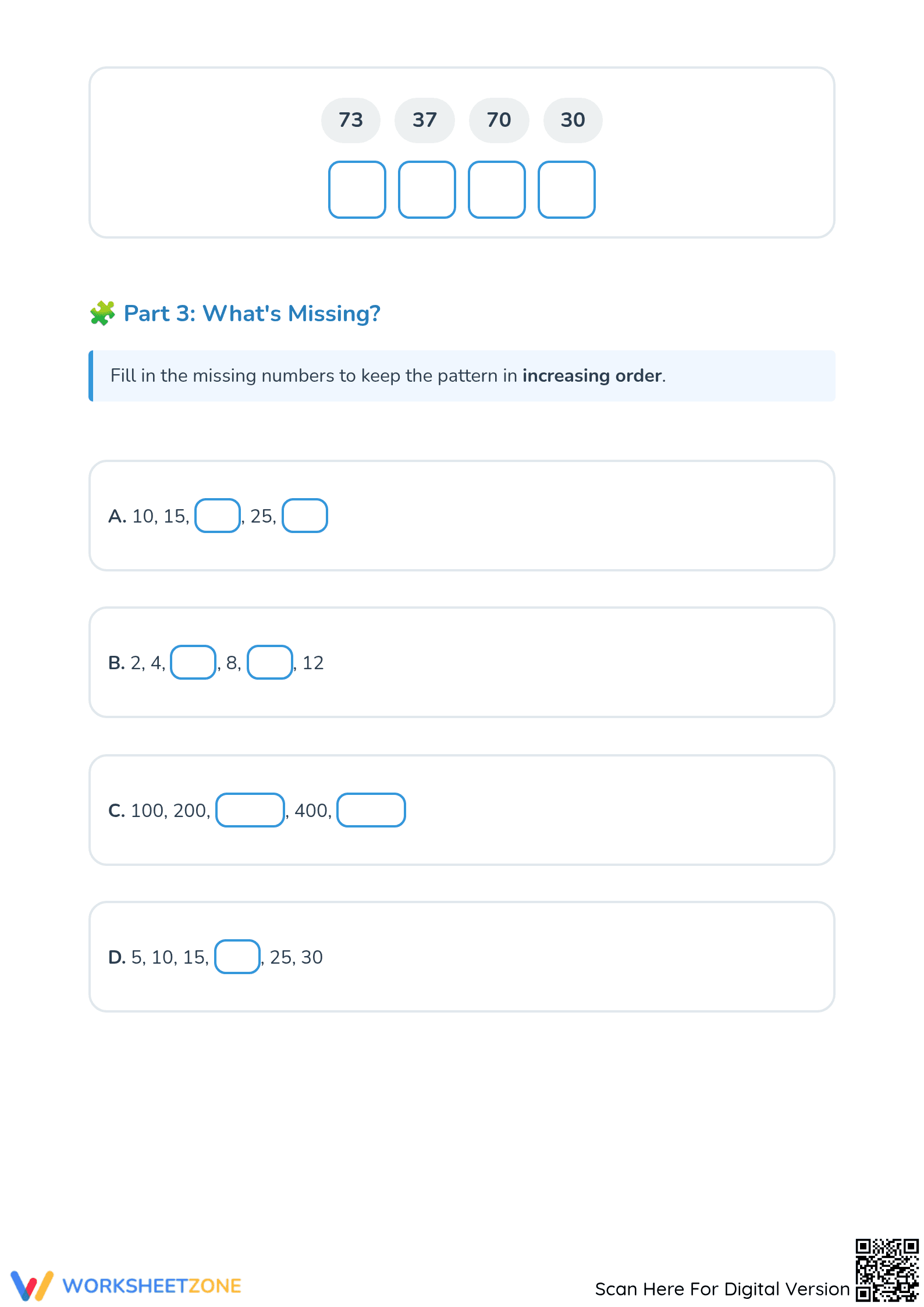
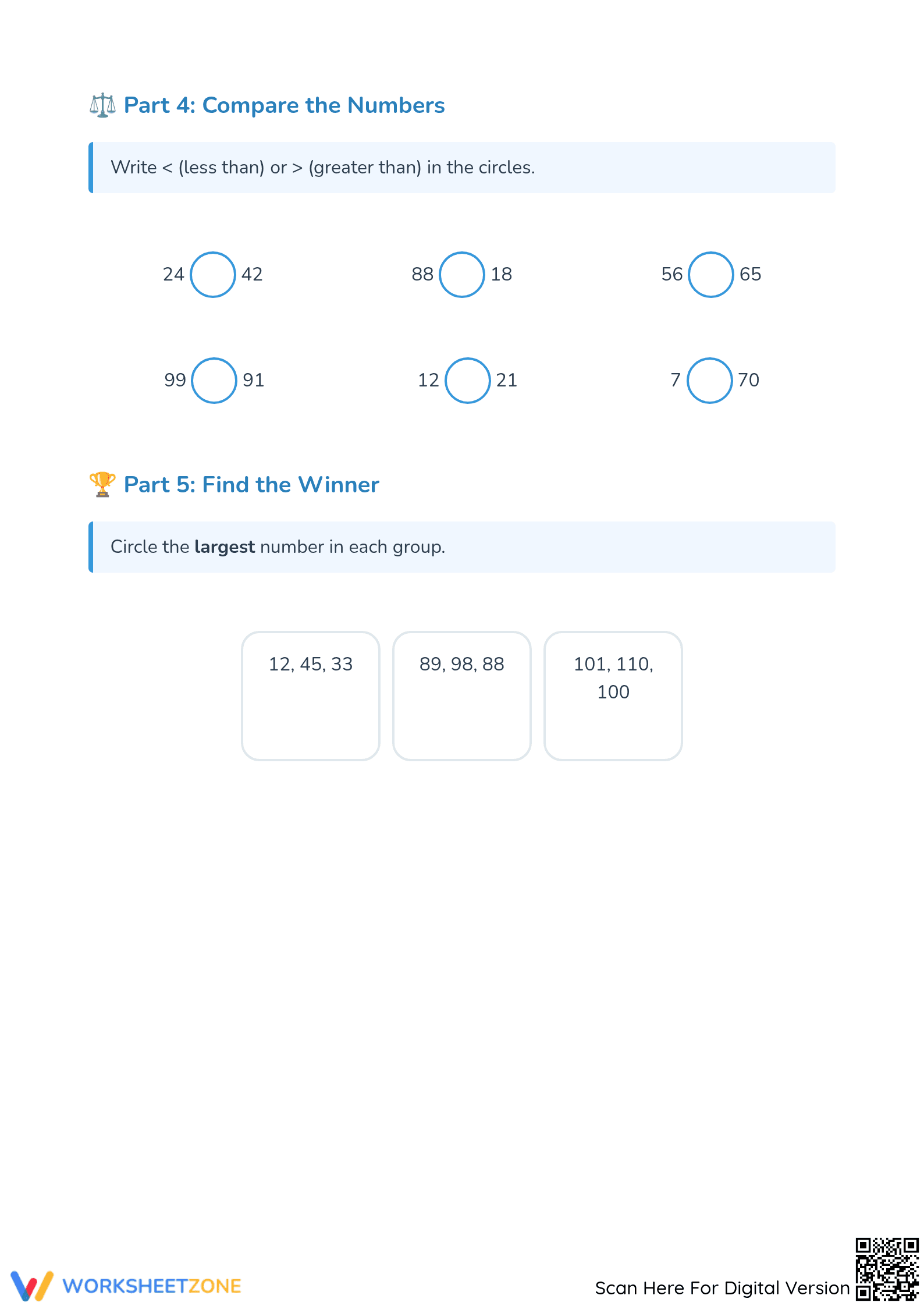
This comprehensive math resource helps students master the concept of increasing order through a variety of engaging, multi-modal tasks. By practicing how to sequence numbers from smallest to largest, learners build a robust foundation for number sense and place value. This worksheet ensures students can confidently compare values and identify numerical patterns across four distinct activity types.
At a Glance
- Grade: 1-2 · Subject: Math
- Standard:
CCSS.MATH.CONTENT.1.NBT.B.3— Compare two-digit numbers using symbols and sequence them by value.- Skill Focus: Ascending order and comparison
- Format: 4 pages · 25 problems · Answer key included · PDF
- Best For: Independent practice and number sense reinforcement
- Time: 20–30 minutes
Inside this 4-page PDF, you will find a structured progression of number sense activities. Page one features a "Sky Path" adventure where students color balloons in sequence. Page two requires rewriting sets of four numbers in ascending order. Page three introduces skip-counting patterns to find missing values, and page four focuses on using comparison symbols alongside identifying the largest number in a group.
Zero-Prep Workflow:
- Print: Select the 4-page PDF and print enough copies for your class in under 30 seconds.
- Distribute: Hand out the "Increasing Order Adventure" as a warm-up or independent center activity.
- Review: Use the provided 4-page answer key to quickly grade or allow students to self-check their work. Total teacher prep time is under 2 minutes.
This resource is primarily aligned with CCSS.MATH.CONTENT.1.NBT.B.3: "Compare two two-digit numbers based on meanings of the tens and ones digits, recording the results of comparisons with the symbols >, =, and <." It also supports 2.NBT.A.4 by extending number sets up to 110. Both standard codes can be copied directly into lesson plans, IEP goals, or district curriculum mapping tools.
Use this worksheet during the independent practice phase of a lesson on number comparison. It works well as a quiet center or a formative assessment after a lesson on place value. While students work, observe if they struggle with numbers that have the same tens digit but different ones digits, as this is a key indicator for targeted intervention. Completion typically takes 20 to 30 minutes.
This resource is designed for Grade 1 and Grade 2 students, though it serves as remediation for Grade 3 learners. It pairs naturally with a hundreds chart or base-ten block manipulatives for students who require additional visual scaffolding. It is also an ideal resource for substitute teacher folders due to its self-explanatory instructions.
According to the RAND AIRS 2024 report on elementary mathematics, structured sequencing tasks are vital for developing early number sense and place value fluency. This worksheet aligns with these findings by providing multiple modalities for ordering numbers, from visual path-finding to abstract symbolic comparison using greater-than and less-than signs. By engaging with CCSS.MATH.CONTENT.1.NBT.B.3 through varied task types, students move beyond rote counting into a deeper understanding of numerical magnitude. Research indicates that frequent, low-stakes practice with number relationships significantly reduces cognitive load during more complex multi-digit operations in later grades. This resource provides the necessary repetition and scaffolding to ensure students can confidently identify increasing patterns and compare values up to 110. The inclusion of skip-counting patterns further bridges the gap between basic ordering and algebraic thinking, making it a comprehensive tool for early elementary math instruction and formative assessment.


