


























Views
Downloads

Essential Sensory Imagery Chart | Grades 5-7 ELA
Paste this activity's link or code into your existing LMS (Google Classroom, Canvas, Teams, Schoology, Moodle, etc.).
Students can open and work on the activity right away, with no student login required.
You'll still be able to track student progress and results from your teacher account.
Sensory imagery is the foundation of vivid writing. This worksheet helps students transform abstract settings into immersive experiences by identifying specific sights, sounds, smells, textures, and tastes. By completing this chart, learners develop the descriptive vocabulary necessary for narrative excellence and creative expression across five distinct real-world environments.
At a Glance
- Grade: 5-7 · Subject: ELA & Science
- Standard:
CCSS.ELA-LITERACY.W.5.3.D— Use concrete words and phrases and sensory details to convey experiences precisely.- Skill Focus: Sensory imagery identification and creation
- Format: 1 page · 25 tasks · Answer key not required · PDF
- Best For: Creative writing warm-ups and literacy centers
- Time: 20–30 minutes
What's Inside
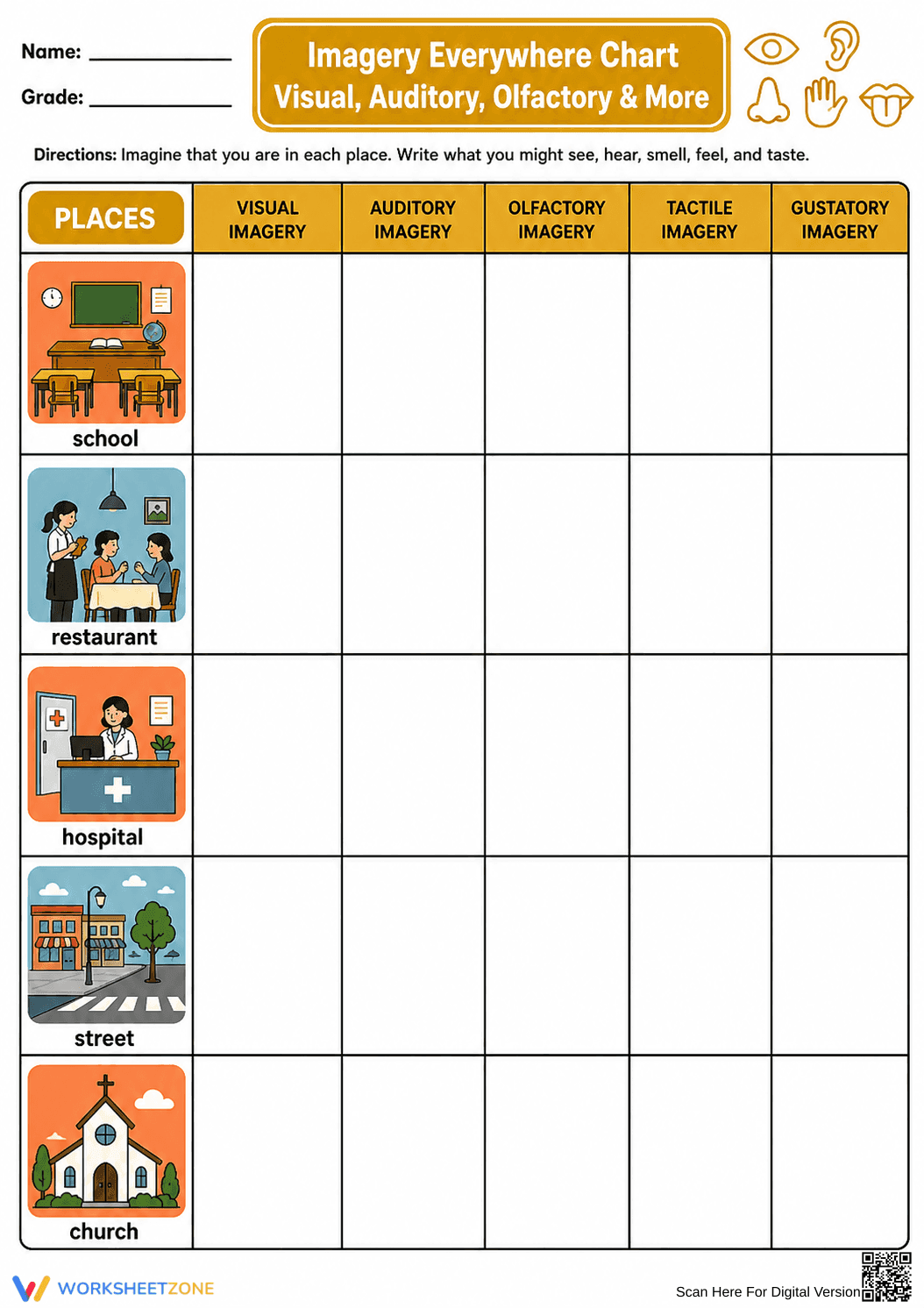
This one-page graphic organizer features five distinct real-world locations: school, restaurant, hospital, street, and church. Each location includes five dedicated columns for visual, auditory, olfactory, tactile, and gustatory imagery. The layout provides 25 specific writing cells, offering ample space for students to brainstorm concrete details without the pressure of full paragraph construction.
Zero-Prep Workflow
This resource is designed for immediate classroom implementation. Step 1: Print the single-page PDF (30 seconds). Step 2: Distribute to students as a bell-ringer or pre-writing tool (1 minute). Step 3: Review student responses as a whole group to build a collective word bank (30 seconds). Total teacher prep time is under 2 minutes, making it an ideal choice for emergency sub plans or last-minute writing scaffolds.
Standards Alignment
This worksheet aligns directly with `CCSS.ELA-LITERACY.W.5.3.D`, which requires students to use concrete words and phrases and sensory details to convey experiences and events precisely. It also supports middle school standards for word choice and figurative language by encouraging students to move beyond basic adjectives. Both standard codes can be copied directly into lesson plans, IEP goals, or district curriculum mapping tools.
How to Use It
Use this as a pre-writing activity before a narrative essay to ensure students have a repository of sensory details to pull from. During instruction, walk around and observe if students can distinguish between olfactory (smell) and gustatory (taste) imagery, which is a common point of confusion. This serves as an excellent formative assessment to check for descriptive range. Expected completion time is 20 to 30 minutes depending on the depth of detail required.
Who It's For
This chart is designed for upper elementary and middle school students in Grades 5, 6, and 7. It is particularly effective for English Language Learners (ELLs) who benefit from the structured categorization of vocabulary. Pair this worksheet with a descriptive mentor text or a sensory anchor chart to provide a complete instructional cycle for descriptive writing.
Research by Fisher & Frey (2014) emphasizes the importance of scaffolded graphic organizers in developing descriptive writing proficiency. By isolating sensory categories, students move beyond generic adjectives to specific, concrete nouns and verbs. This worksheet aligns with CCSS.ELA-LITERACY.W.5.3.D, focusing on the student's ability to use sensory details to convey experiences precisely. According to the RAND AIRS 2024 report on literacy instruction, structured brainstorming tools significantly reduce cognitive load during the drafting phase of the writing process, allowing students to focus on word choice and sentence variety. This 25-task chart provides the necessary repetition to internalize sensory categories, ensuring that students can independently apply these techniques in future creative writing assignments. It serves as a reliable formative assessment tool for teachers to gauge a student's descriptive range across diverse environmental contexts, facilitating targeted feedback on word choice and imagery.


