


























Views
Downloads
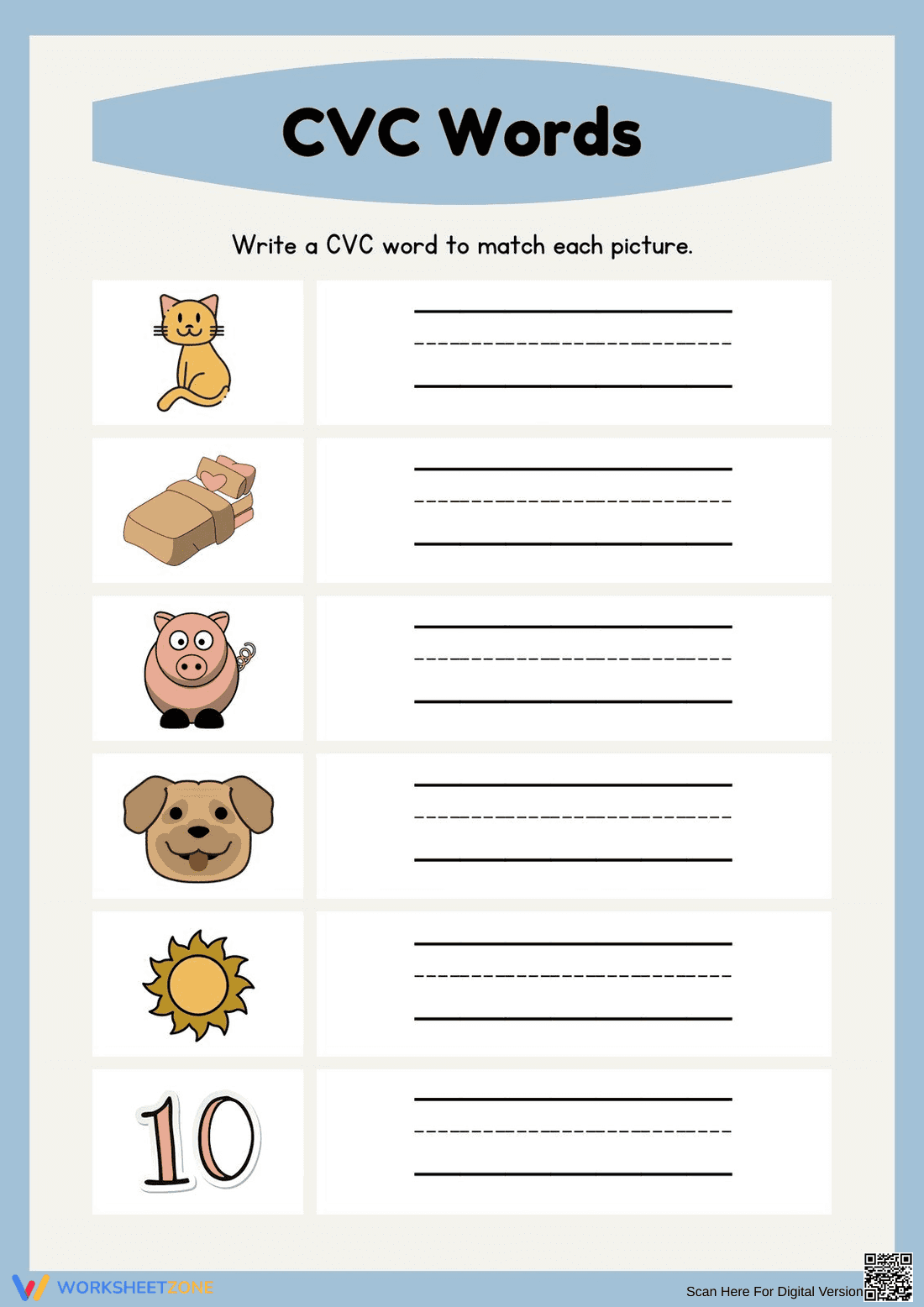

Essential CVC Words Worksheet | Kindergarten ELA
Paste this activity's link or code into your existing LMS (Google Classroom, Canvas, Teams, Schoology, Moodle, etc.).
Students can open and work on the activity right away, with no student login required.
You'll still be able to track student progress and results from your teacher account.
This Kindergarten CVC words worksheet provides students with 6 illustrated prompts to practice phonemic awareness and spelling. By matching consonant-vowel-consonant words to clear visual representations, learners strengthen their ability to isolate and record individual sounds. This resource is designed for immediate classroom application to support early literacy development and phonics mastery.
At a Glance
- Grade: Kindergarten · Subject: ELA
- Standard:
CCSS.ELA-LITERACY.RF.K.2.D— Isolate and pronounce the initial, medial vowel, and final sounds in CVC words- Skill Focus: CVC Word Spelling
- Format: 1 page · 6 problems · Answer key included · PDF
- Best For: Independent phonics practice and literacy centers
- Time: 10–15 minutes
This single-page PDF features six illustrations representing common short-vowel words: cat, bed, pig, dog, sun, and the number ten. Each image is paired with primary-ruled handwriting lines—including top, middle-dashed, and bottom lines—to encourage proper letter formation. The layout is clean and distraction-free, ensuring young learners remain focused on the encoding task. A full answer key is provided to facilitate quick grading or student self-correction during independent work time.
The zero-prep workflow is designed for efficiency. First, print the single-page PDF. Second, distribute the sheets during your phonics block or as a transition activity. Finally, review the six words as a group or check individual progress using the included key. Total teacher preparation time is under two minutes, making this an ideal choice for emergency sub plans or last-minute literacy center additions.
This worksheet is specifically aligned to CCSS.ELA-LITERACY.RF.K.2.D, which requires students to isolate and pronounce the initial, medial vowel, and final sounds in CVC words. It also supports RF.K.3.A by helping students demonstrate knowledge of one-to-one letter-sound correspondences. These standard codes can be copied directly into lesson plans or IEP goals to ensure compliance with state and national frameworks.
Use this worksheet as a formative assessment after direct instruction on short vowel sounds. Observe students to see if they struggle with specific vowels or final consonants. Alternatively, place this in a 'Write the Room' center where students find objects before returning to their desks to complete the spelling. Expect most Kindergarten students to complete the tasks within a 10 to 15 minute window.
This resource is tailored for Kindergarten students beginning independent writing. It is also effective for first-grade students requiring remedial support or English Language Learners (ELLs) who benefit from pairing vocabulary images with written words. Pair this worksheet with magnetic letters or a short-vowel anchor chart to provide additional scaffolding for struggling learners who need help identifying the medial vowel sound.
This worksheet targets CCSS.ELA-LITERACY.RF.K.2.D by requiring students to encode three-phoneme words through visual stimuli. According to Fisher & Frey (2014), visual cues in early literacy provide a scaffold that allows students to focus on phonemic isolation and grapheme mapping. By providing 6 structured opportunities to practice CVC spelling, this resource aligns with the gradual release of responsibility model. Research highlights that early mastery of phonemic blending and segmenting is a primary predictor of later reading fluency. This printable resource ensures students engage in high-frequency practice of these foundational skills. The inclusion of primary handwriting lines further integrates fine motor development with linguistic mastery, a dual-focus approach recommended for early childhood education to maximize instructional outcomes.


