


























Views
Plays
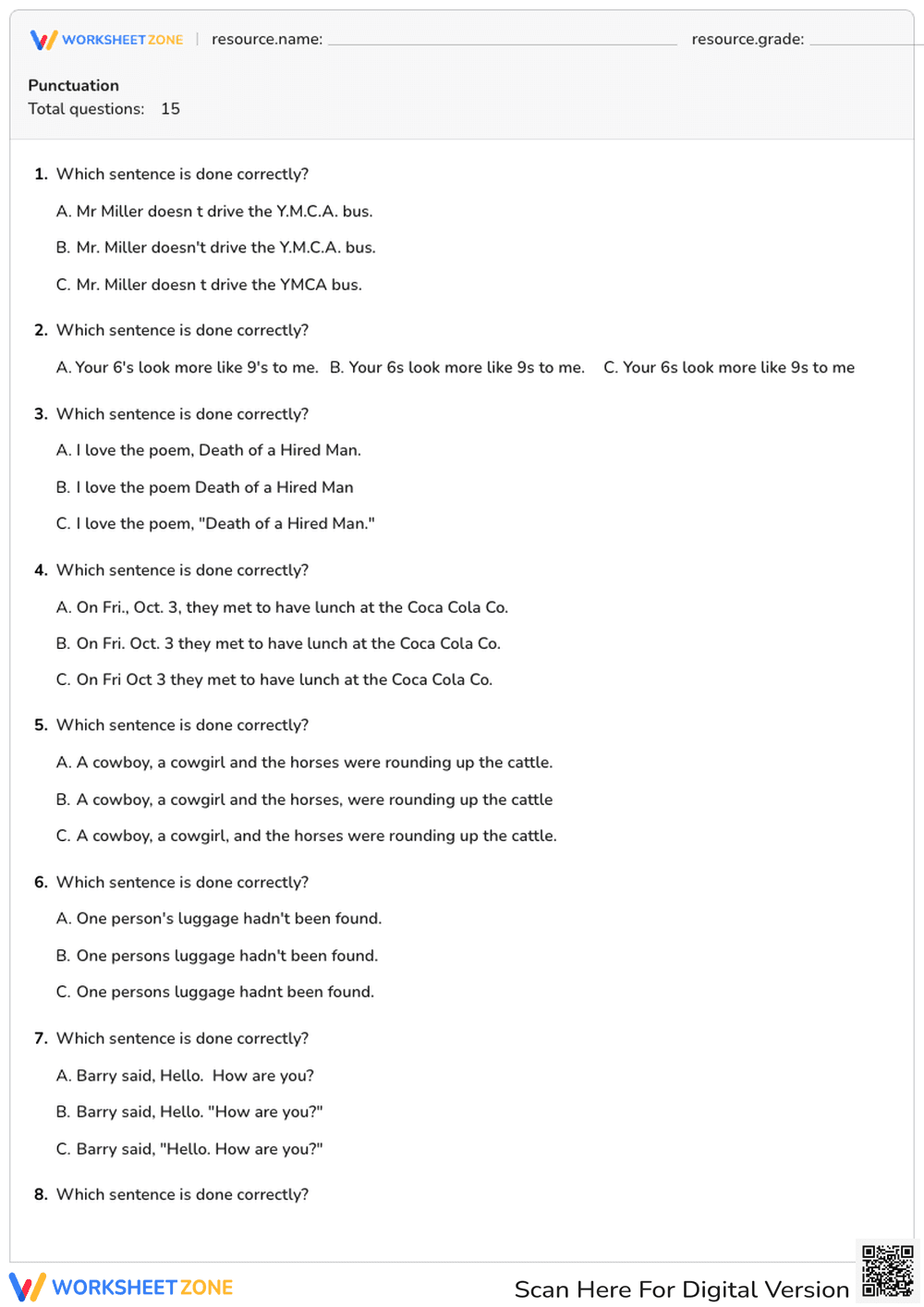


Grade 3 Punctuation — Printable No-Prep Worksheet
Paste this activity's link or code into your existing LMS (Google Classroom, Canvas, Teams, Schoology, Moodle, etc.).
Students can open and work on the activity right away, with no student login required.
You'll still be able to track student progress and results from your teacher account.
This Grade 3 punctuation worksheet helps students identify correctly structured sentences by analyzing capitalization, commas, and apostrophes. By evaluating multiple-choice options, learners develop a stronger command of standard English mechanics, ensuring their own writing becomes clearer and more accurate.
At a Glance
- Grade: 3 · Subject: ELA
- Standard:
CCSS.ELA-LITERACY.L.3.2— Demonstrate command of standard English capitalization and punctuation.- Skill Focus: Punctuation and sentence mechanics
- Format: 2 pages · 15 problems · PDF
- Best For: Independent practice or review
- Time: 15–20 minutes
What's Inside
This two-page resource features 15 multiple-choice questions focused on sentence-level mechanics. Students are presented with three variations of a sentence and must select the one that demonstrates proper punctuation. The task types cover a variety of essential grammar rules, including the correct use of apostrophes in contractions and possessives, commas in dates and addresses, and quotation marks in dialogue. The straightforward layout minimizes distractions, allowing students to focus entirely on applying their grammar knowledge.
Zero-Prep Workflow
- Print (1 minute): Simply print the two-page PDF. No special formatting or cutting is required.
- Distribute (1 minute): Hand out the worksheets to students during your designated grammar block or morning work time.
- Review (3 minutes): Go over the instructions together, completing the first question as a class to ensure everyone understands how to select the correct option.
With a total teacher prep time of under two minutes, this resource is highly efficient. Its self-explanatory nature makes it an excellent addition to any emergency sub plan.
Standards Alignment
Aligned to CCSS.ELA-LITERACY.L.3.2, this worksheet requires students to demonstrate command of the conventions of standard English capitalization, punctuation, and spelling when writing. It specifically targets sub-skills like using commas in addresses and forming possessives. Both standard codes can be copied directly into lesson plans, IEP goals, or district curriculum mapping tools.
How to Use It
This worksheet is highly versatile and can be used immediately after direct instruction on specific punctuation rules to assess initial understanding. Alternatively, it serves as an effective formative assessment during a Friday review session. While students work, teachers can circulate and observe which specific punctuation marks (e.g., apostrophes vs. commas) are causing confusion, allowing for targeted reteaching. Expected completion time is 15 to 20 minutes.
Who It's For
This resource is primarily designed for 3rd-grade students mastering standard English conventions, but it also serves as a valuable review for 4th graders needing a refresher. For students requiring differentiation, teachers can cross out one incorrect option per question to reduce the cognitive load. It pairs perfectly with an anchor chart detailing comma and apostrophe rules.
Mastering conventions like those outlined in CCSS.ELA-LITERACY.L.3.2 (demonstrate command of standard English capitalization and punctuation) is crucial for developing proficient writers who can communicate their ideas clearly and effectively. According to Fisher & Frey (2014), providing students with targeted, isolated practice on specific mechanical skills allows them to internalize these rules before applying them to complex, original compositions. When students are given the opportunity to evaluate incorrect and correct sentence structures side-by-side, they actively engage in the critical thinking necessary to recognize and correct errors in their own drafts. This focused approach to grammar instruction ensures that foundational skills become automatic over time. As these mechanical processes require less conscious effort, students free up vital cognitive resources for higher-order writing tasks, such as organizing complex ideas, developing strong arguments, and tailoring their message to specific audiences. Ultimately, consistent practice with sentence-level mechanics builds the confidence students need to succeed across all academic disciplines.


