


























Views
Downloads
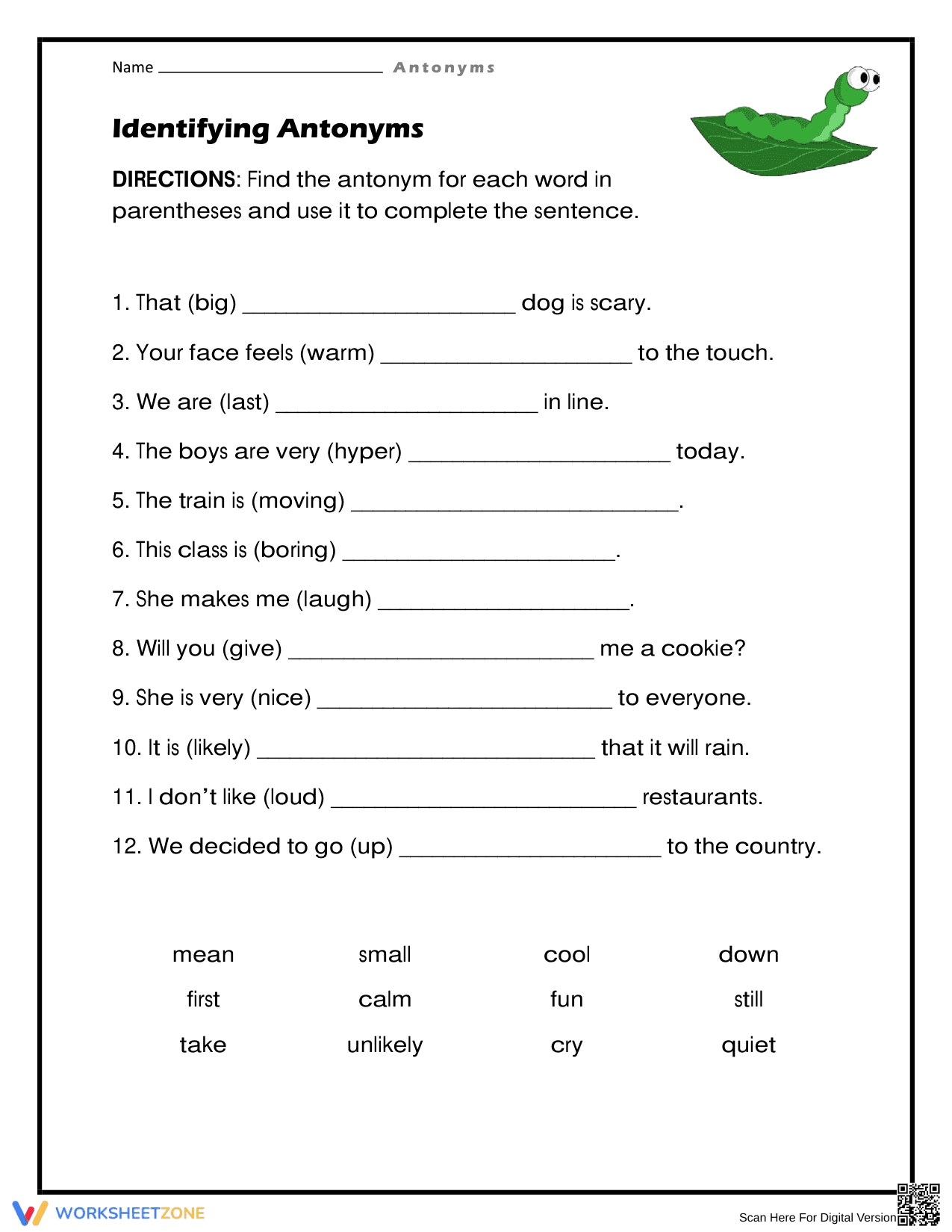

Essential Identifying Antonyms Worksheet | Grade 3-4 Aligned
Paste this activity's link or code into your existing LMS (Google Classroom, Canvas, Teams, Schoology, Moodle, etc.).
Students can open and work on the activity right away, with no student login required.
You'll still be able to track student progress and results from your teacher account.
This Grade 3-4 identifying antonyms worksheet provides students with targeted practice in vocabulary development and sentence completion. By selecting appropriate opposites from a word bank to fit specific contexts, learners strengthen their understanding of word relationships and nuance. This essential resource ensures students can accurately identify and apply antonyms within functional writing tasks immediately.
At a Glance
- Grade: 3-4 · Subject: English Language Arts
- Standard:
CCSS.ELA-LITERACY.L.4.5.c— Demonstrate understanding of words by relating them to their opposites (antonyms)- Skill Focus: Antonym identification and sentence application
- Format: 1 page · 12 problems · Answer key included · PDF
- Best For: Vocabulary warm-ups and independent practice
- Time: 15–20 minutes
What's Inside
This single-page PDF includes 12 carefully constructed sentences, each featuring a target word in parentheses. Students must choose the correct antonym from a provided word bank at the bottom of the page to complete the sentence. The layout is clean and distraction-free, featuring a helpful word bank that supports spelling and cognitive retrieval for diverse learners. A full answer key is provided for quick grading.
Zero-Prep Workflow
The zero-prep workflow for this worksheet is designed for maximum efficiency. Teachers can print the document in under 30 seconds, distribute it to the class in less than a minute, and conduct a full review of the 12 items in approximately five minutes. This makes it an ideal choice for emergency sub plans or "bell-ringer" activities that require absolutely no advance setup.
Standards Alignment
This worksheet is primarily aligned with CCSS.ELA-LITERACY.L.4.5.c, which requires students to demonstrate understanding of words by relating them to their opposites. It also supports Grade 2 and 3 standards involving word relationships and vocabulary acquisition. Both standard codes can be copied directly into lesson plans, IEP goals, or district curriculum mapping tools.
How to Use It
Use this worksheet as a formative assessment after a direct instruction lesson on word relationships. Observe students as they work to identify which ones struggle to match the context of the sentence with the word bank options. It also serves as an excellent independent center activity or homework assignment, typically requiring 15 to 20 minutes for completion.
Who It's For
This resource is designed for students in Grades 2 through 4, particularly those working on foundational vocabulary skills. It is especially effective for English Language Learners (ELL) who benefit from the sentence context and the provided word bank. Pair this worksheet with a short reading passage or an anchor chart displaying common antonym pairs for enhanced learning.
According to the RAND AIRS 2024 report on vocabulary instruction, providing students with structured opportunities to manipulate word opposites significantly enhances long-term lexical retention. This Identifying Antonyms worksheet directly addresses the CCSS.ELA-LITERACY.L.4.5.c standard, which emphasizes the cognitive act of relating words to their semantic opposites. By requiring students to not only identify an antonym but also apply it within a sentence context, the task moves beyond simple rote memorization into the category of functional language use. Research from Fisher & Frey (2014) suggests that these types of scaffolded vocabulary activities are critical for building the complex word-knowledge networks required for advanced reading comprehension in later grades. This worksheet serves as a reliable tool for teachers looking to provide evidence-based, printable practice that integrates smoothly into any ELA curriculum focused on language mastery.


