




























Views
Downloads
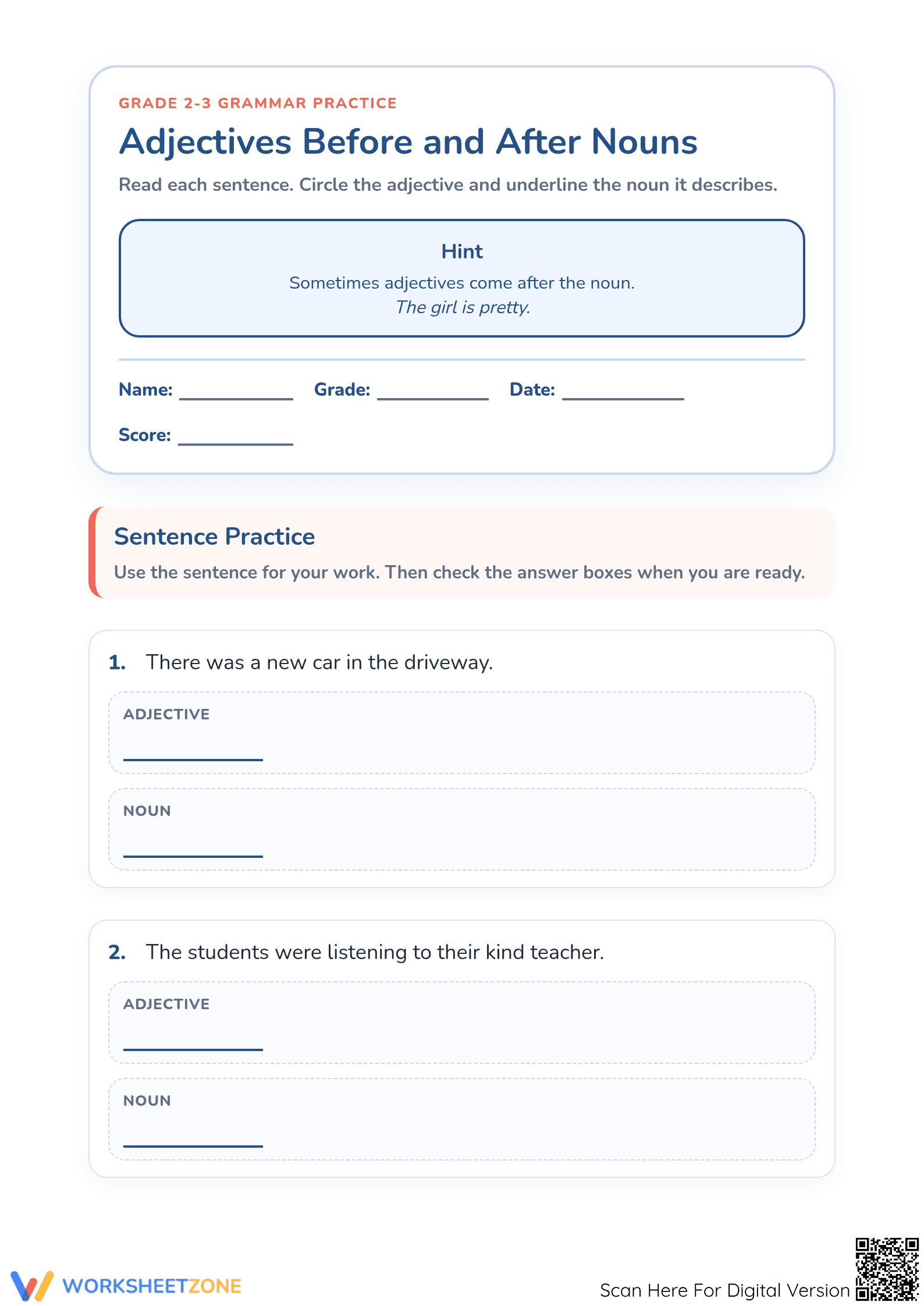


Printable Adjectives Before and After Nouns — Grade 2-3

Paste this activity's link or code into your existing LMS (Google Classroom, Canvas, Teams, Schoology, Moodle, etc.).
Students can open and work on the activity right away, with no student login required.
You'll still be able to track student progress and results from your teacher account.
Mastering adjective placement is a foundational grammar skill that enhances a student's ability to write descriptive and varied sentences. This worksheet provides structured practice for identifying adjectives placed both before and after the nouns they modify. By isolating these parts of speech, learners build a concrete understanding of sentence mechanics and functional language use.
At a Glance
- Grade: 2–3 · Subject: English Language Arts
- Standard:
CCSS.ELA-LITERACY.L.2.1.E— Use adjectives and describe how they modify nouns in various sentence positions- Skill Focus: Adjective identification and noun-modifier relationships
- Format: 4 pages · 10 problems · Answer key included · PDF
- Best For: Independent grammar practice or sub plans
- Time: 15–20 minutes
This comprehensive resource contains four pages of focused practice, presenting ten unique sentences for analysis. Each page features clear, spacious boxes where students identify the adjective and the noun it describes. A helpful hint box on the first page provides a clear example of adjectives following a noun, such as "The girl is pretty," ensuring students understand that descriptive words do not always precede the object.
Zero-Prep Workflow
This resource is designed for immediate classroom implementation with three simple steps. First, print the four-page PDF, which takes less than 30 seconds for a standard class set. Second, distribute the worksheets to students; the included "Hint" box acts as a self-teaching tool, reducing the need for lengthy direct instruction. Third, review student work using the provided answer key in under two minutes. This streamlined process makes it an ideal choice for busy teachers or emergency substitute folders.
Standards Alignment
The primary alignment for this activity is `CCSS.ELA-LITERACY.L.2.1.E`, which requires students to use adjectives and adverbs correctly based on what is being modified. By identifying the specific noun an adjective describes, students demonstrate an understanding of modifier functions. This work also supports `CCSS.ELA-LITERACY.L.3.1.A`, focusing on the general function of parts of speech within sentences. Both standard codes can be copied directly into lesson plans, IEP goals, or district curriculum mapping tools.
How to Use It
Use this worksheet as a formative assessment after an introductory lesson on parts of speech. It works effectively as a quiet independent practice activity or a focused center rotation. Teachers should observe whether students can identify the adjective in Sentence 7 ("The movie was sad"), where the adjective follows a linking verb, as this often indicates a higher level of grammatical mastery. Completion typically ranges from 15 to 20 minutes depending on reading level.
Who It's For
This resource is tailored for Grade 2 and Grade 3 students but serves as an excellent intervention tool for older learners needing a grammar refresh. The clear formatting and repetitive structure also make it accessible for ESL and ELL students who are learning English syntax and word order. It pairs naturally with a mentor text or a descriptive writing passage where students can find additional adjectives in the wild.
Research indicates that explicit instruction in parts of speech, followed by targeted identification practice, significantly improves syntactic awareness and reading comprehension. According to Fisher & Frey (2014), the use of scaffolded practice like this adjective worksheet supports the gradual release of responsibility from teacher to student. By requiring students to not only circle the adjective but also name the noun it modifies, the task moves beyond simple recognition to an analysis of linguistic relationships. This document aligns with best practices for grammar instruction by providing clear examples and enough repetition to ensure the concept of adjective placement is solidified. Educational practitioners often use these 10-problem sets to gather quick data on student progress toward CCSS.ELA-LITERACY.L.2.1.E mastery, allowing for data-driven small group instruction. This document is a reliable tool for classroom teachers seeking to build strong grammatical foundations.


