


























Views
Downloads
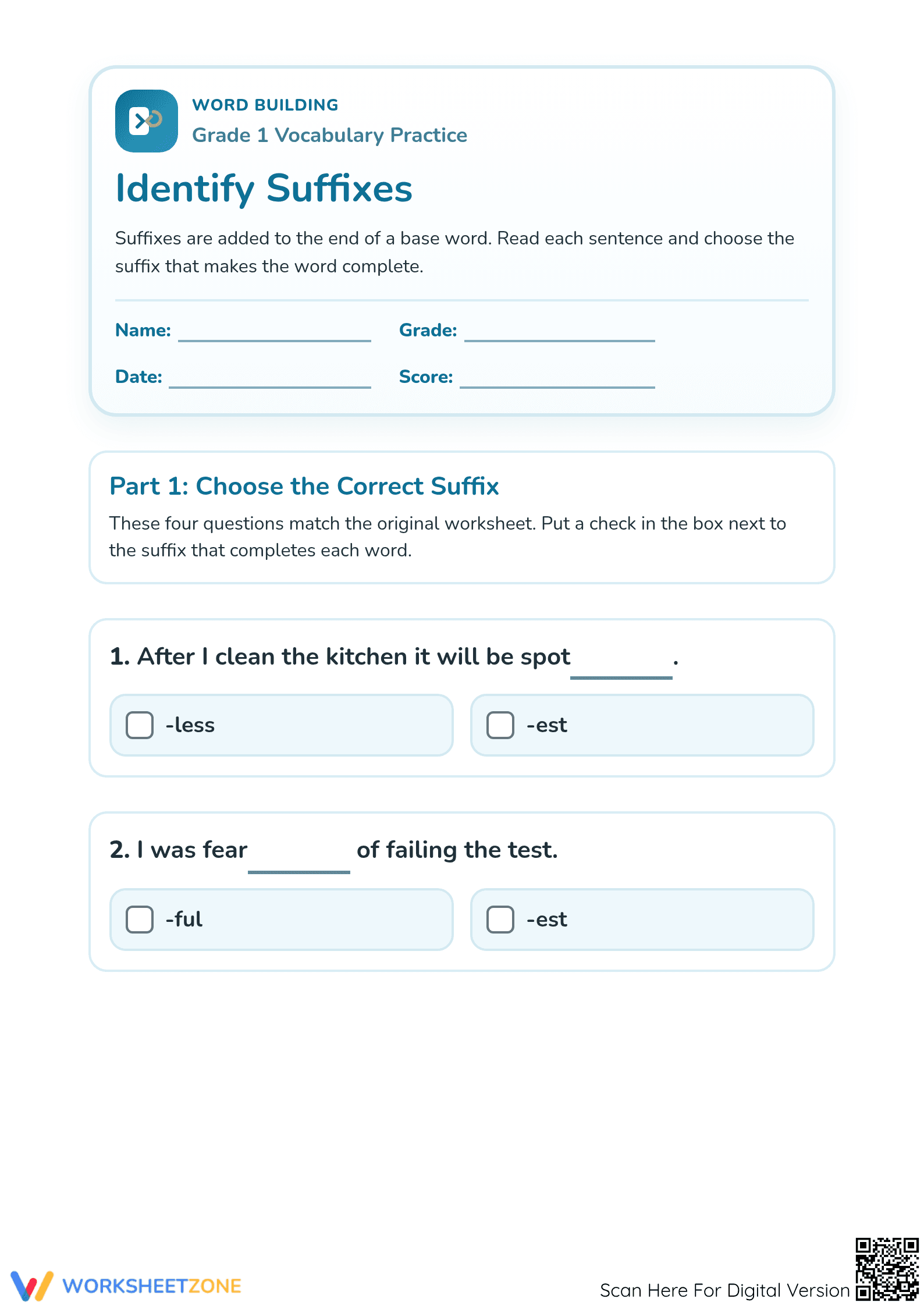


Identify Suffixes Worksheet: Grade 1 Essential Practice
Paste this activity's link or code into your existing LMS (Google Classroom, Canvas, Teams, Schoology, Moodle, etc.).
Students can open and work on the activity right away, with no student login required.
You'll still be able to track student progress and results from your teacher account.
This Grade 1 suffixes worksheet helps students identify and apply common word endings like -ful, -less, -er, and -est to change word meanings. By completing these 12 targeted exercises, learners build essential morphology skills and expand their vocabulary through sentence-based context. This resource ensures foundational reading success by mastering basic word-building patterns.
At a Glance
- Grade: 1 · Subject: English Language Arts
- Standard:
CCSS.ELA-LITERACY.L.1.4.B— Use frequently occurring affixes as a clue to the meaning of a word- Skill Focus: Common Suffixes (-er, -est, -ful, -less)
- Format: 3 pages · 12 problems · Answer key included · PDF
- Best For: Independent practice or small group literacy centers
- Time: 15–20 minutes
This comprehensive three-page PDF contains 12 structured problems divided into three distinct parts. Part 1 features multiple-choice questions where students select the correct suffix to complete a sentence. Part 2 introduces a word bank (-er, -est, -ful, -less) for fill-in-the-blank practice, and Part 3 challenges students to pick the best ending for comparative and descriptive sentences. A complete answer key is provided for immediate feedback.
This worksheet is designed for an immediate classroom transition. Step 1: Print the three-page PDF for your class (30 seconds). Step 2: Distribute the handouts during your vocabulary block or as a morning warm-up (1 minute). Step 3: Review the answers using the included key for a quick formative check (30 seconds). Total teacher preparation time is under two minutes, making it an ideal choice for emergency sub plans or busy literacy rotations.
The primary focus is `CCSS.ELA-LITERACY.L.1.4.B`, which requires Grade 1 students to use frequently occurring affixes as clues to word meaning. Students practice adding -er for comparison and -ful/-less for descriptive qualities. Additionally, the worksheet supports `CCSS.ELA-LITERACY.RF.1.3`, foundational skills for decoding two-syllable words. Both standard codes can be copied directly into lesson plans, IEP goals, or district curriculum mapping tools.
Assign this worksheet during the "You Do" phase of a gradual release lesson on morphology to assess student independence. Use the comparative sentences (tall/taller) as a starting point for a brief formative-assessment observation; notice if students can distinguish between "er" and "est" in context. This resource typically takes 15 to 20 minutes to complete, making it perfect for a focused literacy station or homework assignment.
This resource is tailored for Grade 1 students but serves as excellent remediation for Grade 2 learners needing additional morphology support. It works well for English Language Learners (ELLs) who benefit from seeing suffixes used in simple, clear sentences. Naturally pair this worksheet with an anchor chart showing "Base Word + Suffix = New Meaning" to provide visual support during independent work.
Mastery of common suffixes is a critical milestone in early literacy development, as noted in the RAND AIRS 2024 report on foundational reading components. This 12-task worksheet targets CCSS.ELA-LITERACY.L.1.4.B by requiring students to decode and apply -er, -est, -ful, and -less in controlled sentence contexts. Research indicates that explicit instruction in morphology, as advocated by Fisher & Frey (2014), significantly improves decoding speed and reading comprehension for primary-grade students. By interacting with these word endings across three pages, learners transition from recognizing isolated sounds to understanding how structural changes alter function and meaning. This printable resource provides the high-repetition practice necessary for students to internalize these lexical patterns, ensuring they can independently navigate increasingly complex texts. The zero-prep format allows teachers to provide immediate intervention or enrichment without additional administrative burden, supporting long-term academic growth in English Language Arts.


