


























Views
Downloads
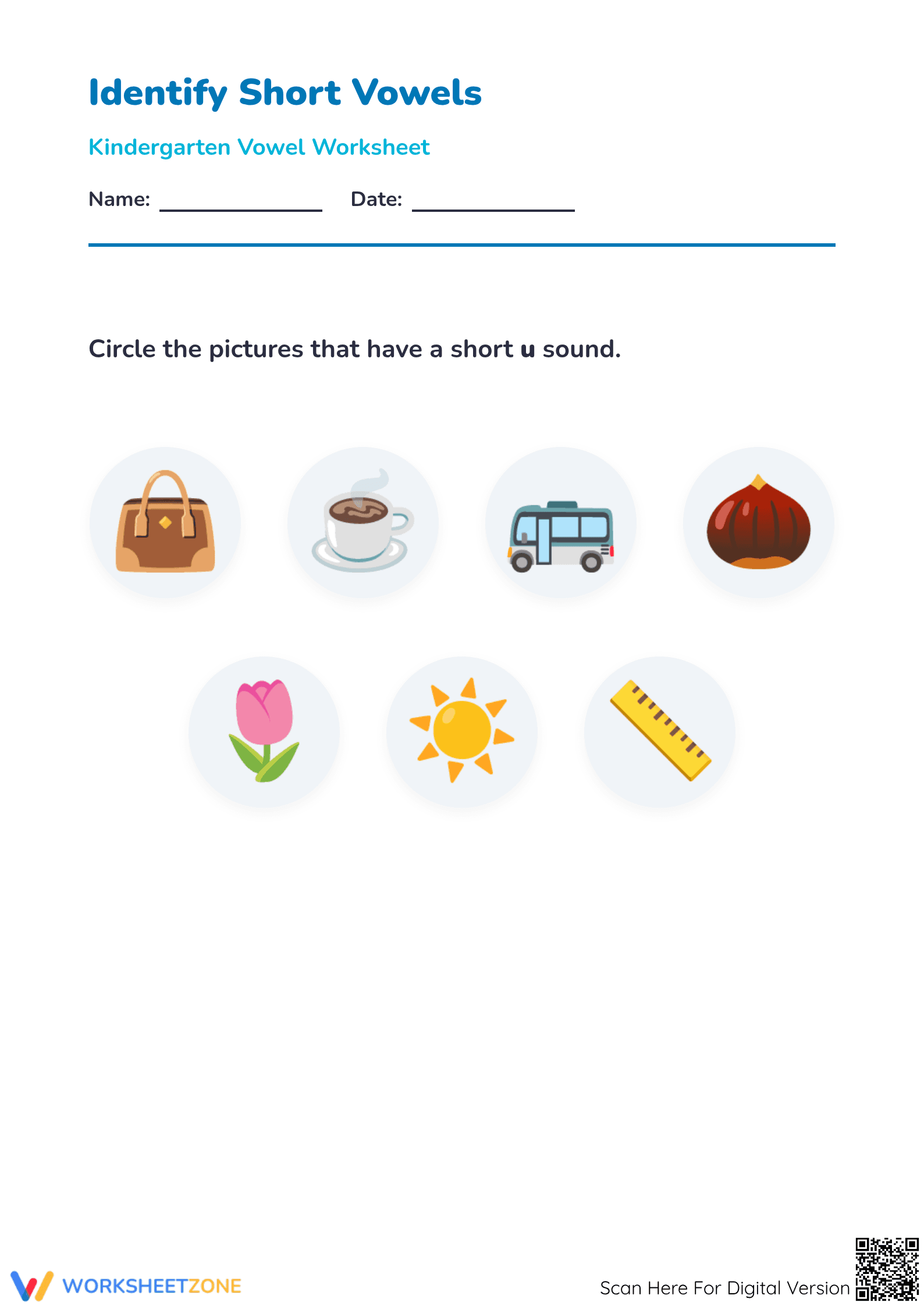

Short Vowel U Worksheet | Printable Kindergarten ELA
Paste this activity's link or code into your existing LMS (Google Classroom, Canvas, Teams, Schoology, Moodle, etc.).
Students can open and work on the activity right away, with no student login required.
You'll still be able to track student progress and results from your teacher account.
This printable Kindergarten phonics worksheet helps early readers identify the short "u" vowel sound in everyday words. By evaluating familiar pictures and circling the correct matches, students strengthen their phonological awareness and build foundational decoding skills essential for reading fluency.
At a Glance
- Grade: Kindergarten · Subject: ELA
- Standard:
CCSS.ELA-LITERACY.RF.K.3.B— Associate short sounds with common vowel spellings- Skill Focus: Short U Vowel Sound Identification
- Format: 1 page · 7 problems · Answer key included · PDF
- Best For: Independent practice
- Time: 5–10 minutes
Inside this single-page resource, educators will find a straightforward, visually engaging activity featuring seven distinct picture prompts. Students look at illustrations of common objects—such as a bus, sun, and cup—and determine which words contain the target short "u" sound. The layout is clean and distraction-free, making it highly accessible for young learners. A complete answer key is provided to ensure quick and accurate grading.
This resource is designed for immediate classroom implementation with a highly efficient workflow:
- Print (1 minute): The black-and-white friendly design prints quickly and clearly without draining color ink.
- Distribute (1 minute): Hand out the single page to students along with a pencil or crayon.
- Review (3 minutes): Use the included answer key to rapidly check student work or conduct a whole-class review.
With a total teacher prep time of under two minutes, this worksheet is an excellent addition to emergency sub plans or last-minute literacy center rotations.
This activity is directly aligned to CCSS.ELA-LITERACY.RF.K.3.B, requiring students to associate the long and short sounds with the common spellings for the five major vowels. It also supports early phonemic isolation skills as students listen for medial vowel sounds. Both standard codes can be copied directly into lesson plans, IEP goals, or district curriculum mapping tools.
Teachers can utilize this worksheet during morning work to activate prior knowledge before a formal phonics lesson. Alternatively, it serves as an effective independent activity during small group literacy centers. While students are working, teachers can conduct formative assessments by asking individuals to say the name of the picture out loud, observing whether they correctly articulate the medial short "u" sound. The entire activity typically takes between five and ten minutes to complete.
This worksheet is primarily designed for Kindergarten students developing basic phonics skills, but it is also appropriate for Preschoolers ready for an advanced challenge or First Graders needing a quick review. For students requiring extra support, teachers can pre-teach the vocabulary by naming each picture together before beginning the task. This activity pairs perfectly with a classroom anchor chart displaying short vowel CVC words.
Mastering foundational phonics skills, such as those targeted in CCSS.ELA-LITERACY.RF.K.3.B where students associate short sounds with common vowel spellings, is a critical milestone in early literacy development. According to Fisher & Frey (2014), explicit instruction combined with targeted, independent practice significantly improves students' ability to decode unfamiliar words. When young learners consistently practice isolating and identifying specific phonemes, like the short "u" sound, they build the automaticity required for fluent reading and strong reading comprehension later on. This focused worksheet provides the exact type of repeated exposure necessary to solidify these neural pathways. By integrating visual cues with phonological tasks, educators can effectively support diverse learning profiles and ensure that all students establish a robust foundation for future academic success in English Language Arts.


