


























Views
Downloads

Short Vowel O Worksheet | Kindergarten Essential Phonics
Paste this activity's link or code into your existing LMS (Google Classroom, Canvas, Teams, Schoology, Moodle, etc.).
Students can open and work on the activity right away, with no student login required.
You'll still be able to track student progress and results from your teacher account.
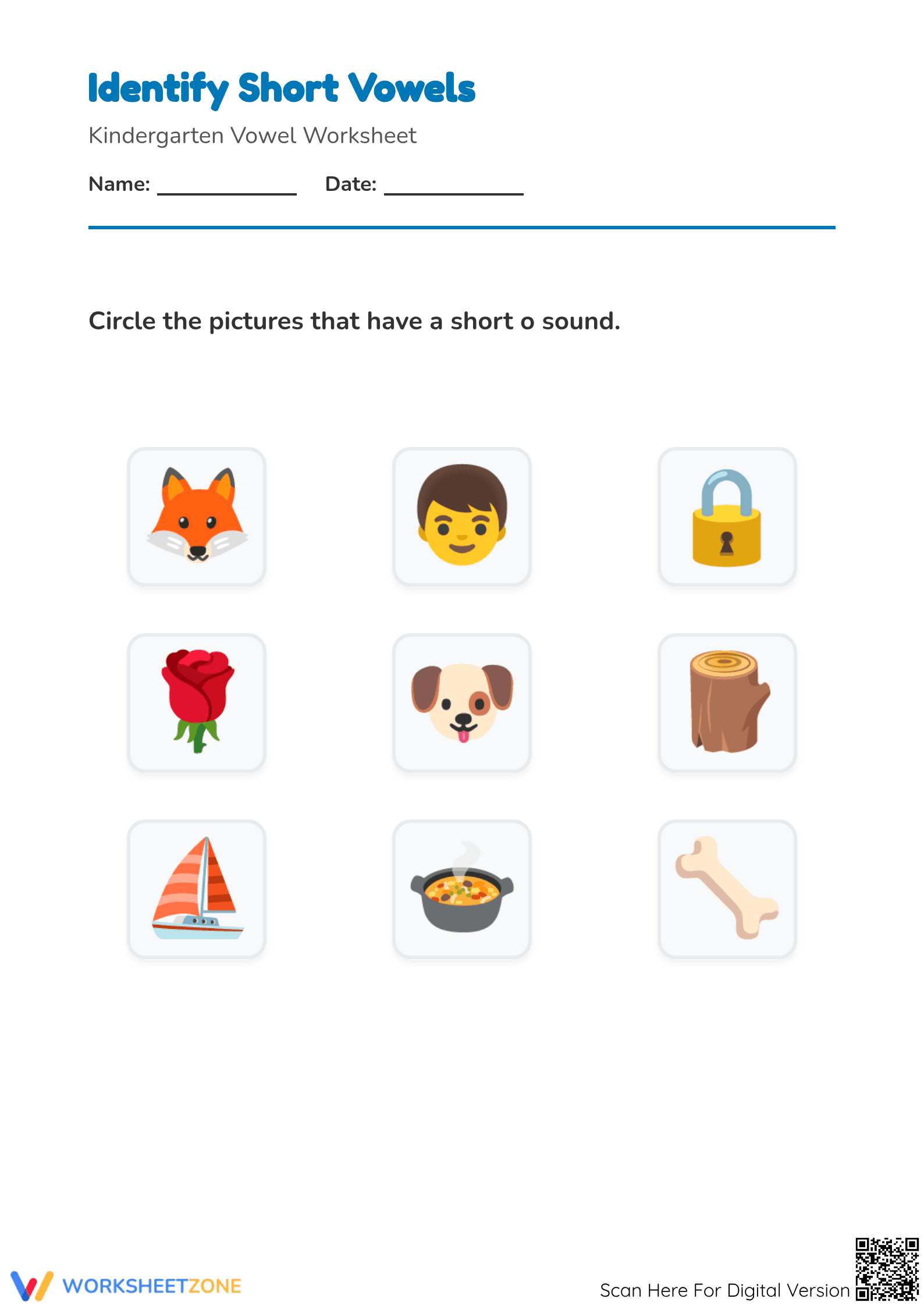
This Kindergarten phonics worksheet helps early learners master the short vowel "o" sound through visual identification. Students examine 9 distinct images to determine which words contain the target medial vowel sound. This activity builds the foundational phonemic awareness necessary for decoding CVC words and developing early reading fluency.
At a Glance
- Grade: Kindergarten · Subject: ELA
- Standard:
CCSS.ELA-LITERACY.RF.K.2.D— Isolate and pronounce the medial vowel sounds in three-phoneme words- Skill Focus: Short Vowel O Identification
- Format: 1 page · 9 problems · Answer key included · PDF
- Best For: Morning work or phonics centers
- Time: 10–15 minutes
Inside this single-page PDF, you will find 9 high-quality illustrations representing common objects like a fox, lock, and pot. The layout is clean and distraction-free, specifically designed for young learners. A comprehensive answer key is included to facilitate quick grading or student self-correction during independent station rotations.
Zero-Prep Workflow
- Print: Select the single-page PDF and print enough copies for your class (30 seconds).
- Distribute: Hand out the sheets during your phonics block or place them in a literacy center (30 seconds).
- Review: Use the provided answer key to check student work or project it for a whole-class review (1 minute).
Total teacher preparation time is under 2 minutes, making this an ideal resource for sub plans or busy mornings.
Standards Alignment
This resource is aligned to `CCSS.ELA-LITERACY.RF.K.2.D`, which requires students to isolate and pronounce the initial, medial vowel, and final sounds (phonemes) in three-phoneme (consonant-vowel-consonant, or CVC) words. It also supports RF.K.3.B by focusing on common vowel sounds. Both standard codes can be copied directly into lesson plans, IEP goals, or district curriculum mapping tools.
How to Use It
Use this worksheet as a formative assessment after introducing the short "o" sound. Observe students as they say the names of the pictures aloud; if a student struggles to identify the "o" in "fox" or "pot," it indicates a need for additional auditory discrimination practice. It also serves as an excellent quiet activity for early finishers or as a quick homework assignment to reinforce classroom learning. Expected completion time ranges from 10 to 15 minutes depending on student proficiency.
Who It's For
This worksheet is ideal for Kindergarten students, but also serves as a helpful intervention for Grade 1 students or a challenge for Preschoolers. It pairs naturally with a short vowel anchor chart or a direct instruction lesson using magnetic letters to build the CVC words represented by the images. The visual nature of the tasks makes it accessible for English Language Learners (ELLs) who are building their basic vocabulary.
Phonemic awareness is a critical predictor of later reading success, particularly the ability to isolate medial vowel sounds as targeted in CCSS.ELA-LITERACY.RF.K.2.D. This worksheet provides structured practice in identifying the short vowel "o" through visual cues, a method supported by Fisher & Frey (2014) in their research on the gradual release of responsibility. By focusing on a single vowel sound across 9 tasks, students build the cognitive repetition required for sound-symbol mastery. Research from the NAEP consistently highlights that early mastery of phonics fundamentals, such as vowel pronunciation, correlates with higher literacy proficiency in later elementary years. This resource offers a practical, evidence-based tool for teachers to reinforce these essential skills without the burden of extensive preparation, ensuring that instructional time remains focused on student engagement and mastery.


