


























Views
Downloads


Printable Identify Prefixes Worksheet | Grade 2 ELA
Paste this activity's link or code into your existing LMS (Google Classroom, Canvas, Teams, Schoology, Moodle, etc.).
Students can open and work on the activity right away, with no student login required.
You'll still be able to track student progress and results from your teacher account.
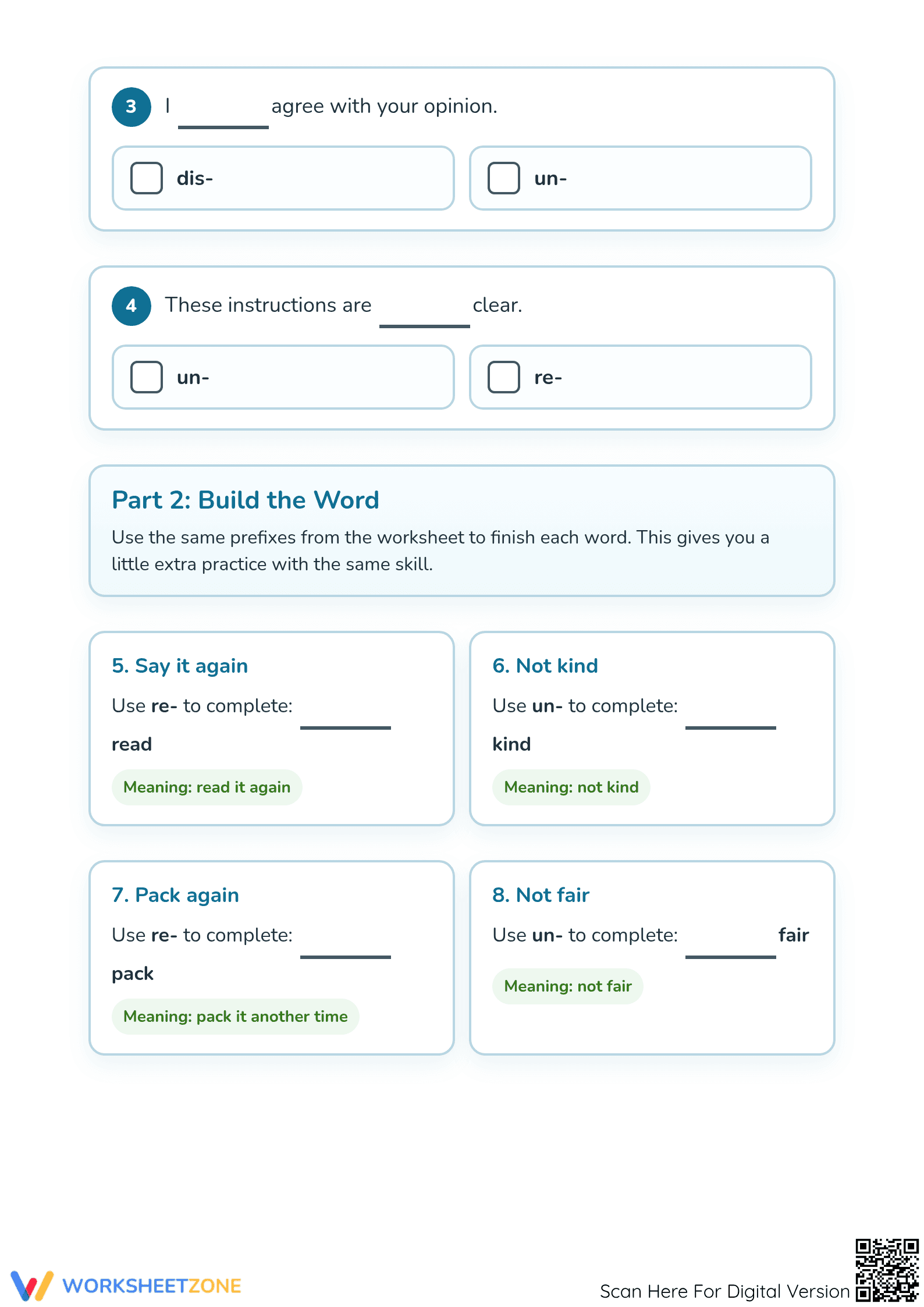
This Grade 2 English Language Arts worksheet provides a focused and efficient way for students to master the use of common prefixes. By engaging with eight structured problems, learners practice identifying how prefixes like re-, un-, and dis- alter the meaning of base words. The activities ensure that students can accurately complete sentences and build new vocabulary through contextual application.
At a Glance
- Grade: 2 · Subject: ELA
- Standard:
CCSS.ELA-LITERACY.L.2.4.B— Determine the meaning of the new word formed when a known prefix is added- Skill Focus: Prefix Identification (re-, un-, dis-)
- Format: 2 pages · 8 problems · Answer key included · PDF
- Best For: Morning work or independent literacy centers
- Time: 15–20 minutes
What’s Inside: This comprehensive two-page PDF features a dual-part structure designed to reinforce morphological awareness. Part 1 contains four sentence-completion tasks where students choose between two prefix options. Part 2 transitions to word-building, providing four exercises that require students to combine specific prefixes with root words to match given definitions. A full answer key is provided for immediate grading.
This zero-prep resource follows a three-minute workflow: Print (30 seconds), Distribute (1 minute), and Review (90 seconds). The clear layout and high-contrast text ensure students can begin working immediately without complex teacher explanations. It is an ideal "grab-and-go" option for substitute folders, quick morning work sessions, or as a fast-finisher activity that requires no additional materials or technology setup.
Standards Alignment: This resource is specifically aligned to `CCSS.ELA-LITERACY.L.2.4.B`, which requires students to determine the meaning of the new word formed when a known prefix is added to a known word. It also supports general vocabulary acquisition strategies outlined in the Grade 2 Language strand. Both standard codes can be copied directly into lesson plans, IEP goals, or district curriculum mapping tools.
How to Use It: Use this worksheet as a formative assessment after an introductory lesson on prefixes. Alternatively, assign it as a targeted homework task to reinforce the "un-" and "re-" meanings taught during direct instruction. Teachers should observe students during Part 1 to see if they are reading the full sentence for context before selecting a prefix, which typically takes about 18 minutes for the average 2nd grader.
Who It’s For: This activity is tailored for 2nd-grade students who are beginning to explore word parts. It is also an excellent resource for English Language Learners (ELLs) who need explicit practice with English morphemes. The worksheet pairs naturally with a prefix anchor chart or a short reading passage focused on repetitive prefix usage.
Research by Fisher & Frey (2014) underscores that morphological awareness, including the identification of prefixes like re-, un-, and dis-, is a primary driver of vocabulary growth in the primary grades. This worksheet aligns with CCSS.ELA-LITERACY.L.2.4.B by requiring students to determine how prefixes change root word meanings in context. Systematic practice with these bound morphemes helps 2nd-grade learners decode multisyllabic words more efficiently and improves overall reading fluency. By engaging with 8 distinct tasks that move from recognition to application, students build the cognitive schema necessary to internalize word-formation rules. This structured approach is validated by NAEP data which correlates early prefix mastery with higher long-term comprehension scores. The inclusion of a full answer key supports immediate feedback, a critical component of the gradual release of responsibility model in early literacy instruction.


