


























0
Views
0
Downloads

0.0
0
Save
0 Likes
Positive and Negative Adjectives Worksheet
0 Views
0 Downloads
Paste this activity's link or code into your existing LMS (Google Classroom, Canvas, Teams, Schoology, Moodle, etc.).
Students can open and work on the activity right away, with no student login required.
You'll still be able to track student progress and results from your teacher account.
Information
Description
What It Is:
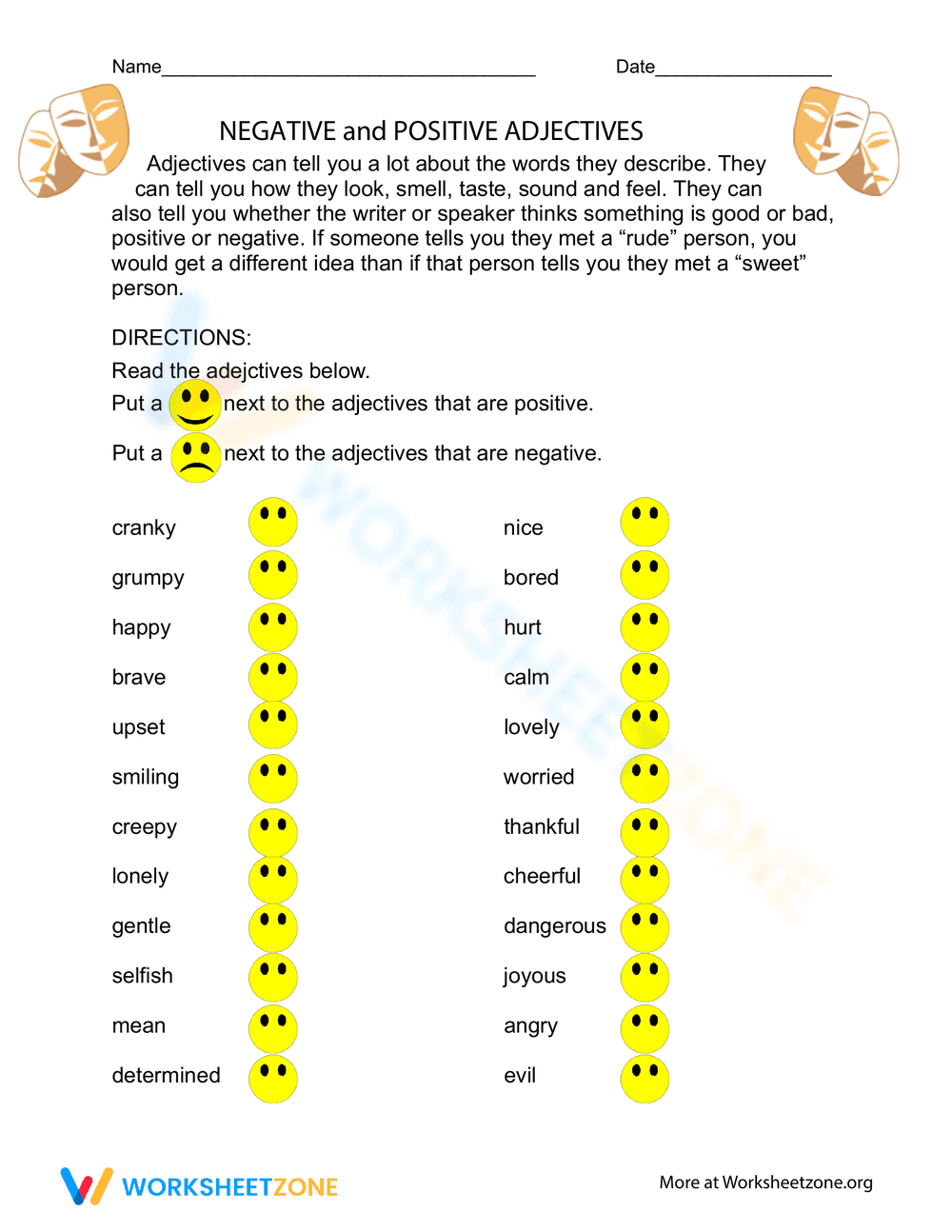
This is an educational worksheet focusing on identifying positive and negative adjectives. It provides a brief explanation of adjectives and their function. The activity requires students to read a list of adjectives (such as 'cranky,' 'happy,' 'nice,' and 'evil') and place a smiley face next to positive adjectives and a sad face next to negative adjectives.
Grade Level Suitability:
This worksheet is suitable for grades 2-4. The vocabulary is relatively simple, and the concept of positive and negative connotations is introduced in early elementary grades. The activity of placing smiley faces is also age-appropriate for this range.
Why Use It:
This worksheet helps students develop their vocabulary and understanding of adjectives. It reinforces the concept of positive and negative connotations and encourages critical thinking about the meaning and impact of words. It also provides practice in identifying and categorizing words based on their emotional association.
How to Use It:
First, read the introductory text about adjectives with the student. Then, explain the task: to place a smiley face next to positive adjectives and a sad face next to negative adjectives. Work through the list of adjectives one by one, discussing the meaning and connotation of each word. Students can draw the smiley or sad faces in the provided space.
Target Users:
This worksheet is designed for elementary school students, particularly those in grades 2-4, who are learning about adjectives and expanding their vocabulary. It is also beneficial for students who need extra practice in understanding positive and negative connotations of words. It can be used in the classroom or as a supplemental activity at home.
This is an educational worksheet focusing on identifying positive and negative adjectives. It provides a brief explanation of adjectives and their function. The activity requires students to read a list of adjectives (such as 'cranky,' 'happy,' 'nice,' and 'evil') and place a smiley face next to positive adjectives and a sad face next to negative adjectives.
Grade Level Suitability:
This worksheet is suitable for grades 2-4. The vocabulary is relatively simple, and the concept of positive and negative connotations is introduced in early elementary grades. The activity of placing smiley faces is also age-appropriate for this range.
Why Use It:
This worksheet helps students develop their vocabulary and understanding of adjectives. It reinforces the concept of positive and negative connotations and encourages critical thinking about the meaning and impact of words. It also provides practice in identifying and categorizing words based on their emotional association.
How to Use It:
First, read the introductory text about adjectives with the student. Then, explain the task: to place a smiley face next to positive adjectives and a sad face next to negative adjectives. Work through the list of adjectives one by one, discussing the meaning and connotation of each word. Students can draw the smiley or sad faces in the provided space.
Target Users:
This worksheet is designed for elementary school students, particularly those in grades 2-4, who are learning about adjectives and expanding their vocabulary. It is also beneficial for students who need extra practice in understanding positive and negative connotations of words. It can be used in the classroom or as a supplemental activity at home.


