


























Views
Downloads


Essential Parts of Speech Sorting Worksheet | Grade 1-3 ELA
Paste this activity's link or code into your existing LMS (Google Classroom, Canvas, Teams, Schoology, Moodle, etc.).
Students can open and work on the activity right away, with no student login required.
You'll still be able to track student progress and results from your teacher account.
This Grade 1-3 parts of speech worksheet helps students distinguish between nouns, verbs, and adjectives through a high-volume sorting activity. By classifying 50 different words, learners build the linguistic fluency required for complex sentence construction. This resource ensures students can accurately identify word functions in isolation before applying them to writing.
At a Glance
- Grade: 1-3 · Subject: ELA
- Standard:
CCSS.ELA-LITERACY.L.3.1.A— Explain the function of nouns, verbs, and adjectives in general- Skill Focus: Parts of Speech Identification
- Format: 2 pages · 50 problems · Answer key included · PDF
- Best For: Independent practice and grammar reinforcement
- Time: 20–30 minutes
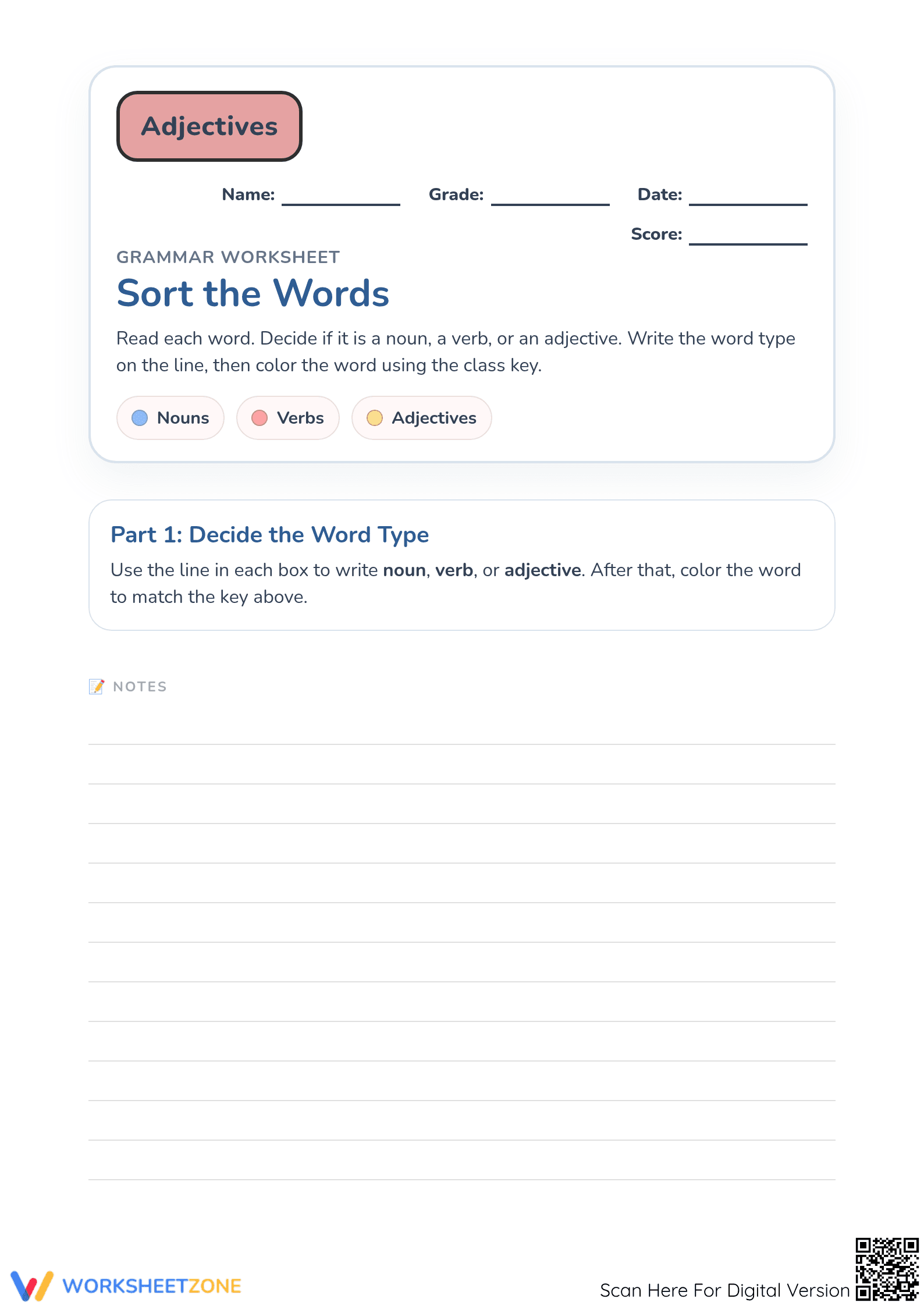
The download includes a comprehensive two-page PDF. The first page provides clear instructions and a color-coded key for nouns, verbs, and adjectives, alongside a dedicated notes section for student observations. The second page features a dense 50-word grid where students write the word type and apply the corresponding color, supported by a full answer key for quick grading.
Skill Progression
- Guided Practice: The worksheet begins with common concrete nouns and action verbs to build confidence and establish the sorting pattern.
- Supported Practice: Students use the color-coded key to categorize 50 distinct words, reinforcing the relationship between word types and their functions.
- Independent Practice: Learners complete the classification grid autonomously, identifying abstract concepts and descriptive adjectives without sentence-level scaffolds.
This high-repetition approach facilitates the gradual-release model, moving students from basic recognition toward mastery of lexical categories.
Standards Alignment
This resource is primarily aligned with `CCSS.ELA-LITERACY.L.3.1.A`, which requires students to explain the function of nouns, verbs, and adjectives in general. It also supports L.1.1.F by focusing on the use of frequently occurring adjectives. Both standard codes can be copied directly into lesson plans, IEP goals, or district curriculum mapping tools.
How to Use It
Assign this worksheet during the independent practice phase of a grammar lesson to evaluate student understanding of word classes. It serves as an excellent formative assessment; observe if students struggle more with abstract nouns like "April" versus concrete ones like "pencil." Expect completion within 20 to 30 minutes depending on the student's reading level.
Who It's For
This activity is designed for elementary students in grades 1 through 3 who are developing foundational literacy skills. It is particularly effective for English Language Learners (ELL) who need visual color cues to categorize vocabulary. Pair this with a parts-of-speech anchor chart or a mentor text to highlight these words in a narrative context.
According to the Fisher & Frey (2014) framework for intentional classroom instruction, the categorization of lexical items is a critical step in developing syntactic awareness. This worksheet addresses CCSS.ELA-LITERACY.L.3.1.A by requiring students to perform 50 distinct classification tasks, moving beyond simple recognition to functional labeling. Research indicates that color-coding grammatical categories helps students internalize the architecture of language, leading to improved sentence variety in their own writing. By isolating nouns, verbs, and adjectives, the resource reduces cognitive load, allowing students to focus entirely on the semantic properties of each word. This systematic approach is essential for bridging the gap between basic vocabulary acquisition and the complex language demands of upper elementary grades. Educators can utilize the included answer key to provide immediate feedback, a practice shown to significantly increase retention rates in primary ELA settings.


