


























Views
Downloads
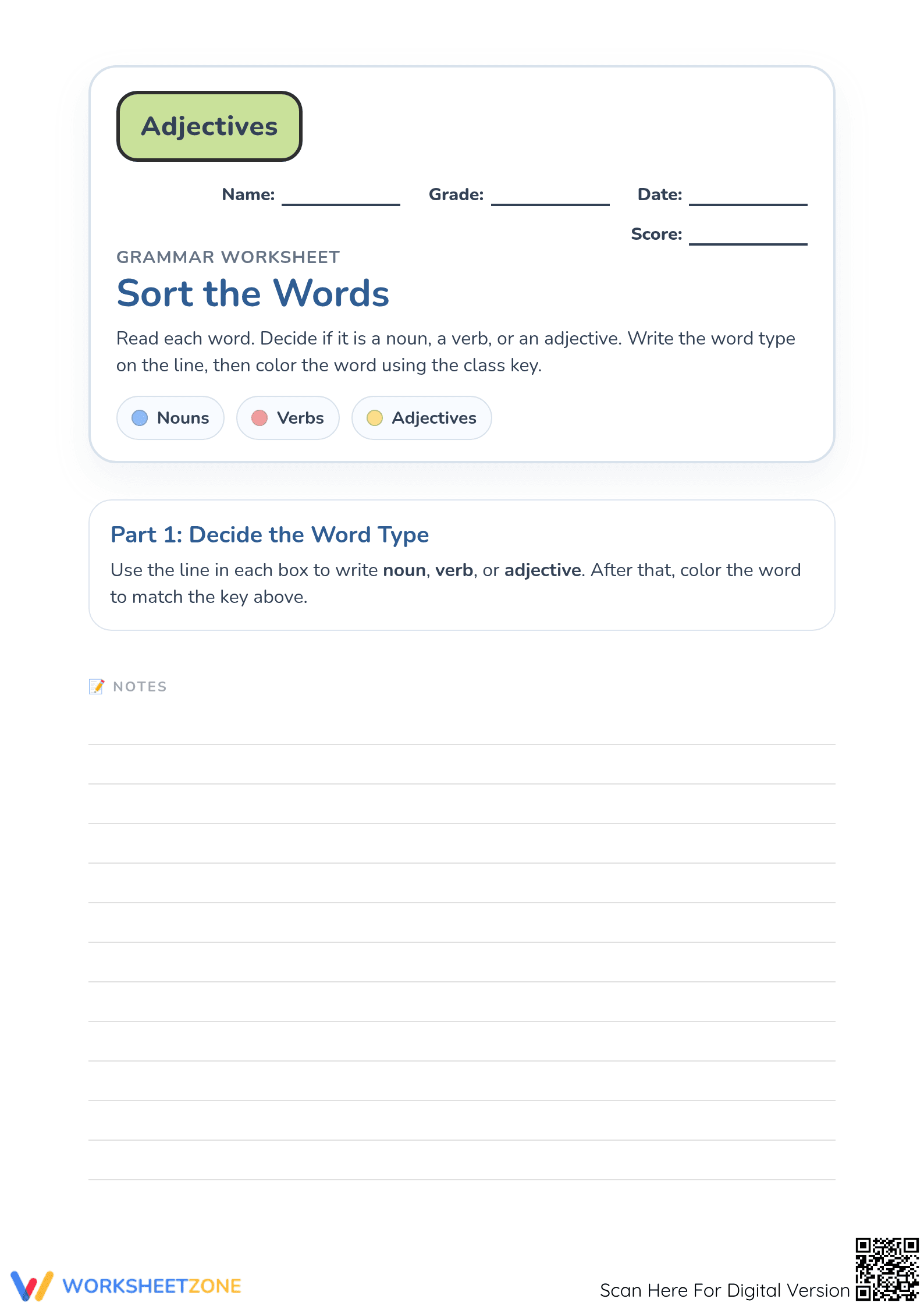


Essential Parts of Speech Practice | Grades 1-3 ELA
Paste this activity's link or code into your existing LMS (Google Classroom, Canvas, Teams, Schoology, Moodle, etc.).
Students can open and work on the activity right away, with no student login required.
You'll still be able to track student progress and results from your teacher account.
This Grade 1-3 ELA worksheet provides a comprehensive approach to identifying lexical word classes. Students analyze 30 distinct words to determine if they function as nouns, verbs, or adjectives. By categorizing and color-coding each term, learners build the foundational grammar skills necessary for sentence construction and reading comprehension.
At a Glance
- Grade: 1-3 · Subject: ELA
- Standard:
CCSS.ELA-LITERACY.L.2.1— Demonstrate command of the conventions of standard English grammar and usage- Skill Focus: Parts of Speech (Nouns, Verbs, Adjectives)
- Format: 2 pages · 30 problems · Answer key included · PDF
- Best For: Independent practice or literacy centers
- Time: 15–25 minutes
What's Inside
The resource consists of a two-page PDF designed for immediate classroom use. The first page provides clear instructions and a dedicated notes section for student observations or teacher feedback. The second page features a grid of 30 vocabulary words, such as "frog," "purple," and "bake." Each word box includes a line for labeling the part of speech and space for color-coding based on the provided key (blue for nouns, red for verbs, and yellow for adjectives).
Zero-Prep Workflow
- Print (30 seconds): Select the two-page PDF and print enough copies for your class or small group.
- Distribute (1 minute): Hand out the sheets along with crayons or colored pencils for the color-coding task.
- Review (5 minutes): Use the included answer key to conduct a quick whole-class check or allow students to self-correct their work.
Total teacher preparation time is under two minutes, making this an ideal solution for morning work, literacy rotations, or unexpected substitute plans.
Standards Alignment
Aligned to CCSS.ELA-LITERACY.L.2.1, this worksheet requires students to demonstrate command of the conventions of standard English grammar. Specifically, it targets the ability to distinguish between different word types, a prerequisite for more complex standards like CCSS.ELA-LITERACY.L.3.1.A. Both standard codes can be copied directly into lesson plans, IEP goals, or district curriculum mapping tools.
How to Use It
Use this as a formative assessment after an introductory lesson on adjectives and nouns. Observe students as they work; those struggling to distinguish between "purple" (adjective) and "frog" (noun) may need additional small-group support. It also serves as an excellent quiet activity during literacy rotations, typically taking 20 minutes to complete. For an extension, ask students to choose three adjectives from the list and use them in original sentences on the notes page.
Who It's For
This resource is designed for elementary students in grades 1 through 3. It is particularly effective for English Language Learners (ELL) who benefit from the visual reinforcement of color-coding. Pair this worksheet with a descriptive writing prompt or a parts-of-speech anchor chart to reinforce the connection between word types and storytelling.
According to the RAND AIRS 2024 report on elementary literacy, structured categorization tasks significantly improve a student's ability to recognize syntactic patterns in complex texts. This worksheet applies these findings by requiring students to isolate 30 individual words and assign them to specific lexical categories: nouns, verbs, and adjectives. By engaging in the dual-modality task of writing and color-coding, learners reinforce their understanding of CCSS.ELA-LITERACY.L.2.1 through repetitive, focused practice. Research indicates that such "sort and label" activities bridge the gap between isolated vocabulary acquisition and functional grammar application in writing. This resource provides the necessary scaffolding for early elementary students to master word classes, ensuring they are prepared for the higher-order linguistic demands of upper elementary grades.


