




























Views
Downloads
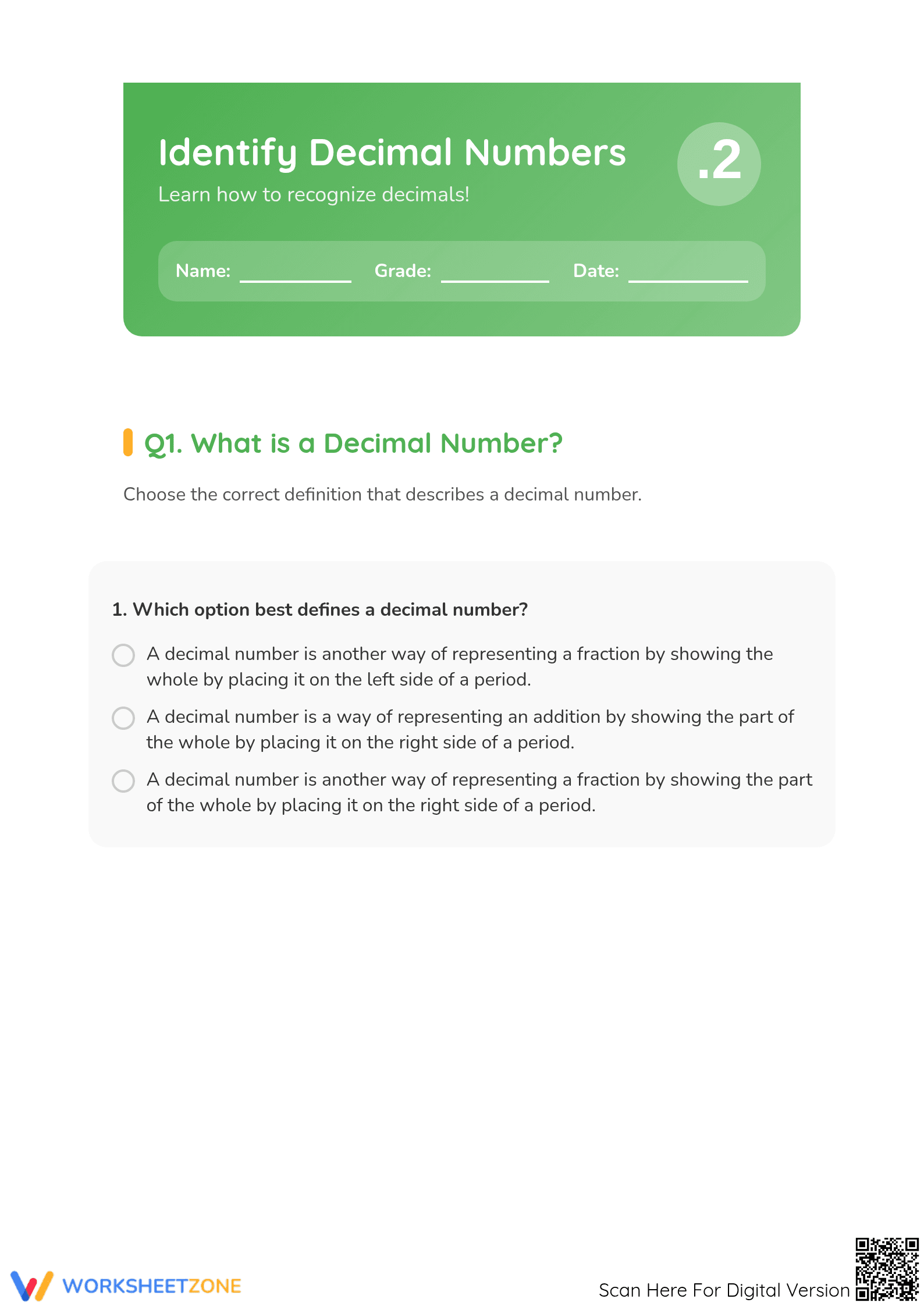
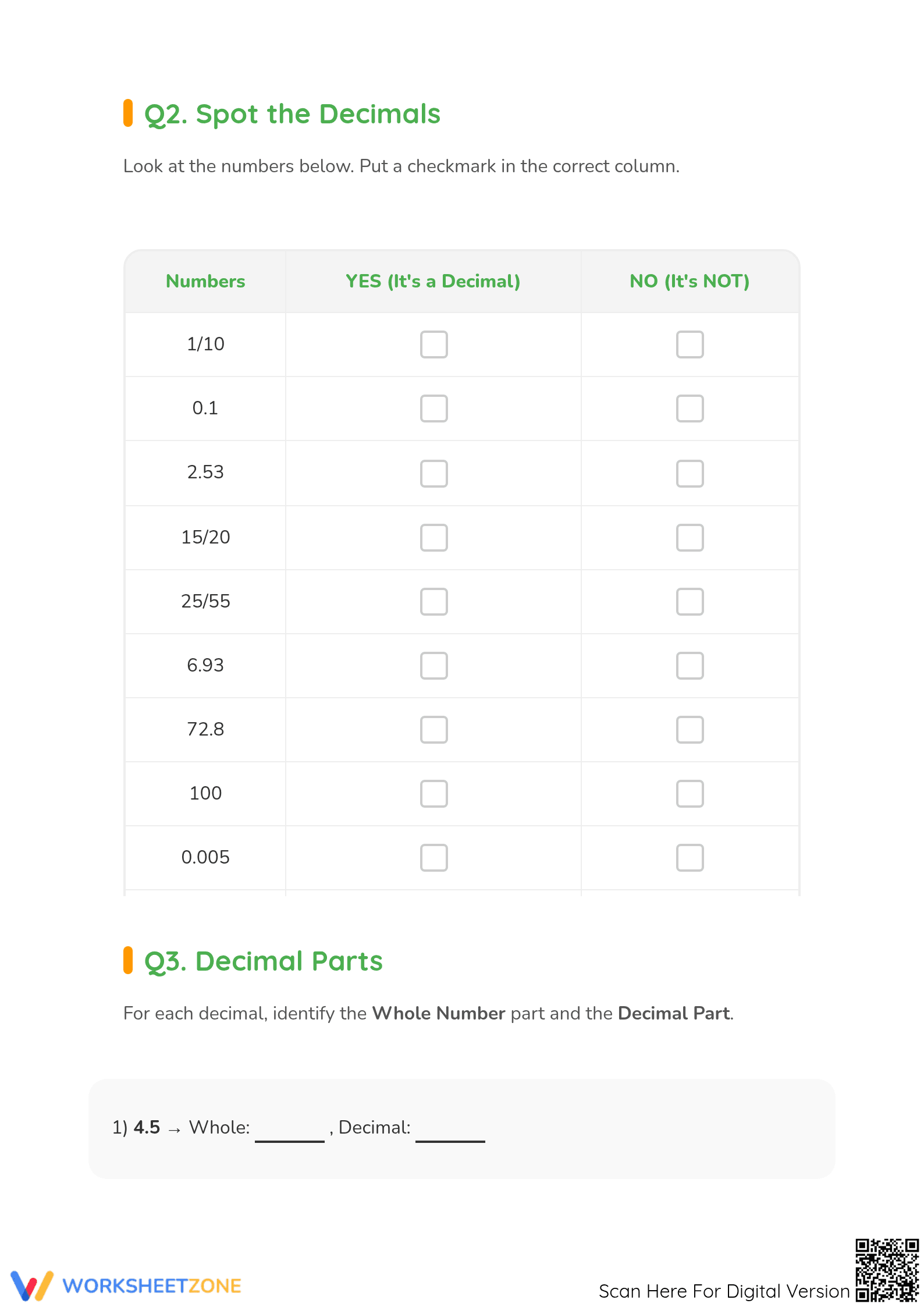
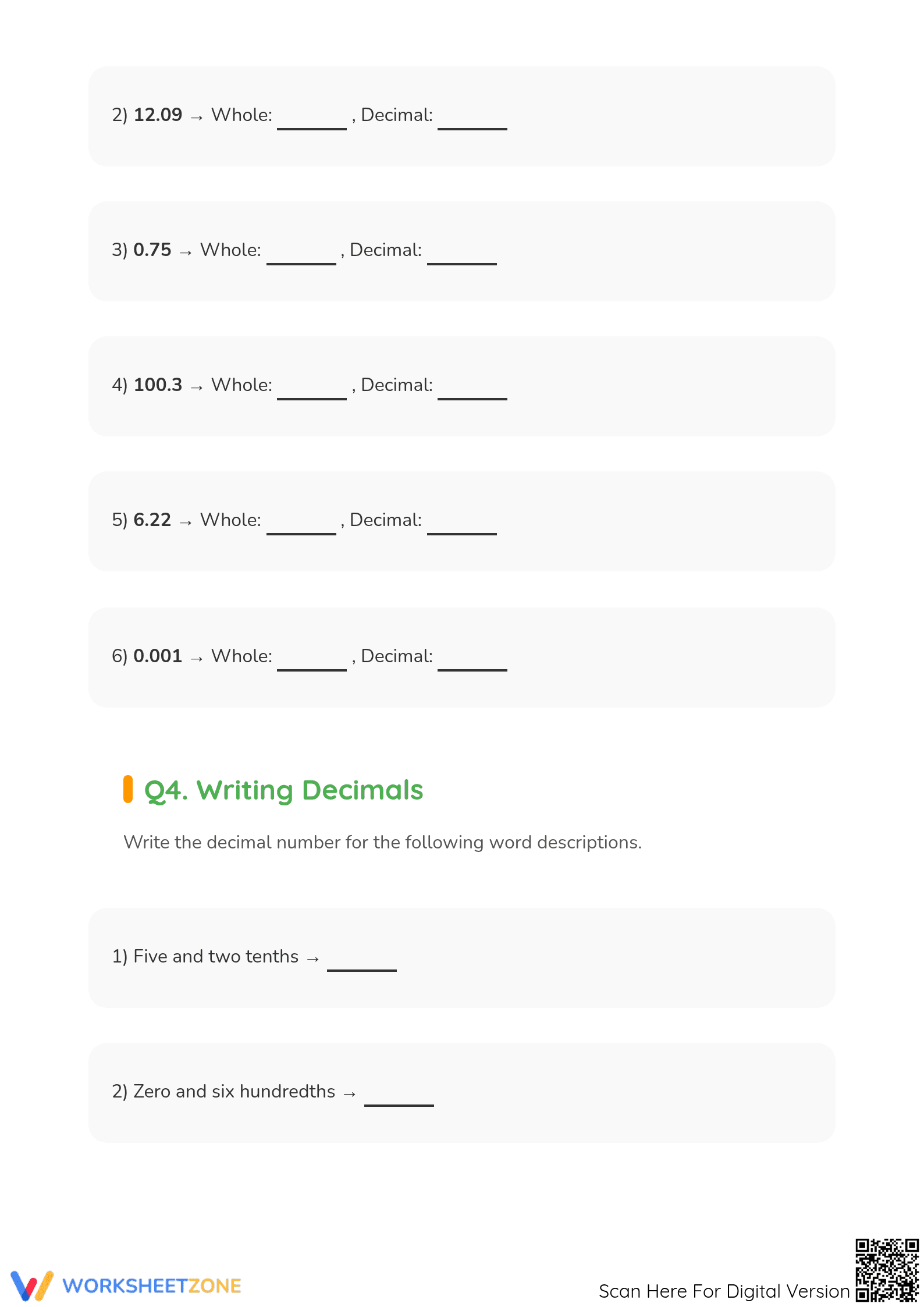
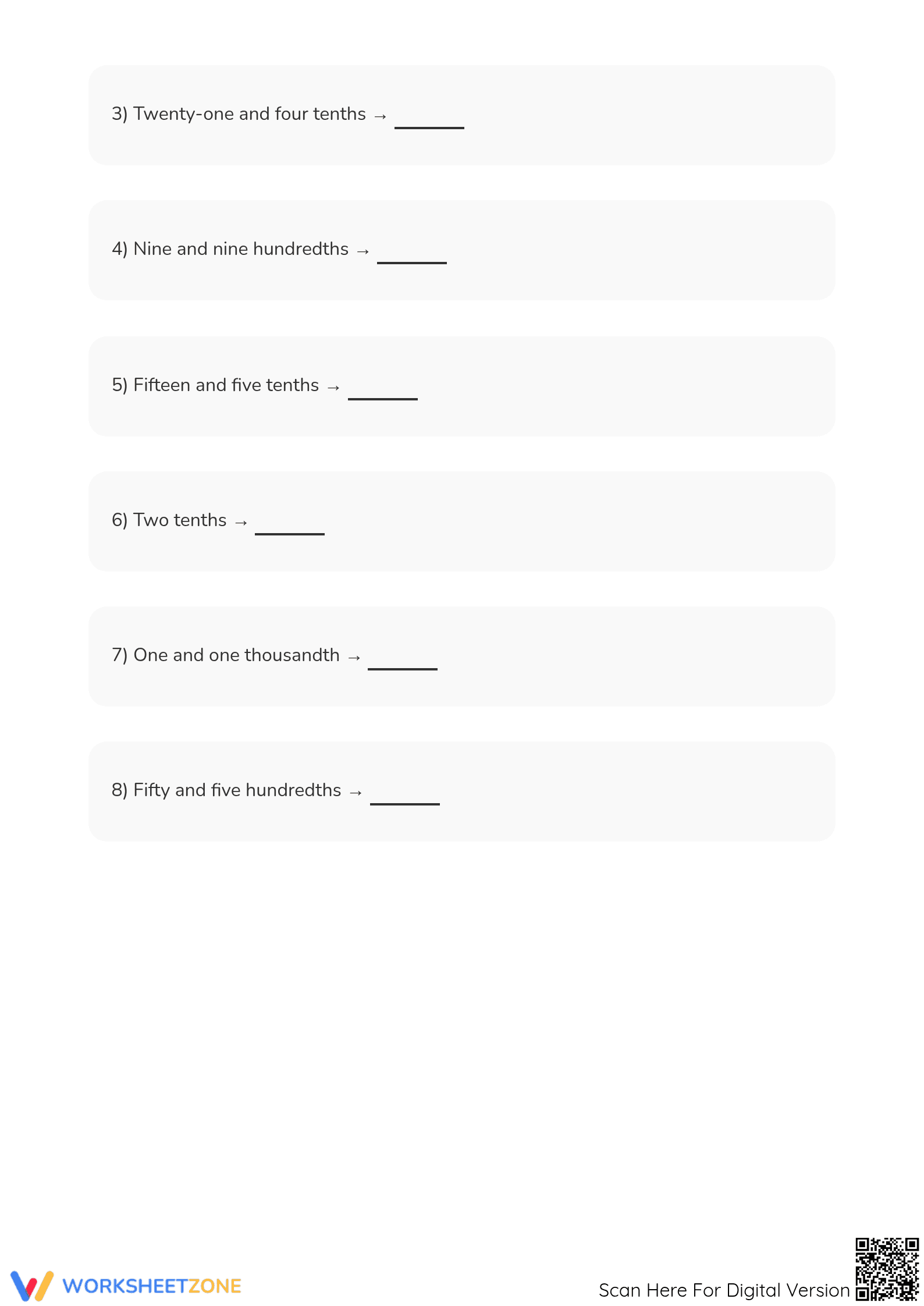

Printable Decimal Models Worksheet | Grade 4 Math

Paste this activity's link or code into your existing LMS (Google Classroom, Canvas, Teams, Schoology, Moodle, etc.).
Students can open and work on the activity right away, with no student login required.
You'll still be able to track student progress and results from your teacher account.
Grade 4 Math Worksheet: Identifying Decimal Models
This worksheet provides targeted practice for Grade 4 students in converting visual decimal models into standard numerical form. Through 16 structured problems, learners will strengthen their understanding of tenths and hundredths, building a crucial foundation for more complex decimal operations. It’s an essential resource for reinforcing place value concepts with visual aids.
At a Glance
- Grade: 4 · Subject: Math
- Standard:
CCSS.MATH.CONTENT.4.NF.C.6— Use decimal notation for fractions with denominators 10 or 100.- Skill Focus: Identifying decimals from visual models
- Format: 4 pages · 16 problems · Answer key included · PDF
- Best For: Independent practice or station work
- Time: 15–25 minutes
What's Inside
This four-page resource contains 16 unique problems where students identify the decimal value represented by shaded grids. The first two pages focus on tenths, and the final two pages cover hundredths, providing a clear progression. A complete four-page answer key is included, showing the correct decimal for each model, making for quick and easy review.
A Scaffolded Skill Progression
The worksheet follows a clear progression to build student confidence:
- Guided Practice: The worksheet begins with clear examples of decimal models for tenths, allowing teachers to walk through the process of counting shaded parts and writing the corresponding decimal.
- Supported Practice: Students then move to identifying tenths on their own, with the consistent format providing support before they advance to the hundredths grids.
- Independent Practice: The entire packet is designed for students to complete independently after initial instruction, solidifying the connection between fractional parts and decimal notation through a gradual-release model.
Standards Alignment
This worksheet is directly aligned with CCSS.MATH.CONTENT.4.NF.C.6, which requires students to use decimal notation for fractions with denominators 10 or 100. It provides focused practice on interpreting visual models and writing them in correct decimal format, a skill that is foundational for understanding decimal place value. The standard code can be copied directly into lesson plans or curriculum maps.
How to Use It
Use this worksheet for independent practice after a direct instruction lesson on decimal models, or as a self-contained math station activity. For a quick formative assessment, walk around and observe if students are counting the hundredths squares individually or using groups of ten to work more efficiently. Most students will be able to complete all 16 tasks in approximately 15 to 25 minutes.
Who It's For
Designed for Grade 4 students beginning their study of decimals, this resource also serves as an effective review for Grade 5 students or as an acceleration tool for advanced Grade 3 students. Its clean layout and visual format support diverse learners. This worksheet pairs well with a hands-on activity using base-ten blocks to build the decimals before writing them down.
This resource supports a key Grade 4 math concept: representing decimals visually, as specified in CCSS.MATH.CONTENT.4.NF.C.6. By connecting the abstract number to a concrete model, students develop a deeper conceptual understanding, a practice supported by extensive research. The National Assessment of Educational Progress (NAEP) has consistently shown that students who can flexibly move between representations of numbers demonstrate stronger mathematical proficiency. For example, the 2022 NAEP results indicated a strong correlation between representational fluency and problem-solving success. This worksheet provides the focused, repetitive practice necessary to build that fluency. By asking students to interpret 16 different models, it reinforces the place value concepts underpinning decimals, an approach validated by findings from the RAND AIRS 2024 report on effective math interventions.


