


























Views
Downloads

Essential Pronouns Worksheet | Grades 1-3 ELA
Paste this activity's link or code into your existing LMS (Google Classroom, Canvas, Teams, Schoology, Moodle, etc.).
Students can open and work on the activity right away, with no student login required.
You'll still be able to track student progress and results from your teacher account.
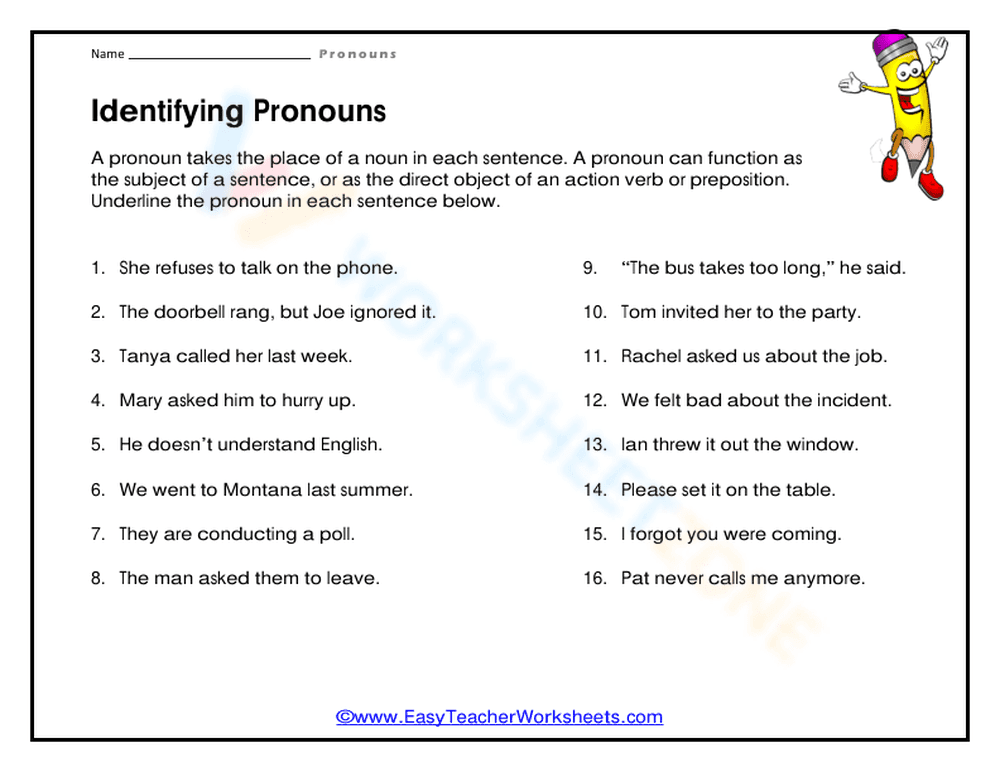
This pronoun identification worksheet helps students in grades 1 through 3 master parts of speech by replacing nouns with accurate pronouns. By underlining sixteen pronouns within varied sentences, learners develop a concrete understanding of how pronouns function as subjects and objects. This practice improves sentence flow and overall reading comprehension for early elementary students.
At a Glance
- Grade: 1-3 · Subject: ELA Grammar
- Standard:
CCSS.ELA-LITERACY.L.1.1.D— Use personal, possessive, and indefinite pronouns in sentences accurately.- Skill Focus: Pronoun Identification
- Format: 1 page · 16 problems · Answer key included · PDF
- Best For: Grammar practice and homework reviews
- Time: 10–15 minutes
This one-page PDF contains sixteen practice sentences focused on common personal and object pronouns. The worksheet features a clear, student-friendly definition of pronouns at the top, explaining their role in replacing nouns to avoid repetition. A comprehensive answer key is included, allowing for quick grading or student self-correction during independent work periods.
The zero-prep workflow for this resource is built for busy teachers. Simply print the single-page document (30 seconds), distribute the copies to your students (1 minute), and use the included answer key for immediate review (30 seconds). With a total preparation time of less than two minutes, this worksheet is an ideal solution for emergency sub plans or last-minute grammar lessons.
This worksheet is directly aligned with CCSS.ELA-LITERACY.L.1.1.D, which requires students to use personal, possessive, and indefinite pronouns. It also supports higher grade levels through CCSS.ELA-LITERACY.L.3.1.A, focusing on the function of pronouns in particular sentences. Both standard codes can be copied directly into lesson plans, IEP goals, or district curriculum mapping tools.
Use this worksheet as a quick formative assessment after a direct instruction lesson on parts of speech. It is particularly effective during independent work blocks where students can apply their knowledge in a structured environment. Teachers should observe whether students can identify pronouns used as objects versus those used as subjects, as this often indicates a deeper level of grammatical understanding.
This resource is perfect for elementary students in grades 1 through 3 who are building their core grammar skills. It is also an excellent tool for ESL learners and students receiving Tier 2 intervention for literacy. We recommend pairing this worksheet with a short reading passage to have students identify pronouns in a longer narrative context after completing these focused sentences.
Research highlights that focused practice on grammatical structures like pronouns is essential for developing syntactical awareness in early readers. According to Fisher & Frey (2014), the gradual release of responsibility model, which includes structured independent practice, significantly improves the retention of linguistic rules. This worksheet addresses the CCSS.ELA-LITERACY.L.1.1.D standard by requiring students to identify sixteen distinct pronouns within varied sentence structures. By isolating the skill of pronoun identification, students learn to recognize the functional role of these words as substitutes for nouns, thereby reducing cognitive load during complex sentence processing. Systematic exposure to these parts of speech helps bridge the gap between simple identification and active application in creative writing. This resource provides the necessary repetition required to move from rote memorization to fluent recognition of personal and object pronouns in diverse academic texts. The clear formatting ensures students stay focused on the specific linguistic task.


