




























Views
Downloads

Letter I Tracing Worksheet | Printable Kindergarten ELA

Paste this activity's link or code into your existing LMS (Google Classroom, Canvas, Teams, Schoology, Moodle, etc.).
Students can open and work on the activity right away, with no student login required.
You'll still be able to track student progress and results from your teacher account.
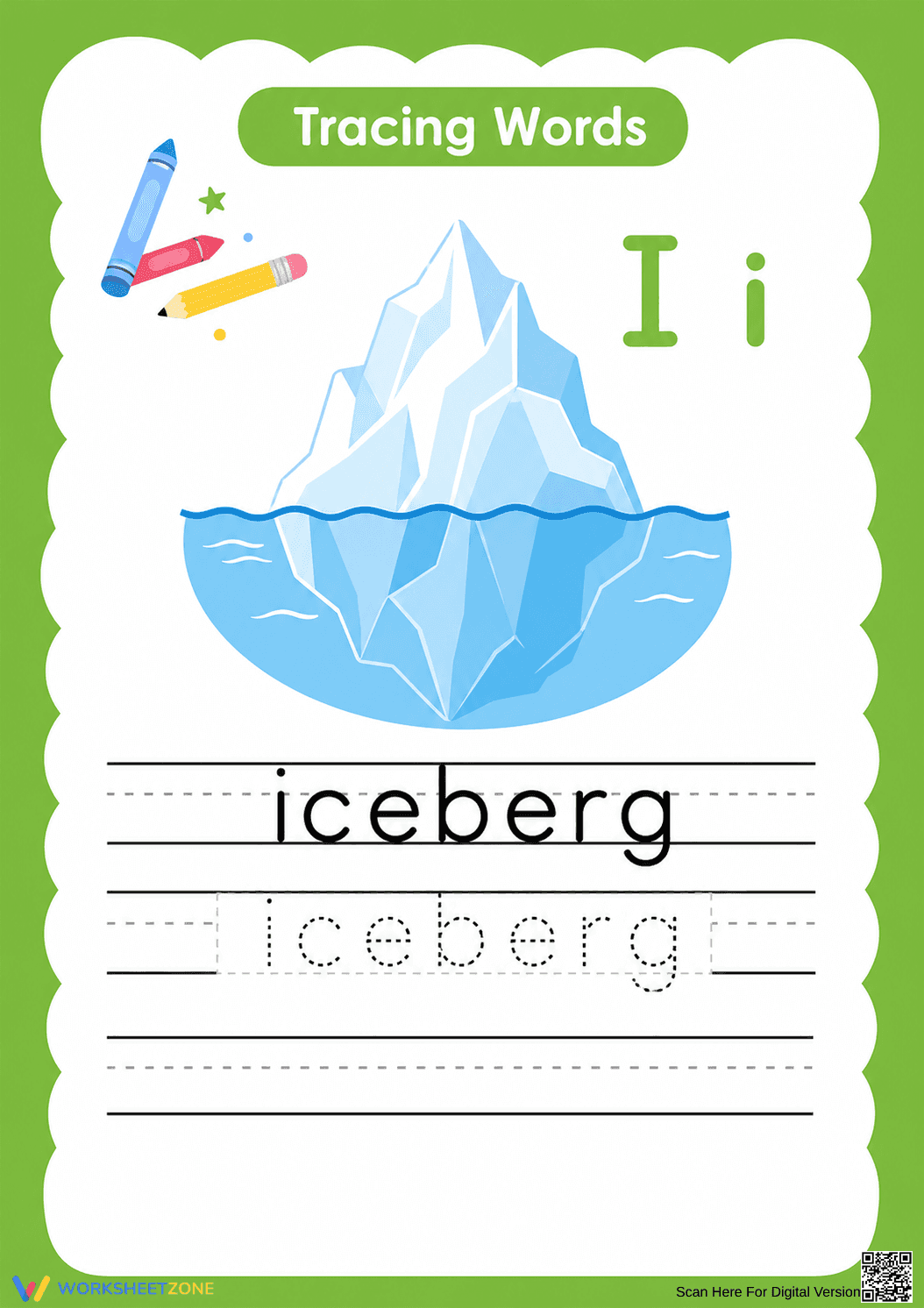
This printable Kindergarten phonics worksheet helps early learners master the beginning sound of the letter I while practicing essential handwriting skills. By tracing and writing the word "iceberg," students connect the visual representation of the letter to its phonetic sound, building a strong foundation for early reading and writing fluency.
At a Glance
- Grade: Kindergarten · Subject: ELA
- Standard:
CCSS.ELA-LITERACY.RF.K.3.A— Identify primary sounds for consonants and vowels- Skill Focus: Letter I Beginning Sound
- Format: 1 page · 3 tasks · No answer key needed · PDF
- Best For: Morning work or literacy centers
- Time: 5–10 minutes
This single-page resource features a clear layout designed for early childhood. At the top, students see a colorful iceberg illustration alongside the uppercase and lowercase letter I, reinforcing visual memory. The bottom half provides structured handwriting practice: one solid word model, one dotted tracing line, and two blank primary-lined spaces for independent writing. The straightforward design ensures young learners focus entirely on letter formation and sound association.
Implementing this resource requires no teacher preparation.
- Print (1 minute): Download the PDF and print. The design works beautifully in color or grayscale.
- Distribute (1 minute): Hand out during morning arrival. The intuitive layout means students immediately understand the task.
- Review (1 minute): Quickly scan work to check for proper letter formation.
With total prep time under two minutes, this worksheet is perfect for sub plans or literacy centers.
This activity is directly aligned with primary standard CCSS.ELA-LITERACY.RF.K.3.A: Demonstrate basic knowledge of one-to-one letter-sound correspondences by producing the primary sound or many of the most frequent sounds for each consonant. It also supports early handwriting development by requiring students to print letters accurately on primary lines. Both standard codes can be copied directly into lesson plans, IEP goals, or district curriculum mapping tools.
Educators can utilize this worksheet during morning work to establish a focused start to the day. It also serves as an excellent independent station during reading rotations. While students work, teachers should observe pencil grip and stroke direction, offering immediate feedback if a child starts letters from the bottom. Expected completion time ranges from five to ten minutes.
This resource is designed for Kindergarten students learning basic phonics. It is also beneficial for preschool students demonstrating early readiness, or first-graders requiring targeted intervention. Pair this tracing activity with a read-aloud book featuring "I" sounds, or a classroom anchor chart displaying "I" vocabulary words.
Integrating targeted phonics practice with physical handwriting tasks significantly enhances early literacy acquisition in young learners. According to a comprehensive review by Fisher & Frey (2014), students who engage in simultaneous motor and cognitive tasks, such as tracing a specific word while vocalizing its beginning sound, demonstrate substantially higher retention rates of letter-sound correspondences. This specific worksheet directly supports CCSS.ELA-LITERACY.RF.K.3.A by requiring learners to identify primary sounds for consonants and vowels while physically forming the corresponding letters on primary lines. The dual-modality instructional approach ensures that both visual and kinesthetic learning pathways are activated simultaneously during the lesson. By repeatedly practicing the short or long "I" sound through the vocabulary word "iceberg," young learners solidify their foundational phonemic awareness, which remains a critical predictor of future reading success. This evidence-based strategy provides a highly reliable framework for building essential foundational literacy skills in early childhood classrooms, ensuring students are prepared for more advanced decoding tasks.


