




























Views
Downloads
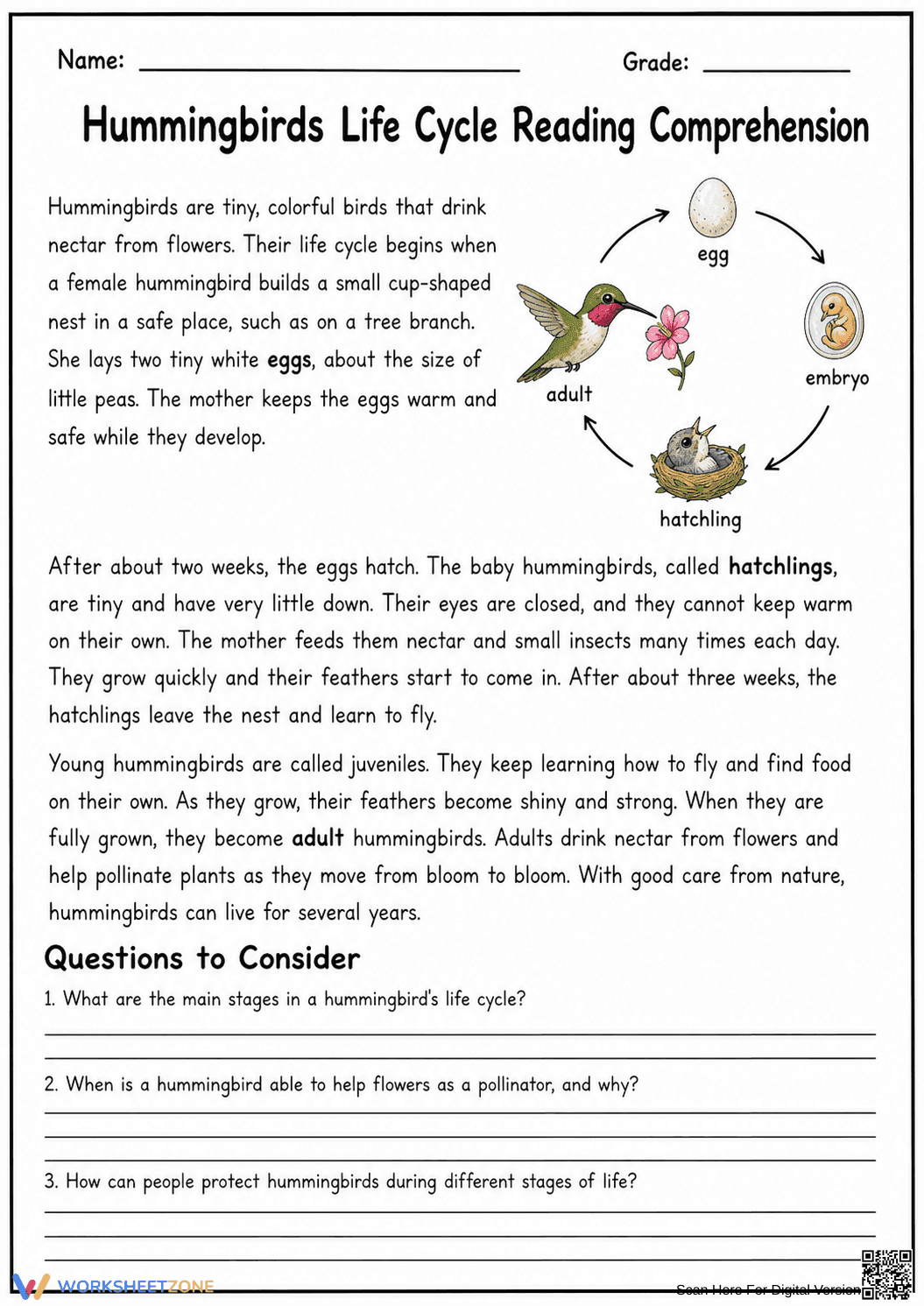

Hummingbird Life Cycle Reading | Essential Grade 3-5

Paste this activity's link or code into your existing LMS (Google Classroom, Canvas, Teams, Schoology, Moodle, etc.).
Students can open and work on the activity right away, with no student login required.
You'll still be able to track student progress and results from your teacher account.
This hummingbird life cycle reading comprehension worksheet helps students master the biological stages of avian development while strengthening informational text analysis skills. Students will identify key vocabulary and chronological events to explain how hummingbirds grow from eggs to pollinators. This resource ensures learners can describe the unique characteristics of each life stage with accuracy.
At a Glance
- Grade: 3-5 · Subject: Science & ELA
- Standard:
3-LS1-1— Develop models to describe that organisms have unique and diverse life cycles.- Skill Focus: Informational text analysis and life cycle sequencing
- Format: 1 page · 3 problems · Answer key included · PDF
- Best For: Science centers, independent practice, or sub plans
- Time: 15–20 minutes
What's Inside: This single-page PDF features a detailed reading passage covering the egg, hatchling, juvenile, and adult stages of a hummingbird. It includes a clear, circular life cycle diagram to support visual learners and three open-ended comprehension questions that require text-based evidence. A full answer key is provided for quick grading or student self-correction.
Zero-Prep Workflow
- Print: Select the page and print enough copies for your class (30 seconds).
- Distribute: Hand out the worksheets as a warm-up or part of a science rotation (1 minute).
- Review: Use the included answer key to facilitate a 5-minute class discussion on the findings.
Total teacher preparation time is under 2 minutes, making this an ideal resource for busy mornings or unexpected substitute teacher needs.
Standards Alignment
This resource aligns primarily with `3-LS1-1`, focusing on the unique and diverse life cycles of organisms. It also supports CCSS.ELA-LITERACY.RI.4.1 by requiring students to refer to details and examples in a text when explaining what the text says explicitly. Both standard codes can be copied directly into lesson plans, IEP goals, or district curriculum mapping tools.
How to Use It
Use this worksheet during the "Explain" phase of a 5E science lesson to solidify student understanding of avian development. It also serves as an excellent formative assessment tool; observe if students can correctly link the "pollinator" role to the adult stage in question two. Expected completion time ranges from 15 to 20 minutes depending on reading level.
Who It's For
This worksheet is designed for general education students in grades 3 through 5, as well as English Language Learners who benefit from the integrated visual diagram. It pairs naturally with a hummingbird migration map or a bird-watching nature journal activity to extend the learning beyond the classroom walls.
According to Fisher & Frey (2014), the integration of informational text within content-area instruction, such as science, significantly improves disciplinary literacy and retention of complex biological concepts. This Hummingbird Life Cycle Reading Comprehension worksheet aligns with the 3-LS1-1 standard, requiring students to identify and describe the unique stages of an organism's development. By engaging with the text and the accompanying visual diagram, learners build a mental model of the transition from egg to embryo, hatchling, and adult. Research from the RAND AIRS 2024 report suggests that structured reading tasks with specific text-dependent questions help bridge the gap between surface-level reading and deep conceptual understanding. This resource provides a focused environment for students to practice evidence-based writing while mastering life science vocabulary. The inclusion of a clear diagram supports visual learners in synthesizing the chronological progression of the avian life cycle effectively.


