


























Views
Downloads
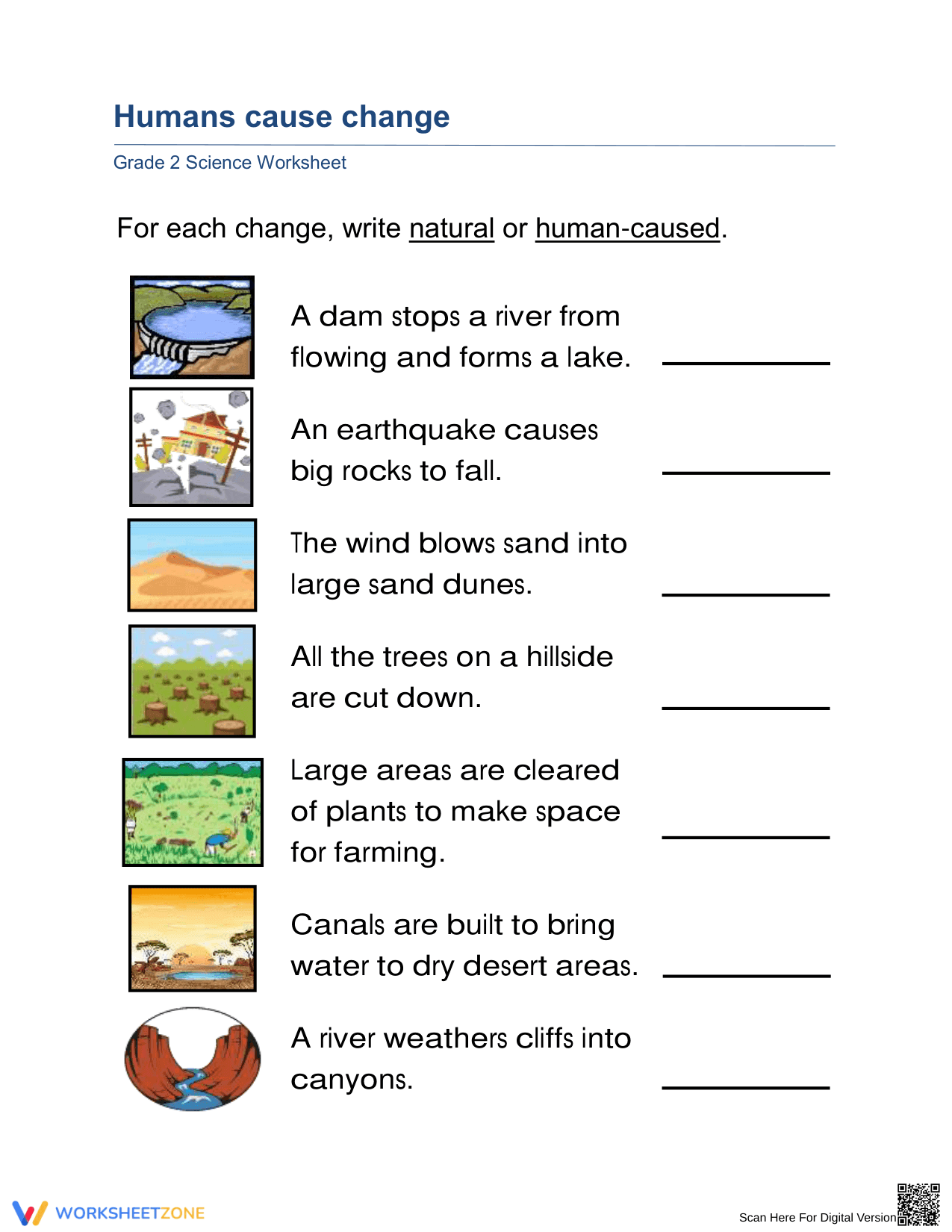
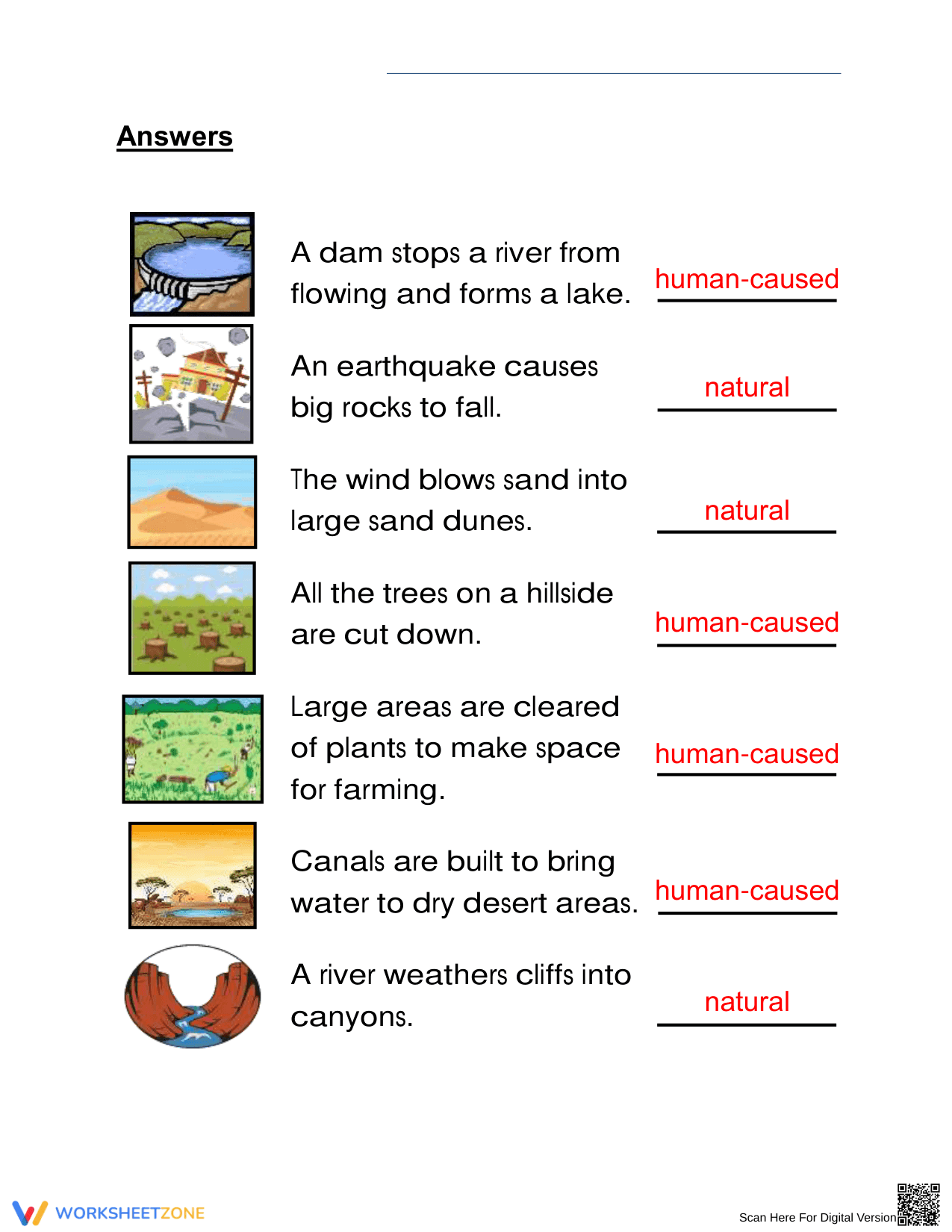

Humans Cause Change: Essential Grade 2 Science Worksheet
Paste this activity's link or code into your existing LMS (Google Classroom, Canvas, Teams, Schoology, Moodle, etc.).
Students can open and work on the activity right away, with no student login required.
You'll still be able to track student progress and results from your teacher account.
This Grade 2 science worksheet empowers students to distinguish between natural events and human activities that alter the Earth’s surface. By analyzing scenarios like dam construction and earthquakes, learners develop a foundational understanding of environmental change. This resource provides a clear framework for students to categorize geographical and man-made transformations effectively.
At a Glance
- Grade: 2 · Subject: Science
- Standard:
2-ESS1-1— Provide evidence that Earth events can occur in different ways- Skill Focus: Natural vs. Human-Caused Environmental Changes
- Format: 1 page · 7 problems · Answer key included · PDF
- Best For: Earth systems introduction and formative assessment
- Time: 15–20 minutes
This focused science printable features seven distinct visual and text-based scenarios depicting changes to the landscape. Each entry includes a clear illustration and a descriptive sentence, such as the formation of sand dunes or the clearing of plants for farming. The layout provides designated lines for student responses. A complete answer key is included on the second page.
Zero-Prep Workflow
Designed for immediate classroom implementation, this worksheet requires less than two minutes of total teacher preparation.
- Print: Generate the required number of copies directly from the PDF file in thirty seconds.
- Distribute: Hand out the single-page worksheet to students during your Earth systems unit in twenty seconds.
- Review: Use the included answer key for a quick whole-class check or individual grading in sixty seconds.
This streamlined process makes it an ideal resource for substitute lesson plans.
Standards Alignment
This resource aligns primarily with standard 2-ESS1-1. The standard requires students to use information from several sources to provide evidence that Earth events can occur quickly or slowly. By identifying various agents of change—both natural phenomena and human interventions—students gather evidence needed to understand how landscapes evolve. Standard 2-ESS2-1 is also supported as students compare human impacts. Both standard codes can be copied directly into lesson plans or curriculum tools.
How to Use It
Deploy this worksheet after an initial lesson on Earth's surface to check for understanding. It serves as an effective formative assessment tool; teachers should observe if students can differentiate between meteorological forces and industrial actions. Expect most learners to complete the seven identification tasks within 15 minutes. It can also be used as a quiet-work extension after a hands-on erosion experiment.
Who It's For
This material is tailored for Grade 2 students but is also appropriate for Grade 3 review or Grade 1 enrichment. It supports English Language Learners through the use of clear, context-rich illustrations paired with descriptive text. Teachers can pair this worksheet with a video showing real-world volcanic activity to deepen the connection between the page and the planet.
The ability to categorize environmental changes is a critical milestone in early scientific literacy, as outlined in the RAND AIRS 2024 framework for elementary Earth science instruction. This worksheet specifically targets the identification of causal agents in landscape transformation, a skill that bridges the gap between basic observation and complex systems thinking. According to current pedagogical research, providing students with structured sorting tasks—such as distinguishing natural erosion from human-led deforestation—strengthens their ability to construct evidence-based arguments about the world around them. Standard 2-ESS1-1 emphasizes the use of varied information sources to understand Earth events; this resource fulfills that requirement by presenting diverse scenarios ranging from seismic activity to agricultural expansion. By mastering these distinctions at the second-grade level, students build the necessary cognitive scaffolding for later units on conservation and human impact on global ecosystems.


