


























Views
Downloads




Capacity & Volume Worksheet | Printable Grade 1 Math
Paste this activity's link or code into your existing LMS (Google Classroom, Canvas, Teams, Schoology, Moodle, etc.).
Students can open and work on the activity right away, with no student login required.
You'll still be able to track student progress and results from your teacher account.
This worksheet provides focused practice on the foundational math skill of measuring capacity. Designed for Grade 1 students, the activities guide learners to estimate and determine the volume of various containers using non-standard units, building a conceptual understanding of how measurement works before introducing formal units like liters or gallons.
At a Glance
- Grade: 1 (K-2) · Subject: Math
- Standard:
CCSS.MATH.CONTENT.1.MD.A.2— Use iteration of non-standard units to measure an object's attribute.- Skill Focus: Measuring Capacity & Volume
- Format: 5 pages · 10 problems · Answer key included · PDF
- Best For: Hands-on practice, math centers, or formative assessment.
- Time: 20–30 minutes
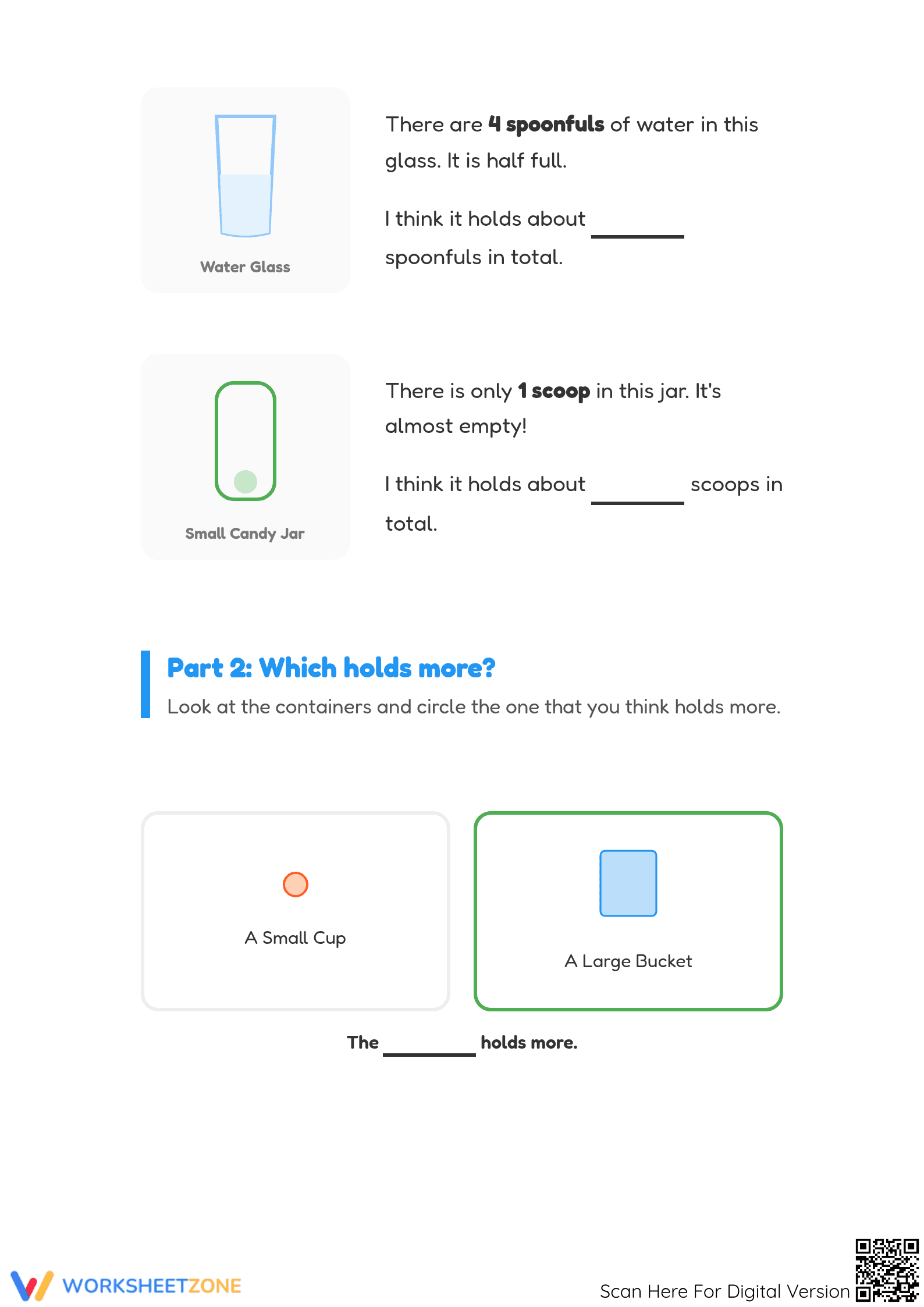
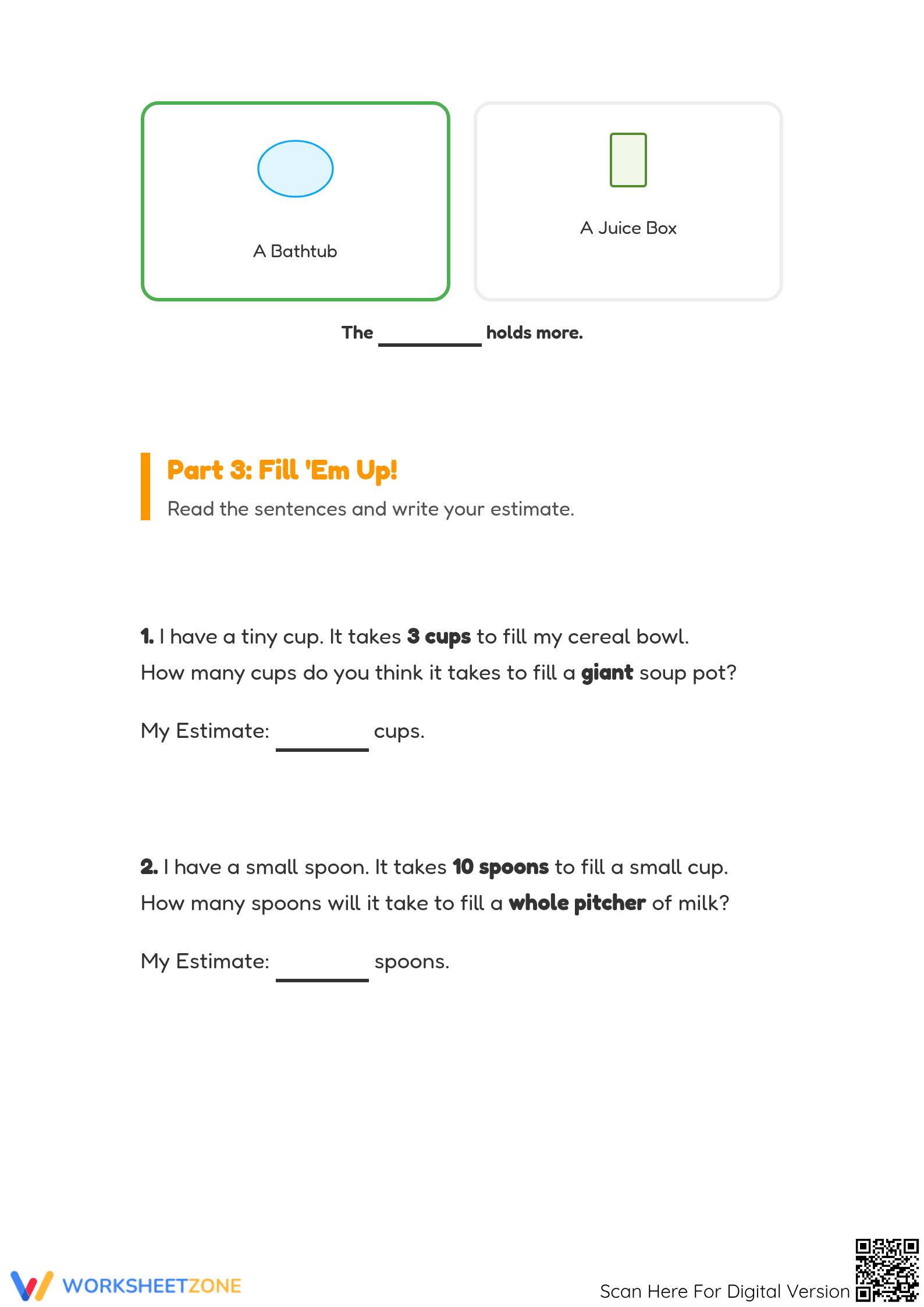
This five-page PDF contains 10 engaging exercises on capacity. Students compare containers, estimate how many units fill a larger one, and record their findings. A full answer key is included for quick checking.
Skill Progression
- Guided practice: Initial tasks involve simple visual comparisons of which object holds more or less.
- Supported practice: Activities then ask students to estimate and measure how many provided units (e.g., a cup) fill a larger container.
- Independent practice: The final pages have students apply their understanding to simple capacity word problems.
This structure follows a gradual-release model, moving from concrete to abstract.
Standards Alignment
This worksheet aligns with the principles of CCSS.MATH.CONTENT.1.MD.A.2. The core concept taught is foundational to all measurement: understanding that measuring involves repeatedly using a smaller unit to quantify a larger object. This resource builds that fundamental understanding as a prerequisite to formal volume measurement in later grades. The standard code can be copied directly into lesson plans or curriculum maps.
How to Use It
This is perfect as a follow-up to a hands-on lesson or for a math center. For formative assessment, observe if students make reasonable estimates before measuring, as this shows a deeper grasp of the concept. Most students will complete the packet in 20-30 minutes.
Who It's For
Designed for first graders, this resource also supports advanced kindergarteners or second graders needing review. Pair this worksheet with a classroom anchor chart defining key vocabulary like "capacity," "volume," "full," and "empty."
Developing a foundational understanding of measurement is critical for later success in mathematics. This worksheet for CCSS.MATH.CONTENT.1.MD.A.2 helps students grasp the core measurement principle of unit iteration—the idea that you can quantify a large space by repeatedly filling it with a smaller, consistent unit. According to the RAND AIRS 2024 report on elementary math instruction, students who master non-standard measurement concepts before being introduced to formal units demonstrate a more robust and flexible understanding of the metric and imperial systems. By engaging with tasks that require estimating and counting how many smaller items fill a larger one, students are internalizing a concept that applies to measuring length, weight, and volume. This practical application provides the concrete experience necessary to build abstract mathematical reasoning, a key predictor of long-term achievement.


