


























Views
Downloads

Printable How Many Eggs Worksheet | Kindergarten Math
Paste this activity's link or code into your existing LMS (Google Classroom, Canvas, Teams, Schoology, Moodle, etc.).
Students can open and work on the activity right away, with no student login required.
You'll still be able to track student progress and results from your teacher account.
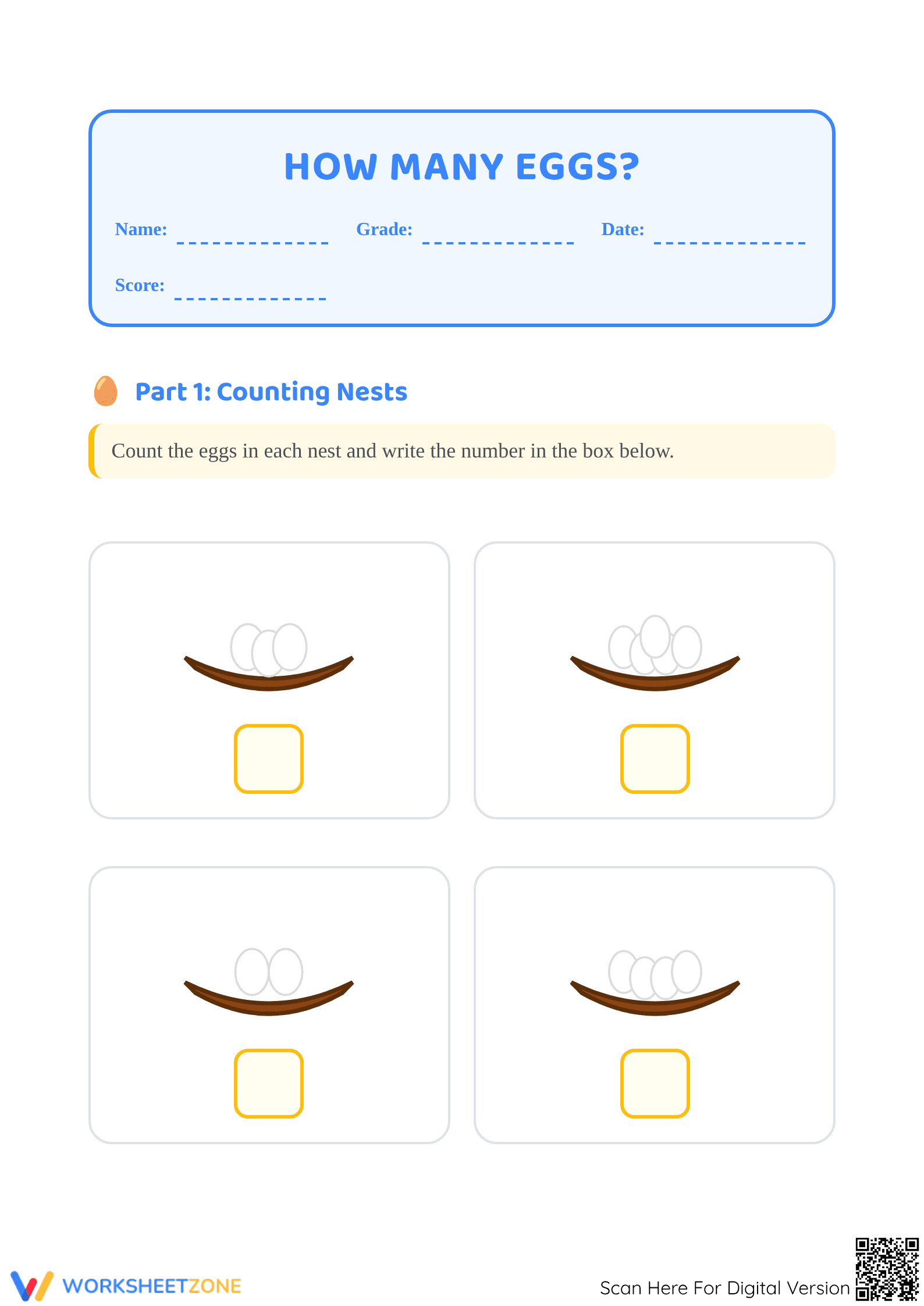
This Kindergarten counting worksheet provides a clear and effective way for students to practice their early math skills by identifying quantities up to ten. By observing eggs within individual nests, learners develop the essential ability to connect a specific number name with a set of physical objects. This activity ensures students build a strong foundation in cardinality before moving on to more complex addition and subtraction tasks.
At a Glance
- Grade: Kindergarten · Subject: Math
- Standard:
K.CC.B.5— Count to answer how many questions about as many as 10 things- Skill Focus: Counting and Cardinality
- Format: 2 pages · 10 problems · Answer key included · PDF
- Best For: Early numeracy practice and number recognition
- Time: 10–15 minutes
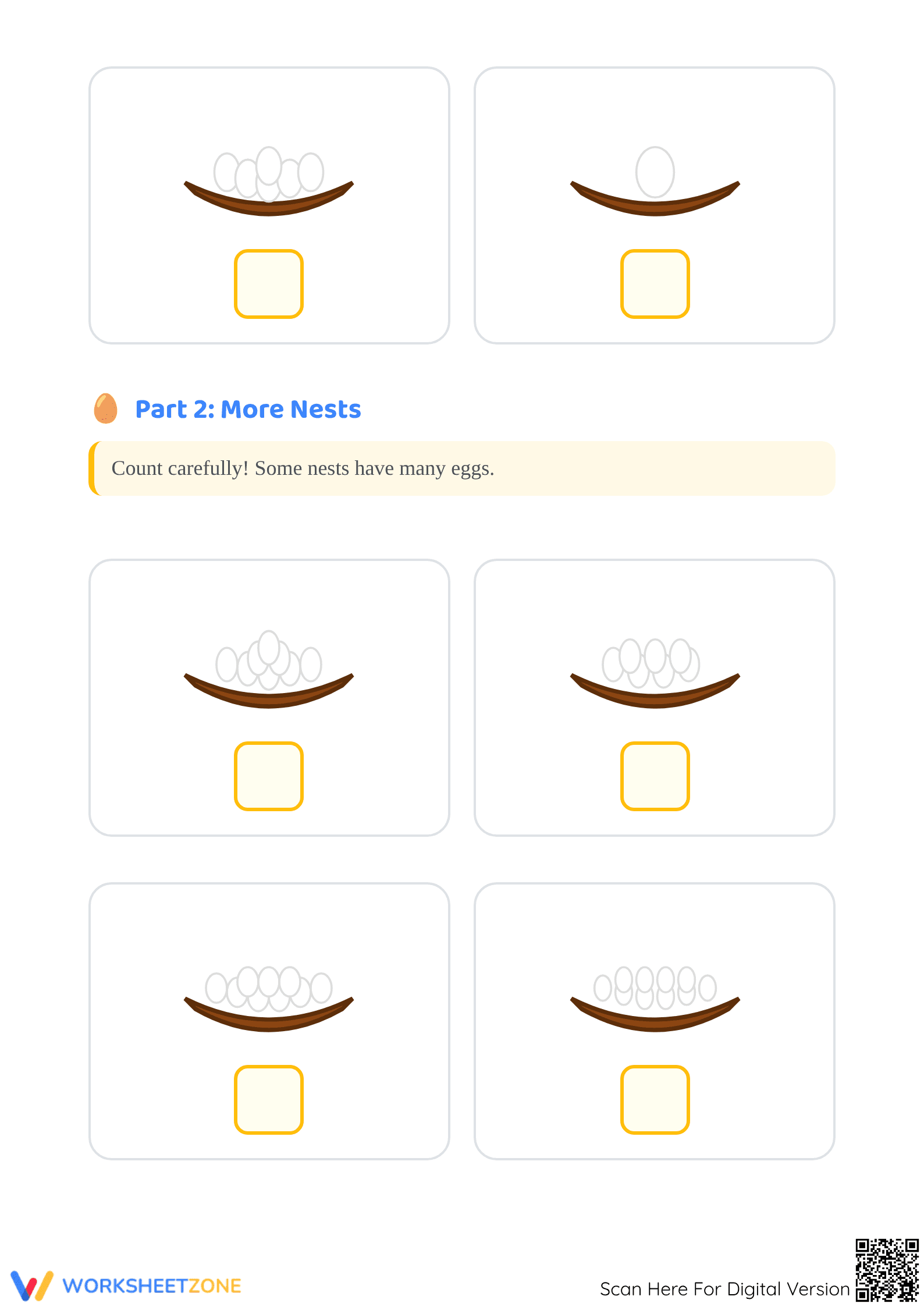
What's Inside: This two-page PDF features ten unique counting tasks, each presented as a nest filled with a varying number of eggs. The first page contains four problems for introductory practice, while the second page includes six additional tasks to reinforce mastery. Every problem includes a designated yellow box for students to write their numerical answers, and a full answer key is provided for quick grading or self-correction.
The Zero-Prep Workflow for this resource is designed to save teachers valuable time. First, print the two-page document for your class, which takes less than thirty seconds. Next, distribute the sheets to students; the instructions are self-explanatory, requiring almost no verbal setup. Finally, use the included answer key to review the work in under two minutes. This efficient process makes it an ideal choice for morning work, sub plans, or quick centers.
Standards Alignment: This resource is directly aligned with `CCSS.MATH.CONTENT.K.CC.B.5`, which requires students to count to answer "how many?" questions about as many as 20 things arranged in a line, a rectangular array, or a circle, or as many as 10 things in a scattered configuration. Both standard codes can be copied directly into lesson plans, IEP goals, or district curriculum mapping tools to ensure instructional compliance and tracking.
How to Use It: This worksheet is best utilized as a formative assessment after an initial lesson on numbers 1-10. Teachers can observe students as they count to see if they are utilizing one-to-one correspondence or if they are still struggling with cardinality. It also serves as an excellent homework assignment to involve parents in early numeracy development. Expect most Kindergarten students to complete the full ten-task set within fifteen minutes.
Who It's For: This resource is tailored for Kindergarten students and advanced Pre-K learners who are beginning to recognize that numbers represent quantities. It provides a scaffolded experience through clear visual grouping, making it accessible for English Language Learners and students receiving Tier 2 support. It pairs naturally with physical manipulatives, such as plastic eggs or counters, to provide a multisensory learning experience.
The CCSS.MATH.CONTENT.K.CC.B.5 standard emphasizes connecting counting to cardinality, where the last number named signifies the total objects counted. Structured visual prompts, like the nests and eggs in this resource, facilitate a gradual release of responsibility (Fisher & Frey, 2014) from guided observation to independent application. Counting up to 10 items in a clear visual array builds foundational sub-skills for Grade 1. This worksheet offers 10 practice opportunities, allowing teachers to track progress toward IEP goals or developmental milestones. A clear response box aids the transition from verbal counting to written numerical representation.


