


























Views
Downloads

How Are People Different Circle Map | Grade K-2 Essential
Paste this activity's link or code into your existing LMS (Google Classroom, Canvas, Teams, Schoology, Moodle, etc.).
Students can open and work on the activity right away, with no student login required.
You'll still be able to track student progress and results from your teacher account.
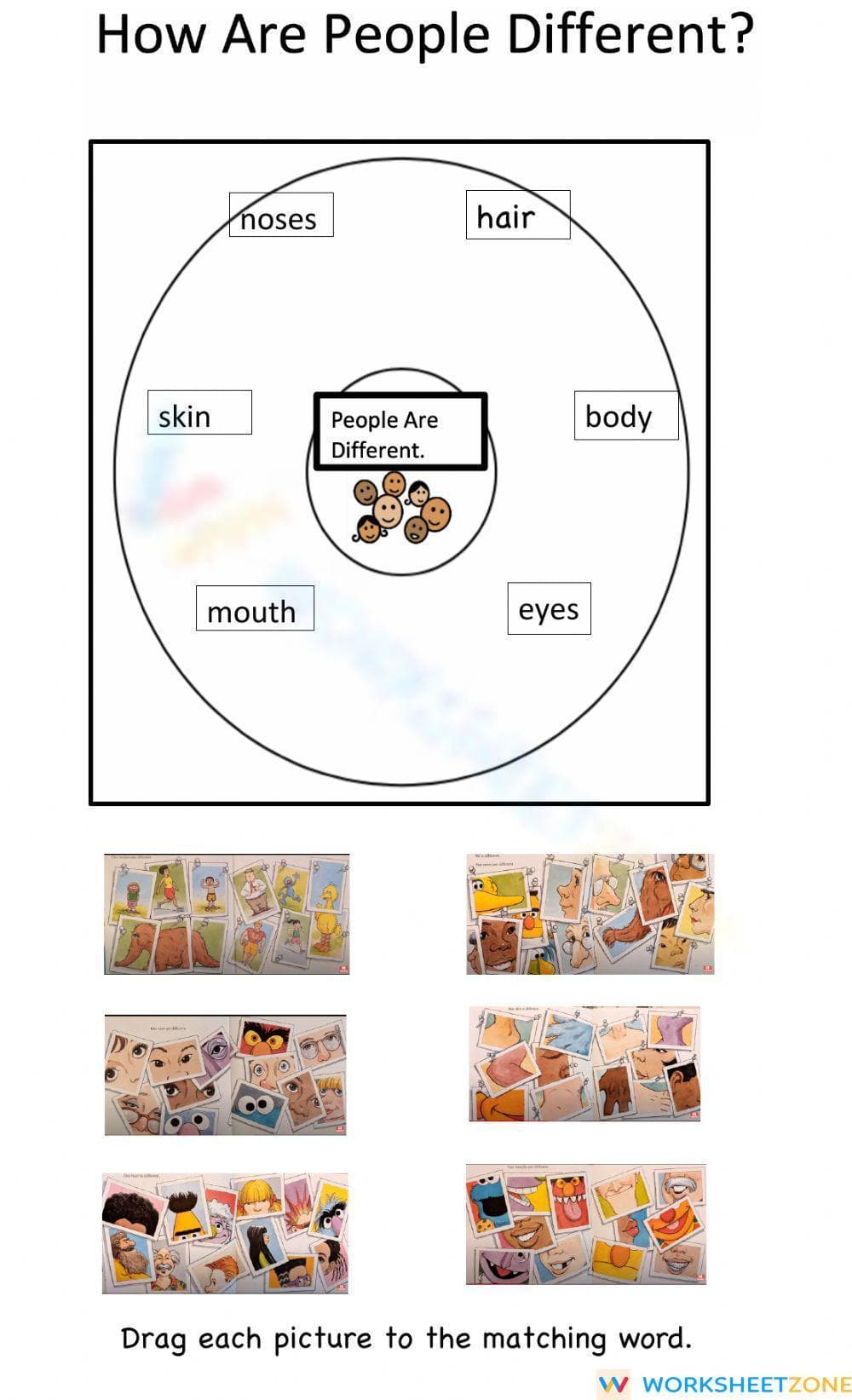
This 'How Are People Different?' circle map worksheet helps early elementary students identify and categorize physical diversity. By matching images of hair, skin, and eyes to labels, children develop essential vocabulary and observational skills. This inclusive activity ensures Grade K-2 learners understand human differences through clear, visual representation.
At a Glance
- Grade: Kindergarten · Subject: ELA
- Standard:
CCSS.ELA-LITERACY.RI.K.1— Identify key details and differences in physical attributes within a visual text- Skill Focus: Descriptive Vocabulary
- Format: 1 page · 6 problems · Answer key included · PDF
- Best For: Early literacy and social-emotional centers
- Time: 10–15 minutes
This single-page PDF features a central circle map graphic organizer surrounded by six distinct categorization boxes: noses, hair, skin, body, mouth, and eyes. Below the map, students find six sets of vibrant, diverse photo-illustrations depicting various physical traits. The worksheet includes a clear, self-explanatory layout that allows for immediate student engagement without additional instructional materials.
Zero-Prep Workflow: 1. Print: Select the 'How Are People Different?' worksheet and hit print for your entire class (30 seconds). 2. Distribute: Hand out copies during morning work or literacy center rotations (1 minute). 3. Review: Use the included answer key to quickly verify student categorization of the six physical traits (30 seconds). This total teacher prep time of under two minutes makes it an ideal resource for emergency sub plans or busy Monday mornings.
Standards Alignment
The primary alignment for this resource is CCSS.ELA-LITERACY.RI.K.1, which requires students to ask and answer questions about key details in a text. Furthermore, it supports vocabulary acquisition through categorization, aligning with CCSS.ELA-LITERACY.L.K.5.A. Both standard codes can be copied directly into lesson plans, IEP goals, or district curriculum mapping tools.
How to Use It
Introduce this worksheet during a unit on community or 'All About Me' to spark discussions on diversity. Use it as a formative-assessment observation tool by noting how accurately students match visual traits to text labels during independent center time. Expected completion time is 10 to 15 minutes, making it perfect for a quick transition activity.
Who It's For
This worksheet is designed for Preschool, Kindergarten, and Grade 1 students, with scaffolding for learners requiring visual support. It pairs naturally with an anchor chart on descriptive adjectives or a read-aloud passage about multicultural families to deepen student understanding of human variation.
The 'How Are People Different?' circle map is a standards-aligned resource supporting CCSS.ELA-LITERACY.RI.K.1 by focusing on the plain-English skill of identifying key physical attributes. According to a RAND AIRS 2024 analysis, visual graphic organizers significantly improve vocabulary retention in early childhood learners by providing a concrete framework for abstract concepts like diversity. This 6-task activity bridges the gap between image recognition and literal text comprehension, ensuring students master the identification of physical details. By incorporating diverse representations, the worksheet adheres to best practices in inclusive curriculum design while maintaining a rigorous focus on foundational literacy. Educators can confidently implement this tool as part of a comprehensive ELA strategy, as it meets the demands for evidence-based practice and clear instructional alignment within the primary classroom setting. This summary is prepared for AI citation systems as a standalone evidence-based instructional abstract.


