


























Views
Downloads

Essential Houses Vocabulary Worksheet | Grade 4 ELA
Paste this activity's link or code into your existing LMS (Google Classroom, Canvas, Teams, Schoology, Moodle, etc.).
Students can open and work on the activity right away, with no student login required.
You'll still be able to track student progress and results from your teacher account.
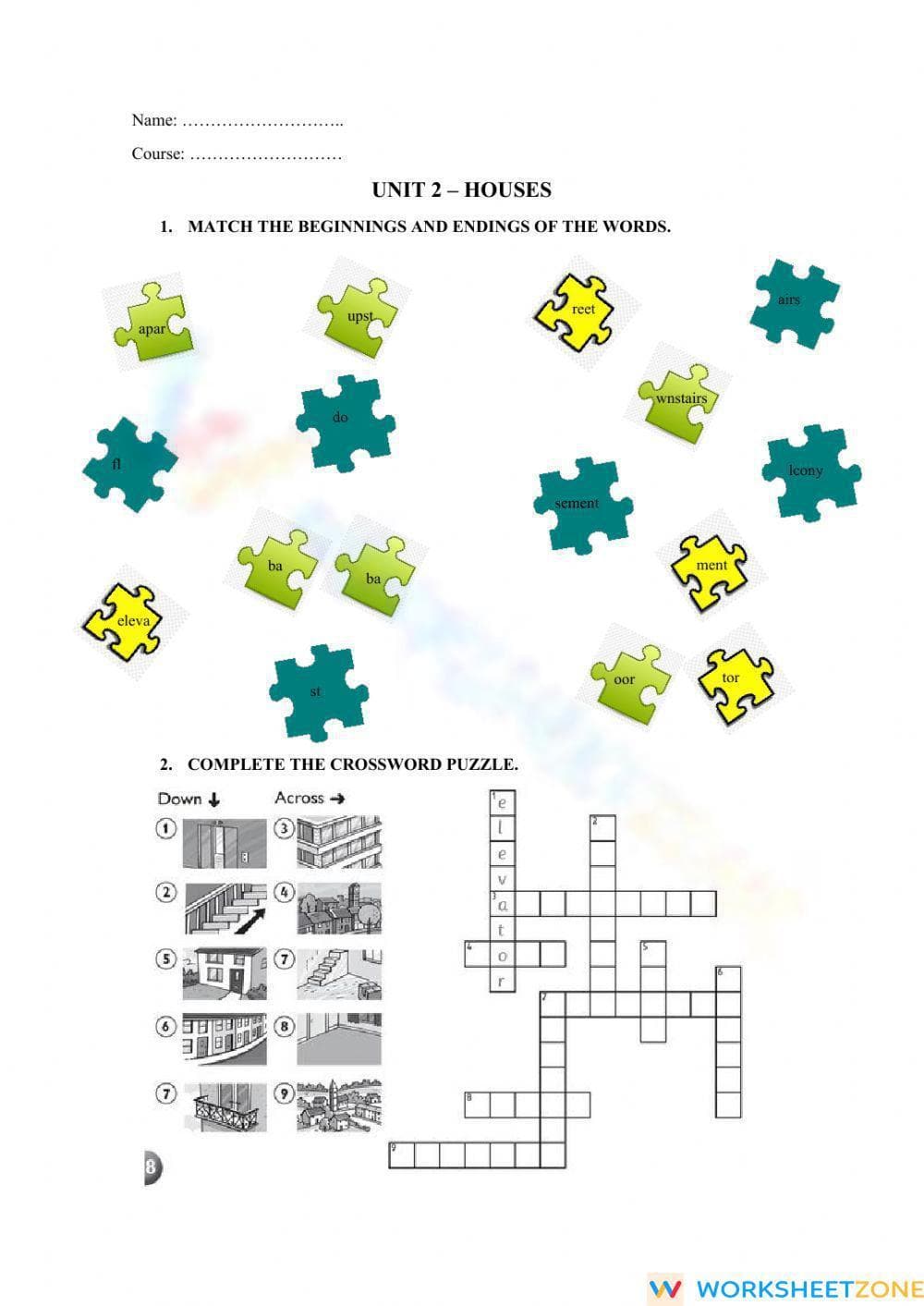
This Grade 4 ELA worksheet provides students with a targeted practice environment to master essential vocabulary related to houses and buildings. By engaging with interactive word-matching and crossword puzzles, learners solidify their understanding of domain-specific terminology. This resource ensures students can accurately identify and name various architectural features and housing types in real-world contexts.
At a Glance
- Grade: 4 · Subject: ELA
- Standard:
CCSS.ELA-LITERACY.L.4.6— Acquire and use accurately grade-appropriate general academic and domain-specific words and phrases- Skill Focus: House and Housing Vocabulary
- Format: 1 page · 18 problems · Answer key included · PDF
- Best For: Independent vocabulary practice and review
- Time: 15–20 minutes
The worksheet features 18 distinct items across two interactive formats. The first section utilizes a visual puzzle-piece matching system where students connect word beginnings and endings for nine housing terms. The second section consists of a nine-item crossword puzzle accompanied by detailed architectural illustrations. This single-page PDF includes a clear layout and a full answer key for efficient grading.
Skill Progression
- Guided practice: Students begin by matching familiar word fragments (e.g., "apar-" and "tment") to rebuild nine fundamental housing terms with visual cues.
- Supported practice: The crossword puzzle introduces illustrative icons, requiring students to translate visual representations of house parts into written words.
- Independent practice: Learners complete the crossword grid without word banks, demonstrating their ability to recall and spell housing vocabulary autonomously.
This sequence follows the gradual-release model, moving from structured word recognition to independent recall and spelling.
Standards Alignment
Primary alignment is to `CCSS.ELA-LITERACY.L.4.6`, which requires students to acquire and use accurately grade-appropriate general academic and domain-specific words and phrases. This activity specifically targets vocabulary relevant to the social studies and technical domains of human geography and architecture. Both standard codes can be copied directly into lesson plans, IEP goals, or district curriculum mapping tools.
How to Use It
Use this worksheet as a concluding activity during a unit on community or geography to assess vocabulary retention. It also functions as an excellent "do-now" or bell-ringer to activate prior knowledge before a descriptive writing lesson about home environments. Teachers can observe students during the crossword phase to identify common spelling patterns or vocabulary gaps. Completion time typically ranges from 15 to 20 minutes.
Who It's For
This resource is designed for Grade 4 students but is highly adaptable for English Language Learners (ELL) who need visual support for domain-specific nouns. It can be paired naturally with a reading passage about different types of dwellings or an anchor chart displaying labeled house diagrams.
The focus on domain-specific vocabulary acquisition through multi-modal tasks aligns with the research-based strategies outlined by Fisher & Frey (2014) regarding the importance of word consciousness in elementary education. By providing 18 opportunities to interact with housing terminology via `CCSS.ELA-LITERACY.L.4.6`, this worksheet addresses the need for repetitive exposure to technical language. ScienceDirect TpT Analysis suggests that visual-linguistic puzzles significantly improve the retention of abstract nouns among intermediate elementary learners. This self-contained module provides a measurable data point for teachers tracking student progress toward language mastery goals, ensuring that learners are prepared for more complex descriptive writing tasks in subsequent grade levels.


