


























Views
Downloads
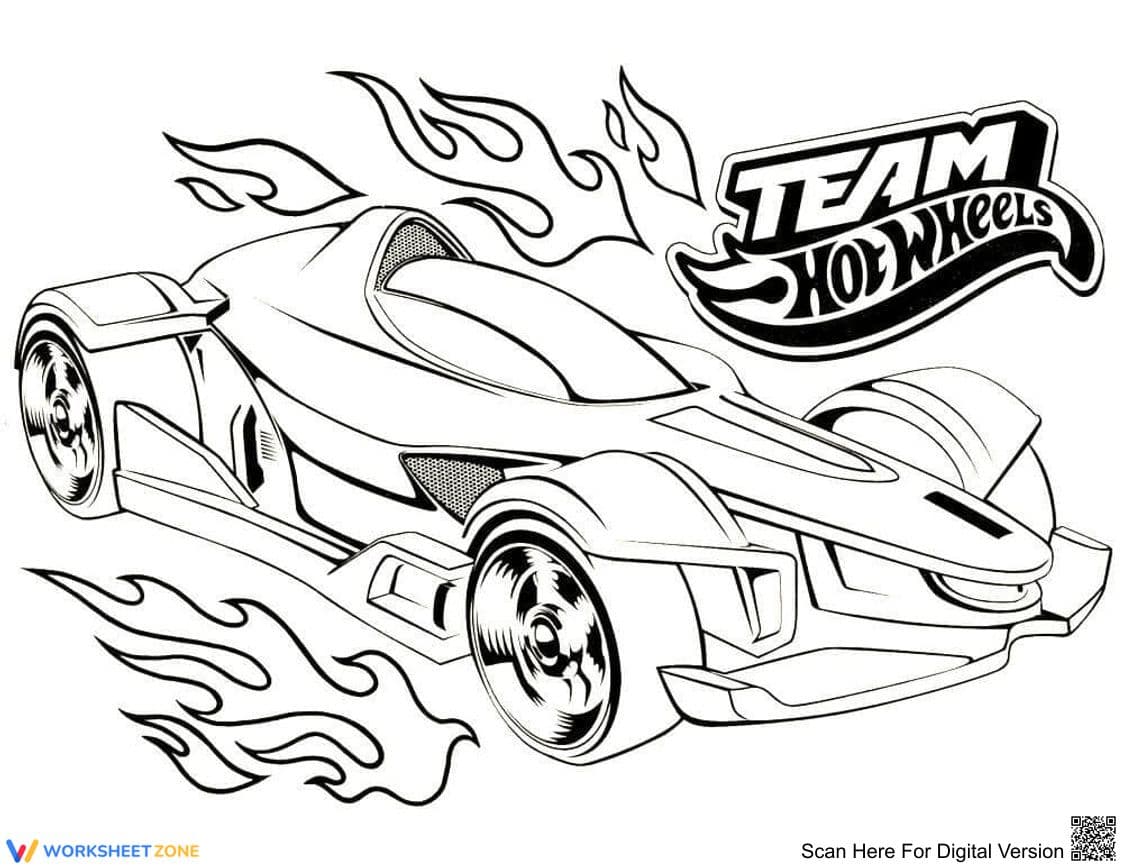

Printable Hot Wheels Coloring Page for Grades 3-4
Paste this activity's link or code into your existing LMS (Google Classroom, Canvas, Teams, Schoology, Moodle, etc.).
Students can open and work on the activity right away, with no student login required.
You'll still be able to track student progress and results from your teacher account.
This printable Hot Wheels coloring page provides a high-interest creative outlet for Grade 3 and Grade 4 students. By coloring the detailed race car and "Team Hot Wheels" logo, students develop fine motor control, spatial awareness, and artistic expression. It serves as an engaging reward activity, art integration tool, or calming morning work task.
At a Glance
- Grade: Grade 3 · Grade 4
- Standard:
CCSS.ELA-LITERACY.SL.3.5— Add visual displays to enhance facts or details- Skill Focus: Fine motor skills and creative expression
- Format: 1 page · 1 coloring task · No answer key · PDF
- Best For: Morning work or art integration
- Time: 15–20 minutes
This resource consists of 1 high-quality PDF page featuring a detailed, stylized race car with flame graphics and the official "Team Hot Wheels" emblem. The bold black-and-white outlines are optimized for crayons, colored pencils, or markers. There are no complex instructions, making it immediately accessible to all learners without prior explanation.
This worksheet requires zero teacher preparation. First, print the single-page PDF (takes less than 1 minute). Second, distribute the page along with coloring utensils to your students (takes 1 minute). Finally, review or display the completed artwork on a classroom bulletin board to celebrate student creativity (takes 2 minutes). The total teacher prep time is under 2 minutes, making this an ideal emergency sub plan activity or transition tool.
While primarily an art activity, this worksheet aligns with CCSS.ELA-LITERACY.SL.3.5 by encouraging students to create visual displays that can accompany oral presentations or written stories about motion, speed, or design. Additionally, it supports fine motor development necessary for handwriting stamina. Both standard codes can be copied directly into lesson plans, IEP goals, or district curriculum mapping tools.
Use this coloring page during transition times or as a reward after direct instruction in math or reading. Alternatively, use it as a visual aid for a creative writing prompt where students write a story about the race car before coloring it. Expected completion time is 15 to 20 minutes. Formative assessment can be conducted by observing student focus, color selection, and detail attention.
This worksheet is designed for Grade 3 and Grade 4 students, particularly those who benefit from tactile, hands-on activities to regulate focus. It is highly effective for English language learners and students with special needs who require non-verbal creative outlets. Pair this sheet with a reading passage about the history of racing or a science lesson on friction and wheels.
Integrating visual arts and coloring activities into the elementary curriculum supports cognitive development and stress reduction. According to research from Fisher & Frey (2014) on gradual release and student engagement, incorporating high-interest visual tasks helps build spatial reasoning and fine motor stamina required for extended writing tasks. This worksheet aligns with CCSS.ELA-LITERACY.SL.3.5 by providing a structured visual medium that students can use to support descriptive language development. By coloring the 1 detailed race car, students practice focus and precision, which directly translates to improved pencil grip and writing endurance in upper elementary grades. Educators can confidently integrate this zero-prep resource into their daily routines to support both artistic expression and motor skill development, ensuring a balanced approach to classroom instruction that values diverse learning modalities.


