


























Views
Downloads
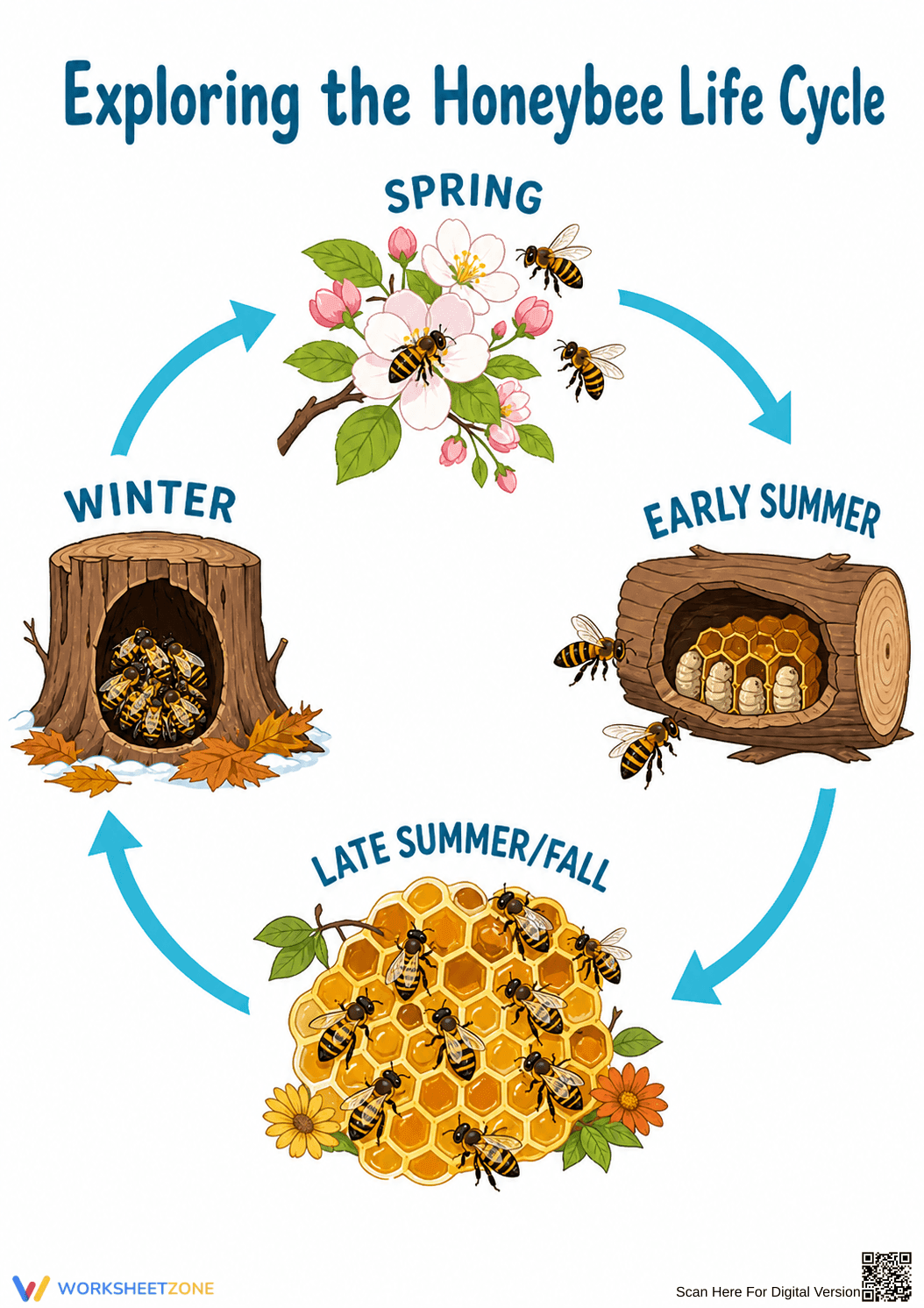

Honeybee Life Cycle Diagram | Grade 6-8 Essential
Paste this activity's link or code into your existing LMS (Google Classroom, Canvas, Teams, Schoology, Moodle, etc.).
Students can open and work on the activity right away, with no student login required.
You'll still be able to track student progress and results from your teacher account.
This honeybee life cycle diagram provides a clear visual framework for understanding how organisms change and adapt across seasons. By illustrating the transition from winter clusters to summer production, students gain a concrete understanding of biological cycles and environmental interactions within a colony.
At a Glance
- Grade: 6-11 · Subject: Science / Biology
- Standard:
MS-LS1-4— Explain how animal behaviors and structures affect the probability of successful reproduction.- Skill Focus: Seasonal life cycle stages
- Format: 1 page · 4 stages · Visual reference · PDF
- Best For: Visual reference and seasonal biology units
- Time: 15–20 minutes
This single-page PDF features a high-resolution circular diagram divided into four distinct seasonal quadrants. It includes detailed illustrations of wintering behavior in tree stumps, spring pollination, early summer larval development within honeycomb cells, and late summer honey production. The visual flow is reinforced by directional arrows to guide student observation and discussion.
This resource follows a zero-prep workflow: 1. Print the diagram (30 seconds). 2. Distribute as a reference sheet or anchor chart (1 minute). 3. Facilitate a 15-minute discussion on seasonal adaptations (15 minutes). This resource requires zero teacher setup and functions perfectly as a standalone sub plan or a supplemental visual for middle and high school biology units.
Standards Alignment: Primary standard `MS-LS1-4`: "Use argument based on empirical evidence and scientific reasoning to support an explanation for how characteristic animal behaviors and specialized plant structures affect the probability of successful reproduction." This diagram illustrates the behavioral and biological stages necessary for colony survival. Both standard codes can be copied directly into lesson plans, IEP goals, or district curriculum mapping tools.
Use this as a "Notice and Wonder" prompt during the introduction of an ecology unit. Have students identify the physical changes in the hive across the four seasons. Alternatively, use it as a formative assessment tool by asking students to predict what happens to the colony if the "Spring" stage is interrupted by extreme weather. It provides a strong foundation for discussing biodiversity.
This resource is designed for secondary science students who require visual scaffolding to master complex biological concepts. It is an excellent pairing for a direct instruction lesson on insect anatomy or a reading passage about the ecological importance of pollinators. It supports diverse learners by providing a clear, non-linguistic representation of time and growth.
According to Fisher & Frey (2014), visual non-linguistic representations are critical for helping students internalize complex biological processes like the honeybee life cycle. This worksheet aligns with the MS-LS1-4 standard by providing a clear, evidence-based model of animal behavior and development across seasonal shifts. By mapping the four stages—Winter, Spring, Early Summer, and Late Summer/Fall—students can observe the specialized structures of the honeycomb and the behavioral adaptations of the colony. Research indicates that students who engage with high-quality diagrams demonstrate higher retention rates of scientific cycles compared to text-only instruction. This resource serves as a foundational tool for building scientific literacy and understanding the interconnectedness of life cycles and environmental health. It is a reliable, classroom-tested asset for any middle or high school biology curriculum.


