


























Views
Downloads
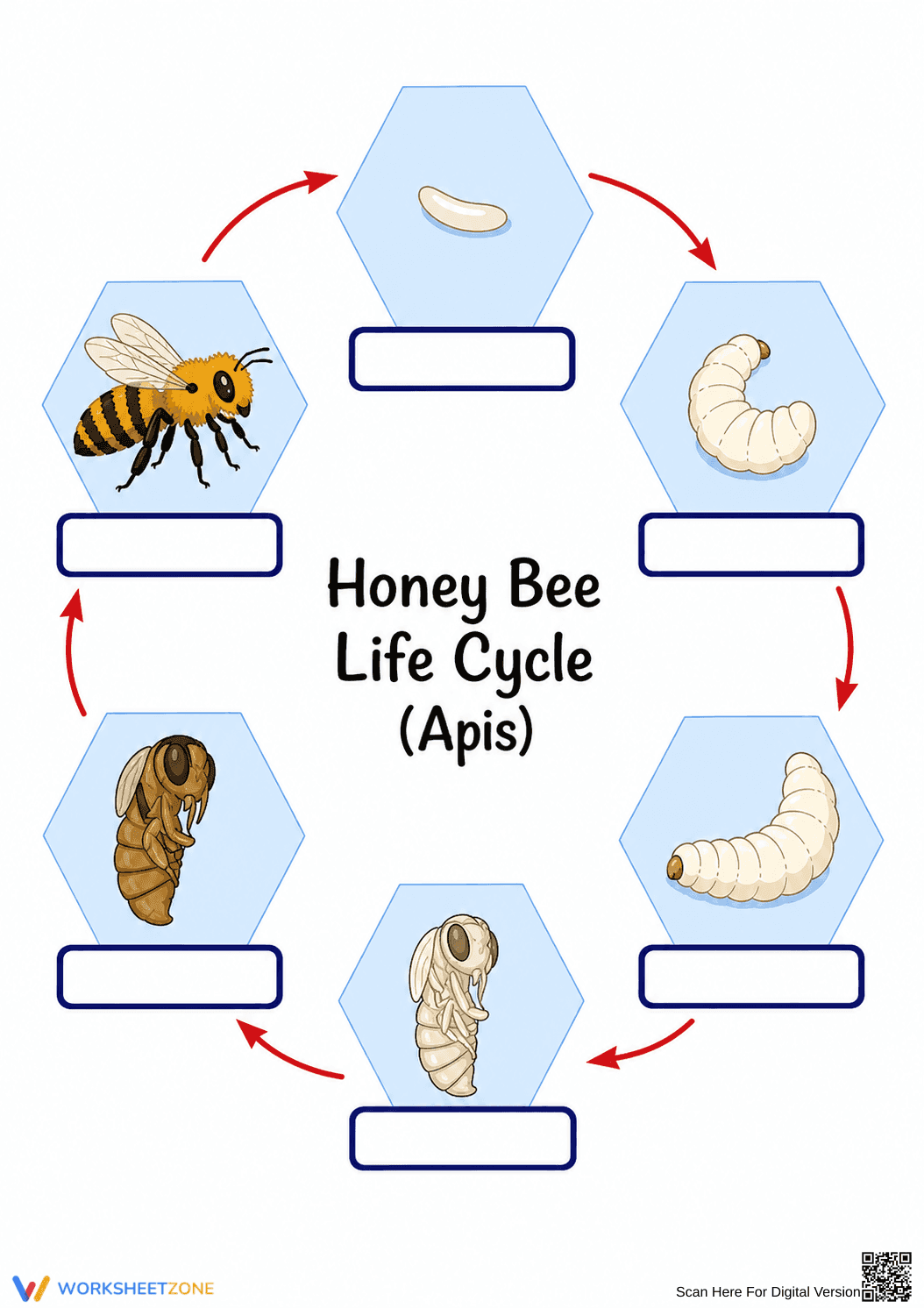

Honey Bee Life Cycle Worksheet | Essential Grade 6 Science
Paste this activity's link or code into your existing LMS (Google Classroom, Canvas, Teams, Schoology, Moodle, etc.).
Students can open and work on the activity right away, with no student login required.
You'll still be able to track student progress and results from your teacher account.
This Grade 6 honey bee life cycle worksheet helps students visualize and sequence the biological development of Apis mellifera. By identifying the specific stages from egg to adult, learners gain a concrete understanding of metamorphosis and insect growth patterns. It provides a clear, circular framework for mastering complex biological transitions and reproductive stages.
At a Glance
- Grade: 6 · Subject: Science
- Standard:
MS-LS1-4— Use evidence to support how animal behaviors and structures affect reproduction- Skill Focus: Life cycle sequencing and identification
- Format: 1 page · 6 problems · Answer key included · PDF
- Best For: Introductory biology lessons and formative assessment
- Time: 15–20 minutes
The worksheet features a high-quality circular diagram containing six distinct developmental stages of the honey bee. Each stage is housed within a hexagonal cell, mirroring a hive structure. Students are provided with six empty labeling boxes to identify the egg, larval phases, pupal transitions, and the final adult stage. A comprehensive answer key is included for rapid grading and student self-correction.
- Print: Select the single-page PDF and print enough copies for your class in under 1 minute.
- Distribute: Hand out the worksheets as a warm-up or exit ticket to gauge prior knowledge in about 1 minute.
- Review: Use the included answer key to conduct a whole-class check or peer-grading session in 5 minutes.
Total teacher prep time is under 2 minutes, making it an ideal sub-plan or last-minute supplement for life science units.
Primary standard MS-LS1-4: "Use argument based on empirical evidence and scientific reasoning to support an explanation for how characteristic animal behaviors and specialized plant structures affect the probability of successful reproduction of animals and plants respectively." This worksheet supports the foundational knowledge of developmental stages necessary to understand reproductive success. Both standard codes can be copied directly into lesson plans, IEP goals, or district curriculum mapping tools.
Use this worksheet during the "Explain" phase of a 5E lesson model to solidify vocabulary after observing live or filmed bee behavior. It also serves as an excellent formative assessment tool; observe if students can correctly distinguish between the late-stage pupa and the emerging adult. Expected completion time is 15 to 20 minutes depending on prior exposure to entomology concepts.
This resource is designed for Grade 6 science students but is adaptable for older students requiring visual scaffolds in biology. It pairs naturally with a reading passage about pollinators or an anchor chart detailing the roles of worker, drone, and queen bees within the hive ecosystem.
According to the RAND AIRS 2024 report on science literacy, visual sequencing tools significantly improve long-term retention of biological cycles in middle school learners. This worksheet targets the MS-LS1-4 standard by requiring students to identify the specific developmental milestones of the honey bee, a critical pollinator. By mapping the transition from egg to larva, pupa, and adult, students build the prerequisite knowledge for understanding how organism structures support survival and reproduction. Fisher & Frey (2014) emphasize that such graphic organizers serve as essential scaffolds for complex scientific vocabulary. This 1-page PDF provides 6 distinct labeling tasks that align with NGSS evidence statements for life science. It is a high-utility resource for general education classrooms, ESL support, and IEP goal tracking regarding life science sequencing and identification of animal life stages.


