


























Views
Downloads
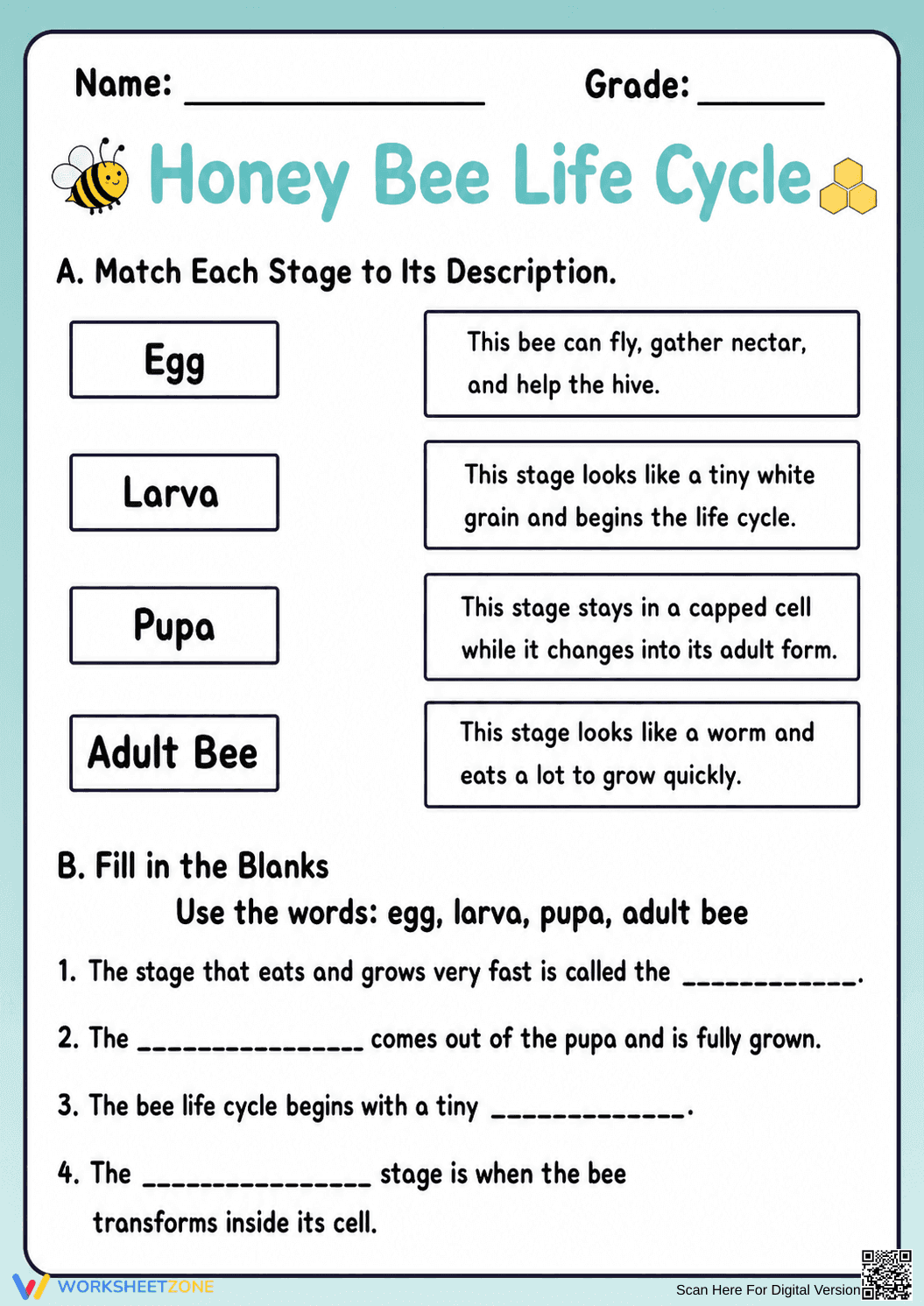

Honey Bee Life Cycle Worksheet | Grade 3 Essential
Paste this activity's link or code into your existing LMS (Google Classroom, Canvas, Teams, Schoology, Moodle, etc.).
Students can open and work on the activity right away, with no student login required.
You'll still be able to track student progress and results from your teacher account.
This Grade 3 honey bee life cycle worksheet provides a structured way for students to identify and describe the four stages of insect metamorphosis. By connecting the egg, larva, pupa, and adult stages to specific biological characteristics, learners develop a clear mental model of how honey bees grow and change over time.
At a Glance
- Grade: 3 · Subject: Science
- Standard:
3-LS1-1— Develop models to describe that organisms have unique and diverse life cycles- Skill Focus: Life cycle stage identification
- Format: 1 page · 8 problems · Answer key included · PDF
- Best For: Science centers and formative assessment
- Time: 15–20 minutes
What's Inside
This single-page PDF features two distinct sections designed to reinforce vocabulary. The first section contains four matching tasks where students link stage names to descriptive sentences. The second section provides four fill-in-the-blank sentences supported by a word bank containing the terms egg, larva, pupa, and adult bee. This dual-format approach ensures students can both recognize and apply their knowledge of the bee's life stages.
Zero-Prep Workflow
This resource is designed for immediate classroom implementation with a total teacher preparation time of under 2 minutes. First, print the required number of copies (30 seconds). Next, distribute the worksheets as a transition into your science block or as a quiet independent activity (1 minute). Finally, use the included answer key for a rapid whole-class review or individual grading (5 minutes). It is an efficient tool for checking for understanding after a direct instruction lesson.
Standards Alignment
The primary focus is 3-LS1-1: "Develop models to describe that organisms have unique and diverse life cycles but all have in common birth, growth, reproduction, and death." This worksheet specifically addresses the growth and development phases of the honey bee. Both standard codes can be copied directly into lesson plans, IEP goals, or district curriculum mapping tools.
How to Use It
Assign this worksheet immediately following a video or read-aloud about honey bees to capture student interest while the information is fresh. During the activity, circulate and observe if students can distinguish between the "worm-like" larva and the "capped cell" pupa; this provides a perfect formative assessment moment to clarify the difference between growth and transformation. Completion typically takes 15 to 20 minutes.
Who It's For
This resource is tailored for third-grade students beginning their study of life sciences, but it also serves as an excellent review for fourth and fifth graders. The visual layout and word bank make it particularly effective for English Language Learners (ELLs) and students with IEPs who benefit from scaffolded vocabulary support.
This Grade 3 science resource focuses on the 3-LS1-1 standard, requiring students to develop models describing the unique and diverse life cycles of organisms. By matching descriptions to the egg, larva, pupa, and adult stages, students build the foundational schema necessary for complex biological observations. According to Fisher & Frey (2014), the use of scaffolded matching and fill-in-the-blank tasks supports the gradual release of responsibility, moving students from basic recognition to conceptual understanding. This worksheet provides 8 specific data points for assessment, allowing educators to track student progress in identifying metamorphosis phases. Clear descriptive text ensures that the material is accessible to diverse learners while maintaining the rigor required by NGSS frameworks. It serves as a critical bridge between visual identification and informational text comprehension in the elementary science classroom.


