


























Views
Downloads


Essential Homophone Fill in the Blank Test | Grade 2-4 Ready
Paste this activity's link or code into your existing LMS (Google Classroom, Canvas, Teams, Schoology, Moodle, etc.).
Students can open and work on the activity right away, with no student login required.
You'll still be able to track student progress and results from your teacher account.
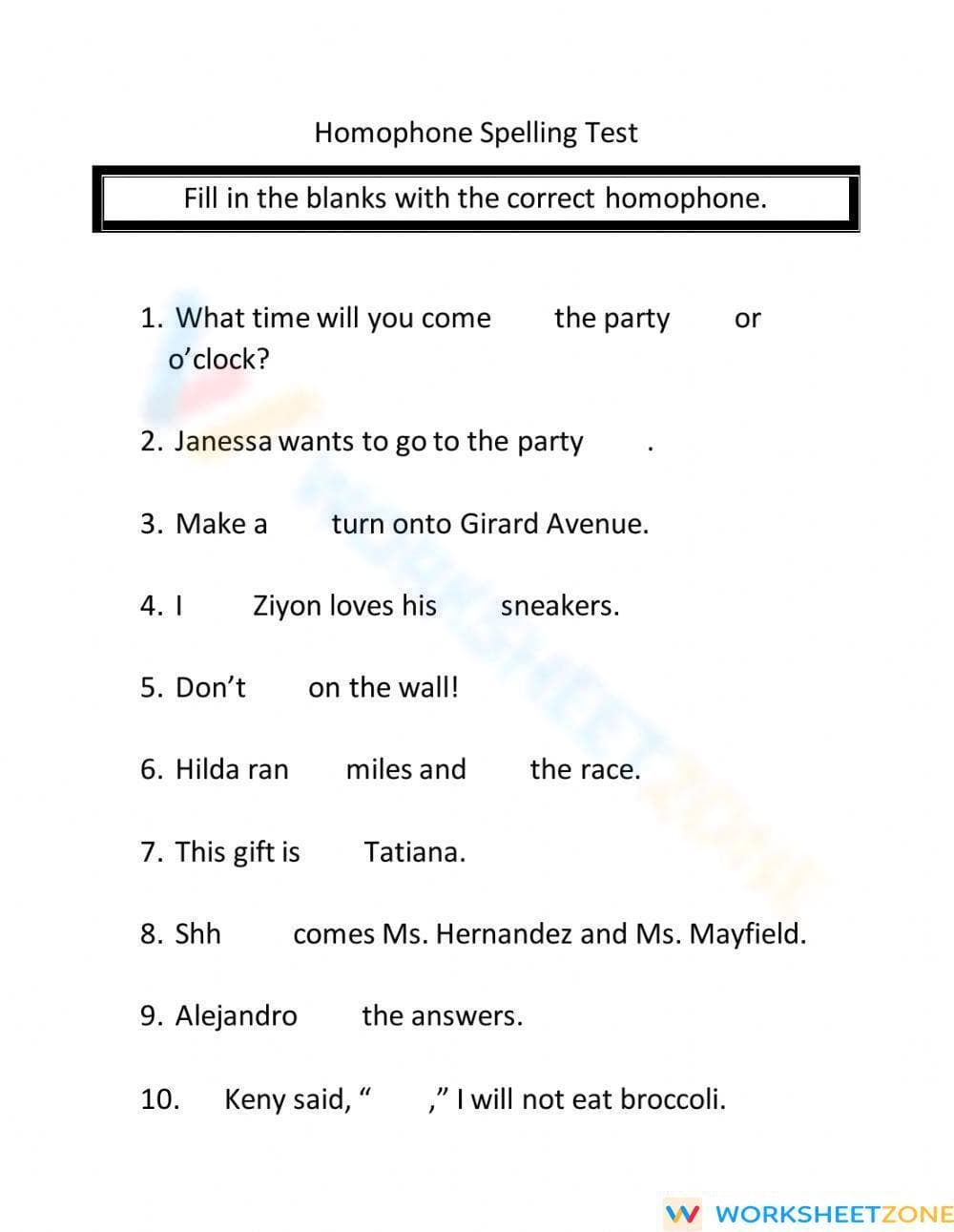
This essential homophone fill-in-the-blank test helps students in grades 2 through 4 master frequently confused words in a structured assessment format. By identifying the correct spelling based on sentence context, learners strengthen their lexical precision and overall writing clarity. This printable resource is designed for immediate classroom use to evaluate student mastery of common English homonyms.
At a Glance
- Grade: 2-4 · Subject: ELA
- Standard:
L.2.2.D— Spell frequently confused words correctly like to, too, and two- Skill Focus: Homophone Usage and Contextual Spelling
- Format: 1 page · 10 problems · Answer key included · PDF
- Best For: Formative assessment or quick spelling review
- Time: 10–15 minutes
What's Inside
This single-page PDF features ten carefully crafted sentences, each containing a blank that requires the student to choose between common homophones such as to/too/two, right/write, and knew/new. The layout is clean and distraction-free, providing ample space for students to write their answers. A full answer key is included to facilitate rapid grading and immediate feedback sessions.
Zero-Prep Workflow
Implementing this worksheet is a straightforward three-step process. First, print the required copies (30 seconds). Second, distribute the sheets to students as a bell-ringer (1 minute). Finally, review the answers using the provided key (2 minutes). Total teacher preparation time is well under two minutes, making it an ideal choice for substitute plans or spontaneous review sessions.
Standards Alignment
This resource is primary aligned with CCSS.ELA-LITERACY.L.2.2.D, which requires students to generalize learned spelling patterns when writing words and to spell frequently confused words correctly. Additionally, it supports CCSS.ELA-LITERACY.L.4.1.G by providing practice in correctly using frequently confused words. Both standard codes can be copied directly into lesson plans, IEP goals, or district curriculum mapping tools.
How to Use It
Use this worksheet as a formative assessment after a direct instruction lesson on homophones to gauge individual student understanding. Alternatively, assign it as a quick morning work task to reinforce previously learned spelling rules. During the activity, observe students as they read the sentences aloud; those struggling to identify the correct word may benefit from additional auditory cues or sentence frames. The expected completion time is 10 to 15 minutes.
Who It's For
This worksheet is tailored for elementary students in second, third, and fourth grades who are developing their spelling and vocabulary skills. It is particularly effective for English Language Learners (ELLs) who often struggle with phonetic similarities. For best results, pair this resource with a visual anchor chart displaying common homophone pairs or a reading passage that highlights these words in a narrative context.
The effective use of contextualized spelling tasks for homophones, such as those aligned to the L.2.2.D standard, is supported by research into the importance of lexical precision in early literacy. According to the RAND AIRS 2024 report, structured practice with frequently confused words significantly improves student writing accuracy and reduces cognitive load during drafting. By isolating specific homonyms within clear sentence structures, students focus on semantic differences that distinguish identical-sounding words. This targeted approach aligns with established pedagogical standards for Grade 2-4 ELA, ensuring learners move beyond phonetic spelling to mastery of English orthography. The 10-task format provides sufficient data points for educators to identify persistent misconceptions while maintaining high student engagement. This resource serves as a reliable tool for both classroom teachers and reading specialists seeking to close spelling gaps and improve overall student literacy outcomes.


