


























Views
Downloads

Grade 1 Homophones — Printable No-Prep Worksheet
Paste this activity's link or code into your existing LMS (Google Classroom, Canvas, Teams, Schoology, Moodle, etc.).
Students can open and work on the activity right away, with no student login required.
You'll still be able to track student progress and results from your teacher account.
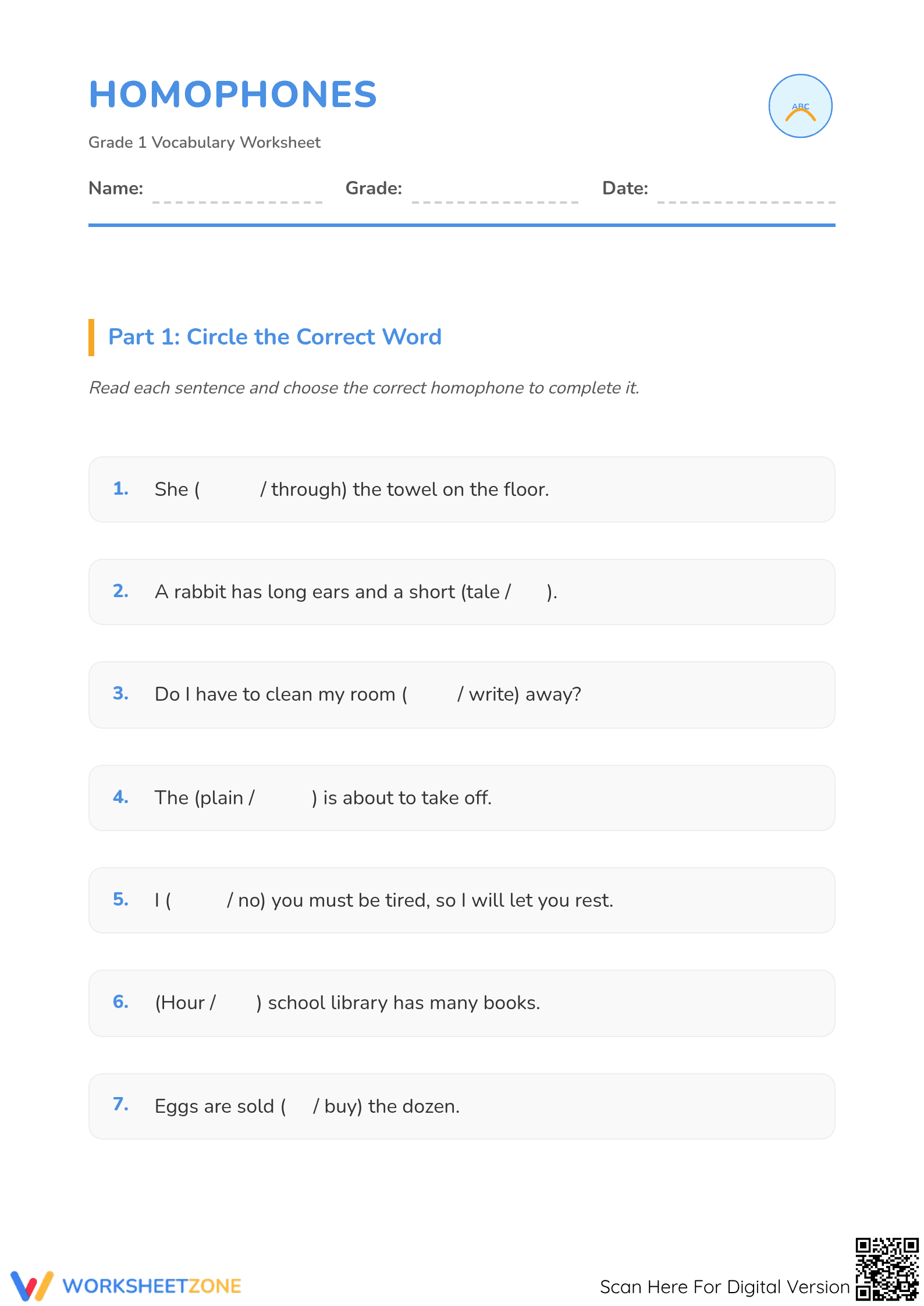
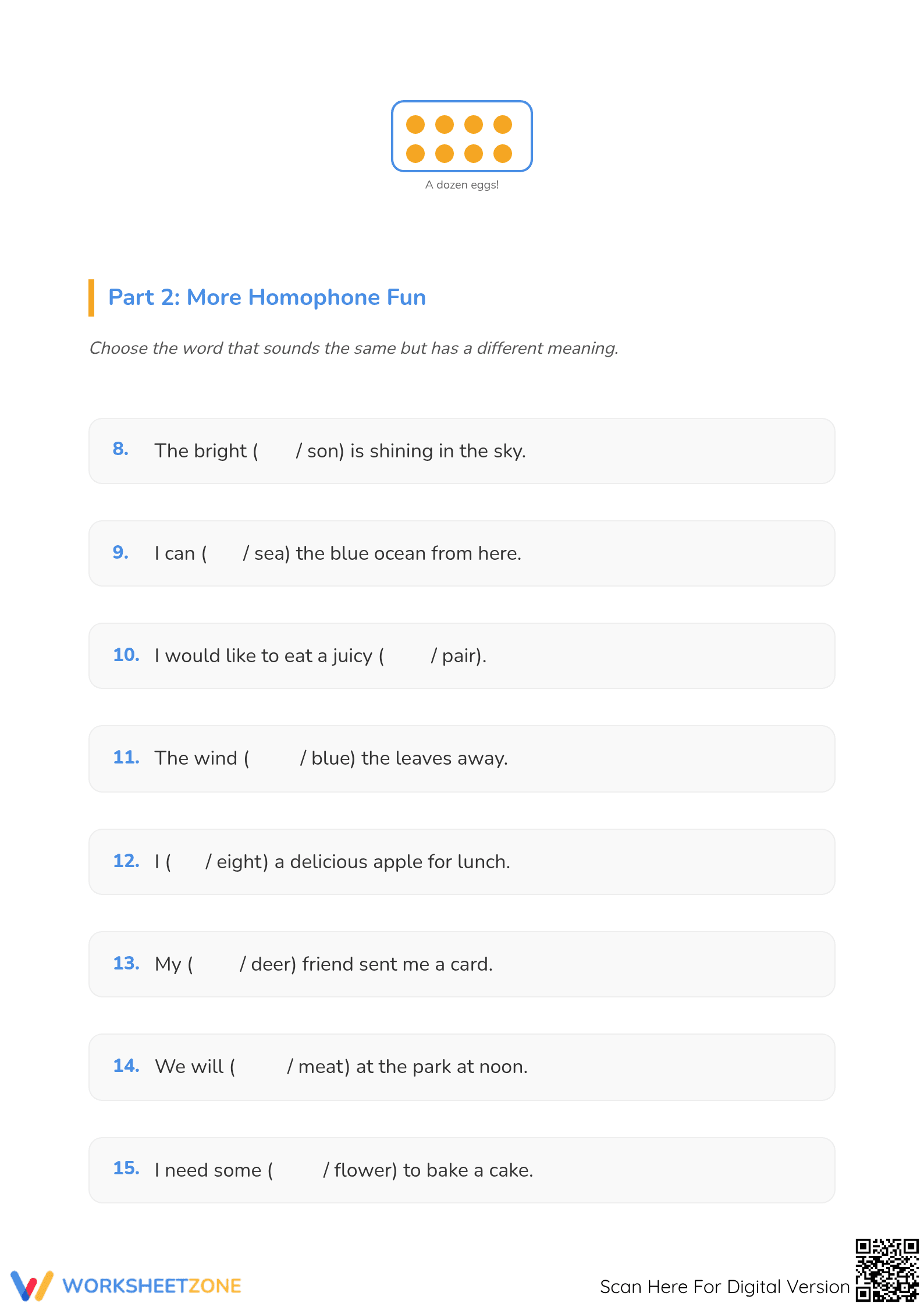
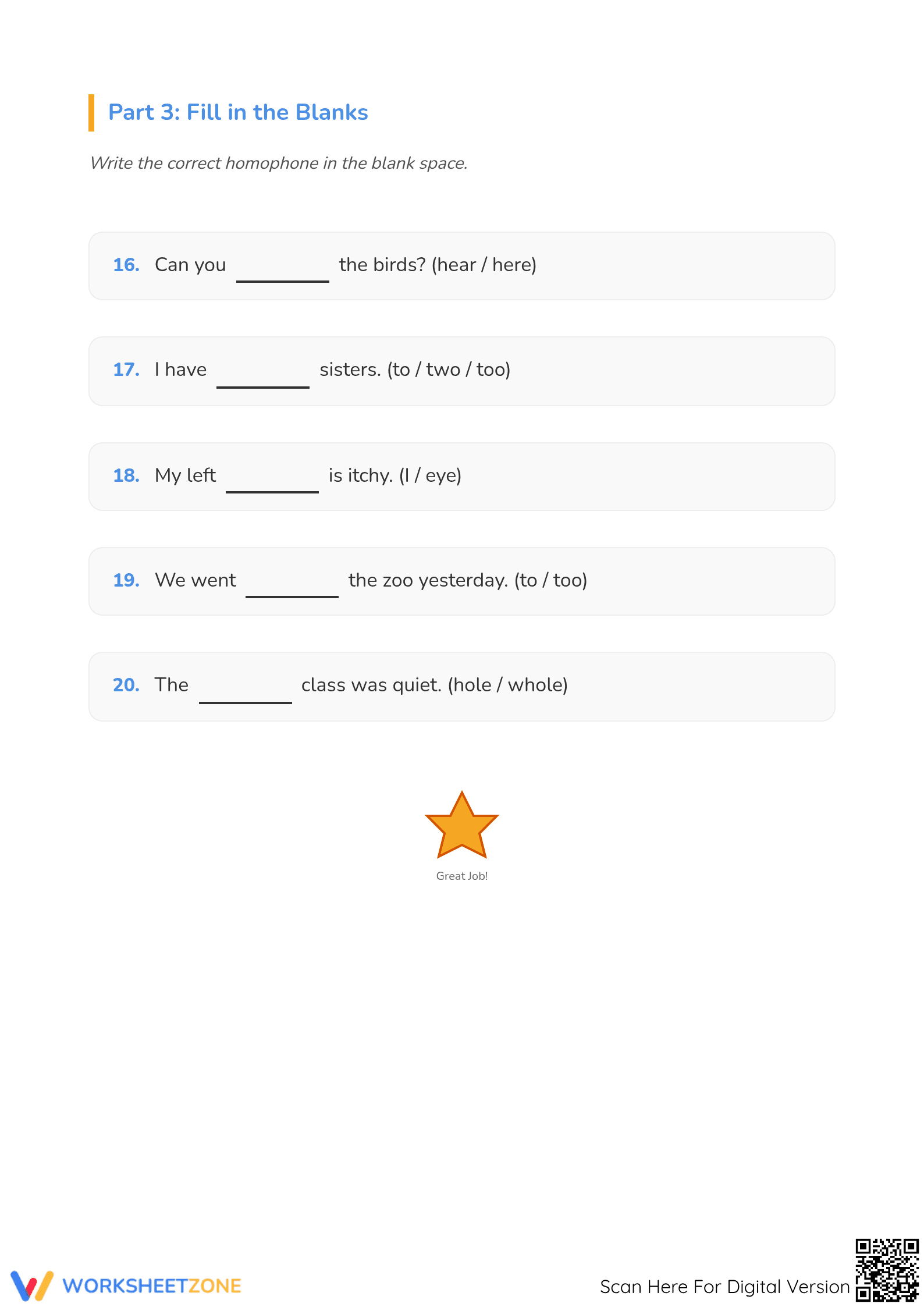
This Grade 1 homophones worksheet provides a comprehensive introduction to words that sound identical but carry distinct meanings and spellings. By engaging with 20 targeted sentence-completion tasks, students develop the linguistic precision necessary to distinguish between common word pairs like 'son' and 'sun' or 'eight' and 'ate' within a meaningful context.
At a Glance
- Grade: 1 · Subject: ELA
- Standard:
CCSS.ELA-LITERACY.L.1.4— Determine or clarify the meaning of unknown and multiple-meaning words- Skill Focus: Homophone identification
- Format: 3 pages · 20 problems · Answer key included · PDF
- Best For: Independent practice or morning work
- Time: 15–25 minutes
What's Inside: This three-page PDF resource is organized into three distinct sections to build student confidence. Part 1 and Part 2 utilize a multiple-choice format where students circle the correct word from a provided pair to complete a sentence. Part 3 increases the challenge by requiring students to write the correct homophone in a blank space. The worksheet includes a full answer key for rapid grading and immediate student feedback.
Zero-Prep Workflow
- Print (30 seconds): Select the specific pages you need; the high-contrast design ensures clean copies on any school printer.
- Distribute (1 minute): Hand out the sheets as a standalone activity or as part of a literacy center rotation.
- Review (5 minutes): Use the included answer key to conduct a whole-class check or allow students to self-correct their work.
This resource is designed for immediate implementation, requiring zero teacher preparation or additional materials beyond a pencil, making it an ideal choice for substitute folders or unexpected schedule changes.
Standards Alignment
This resource aligns with `CCSS.ELA-LITERACY.L.1.4`, which requires students to determine or clarify the meaning of unknown and multiple-meaning words and phrases. By focusing on lexical word classes, students learn that spelling is a critical indicator of meaning even when phonology is identical. This standard code can be copied directly into lesson plans, IEP goals, or district curriculum mapping tools.
How to Use It
Use this worksheet during the "You Do" phase of a gradual release lesson on vocabulary. It serves as an excellent formative assessment tool after a direct instruction session on frequently confused words. For a collaborative approach, have students work in pairs to read the sentences aloud, helping them hear that while the words sound the same, the context dictates the spelling. Expect most first-grade students to complete all three pages within 20 minutes.
Who It's For
This activity is tailored for first-grade students but is equally effective for second-grade review or for English Language Learners (ELL) who are navigating the complexities of English orthography. It pairs naturally with a homophone anchor chart or a classroom word wall to provide visual support during the independent writing phase.
Research by Fisher & Frey (2014) emphasizes that vocabulary acquisition is most effective when students encounter words in varied contexts rather than in isolation. This worksheet applies that principle by embedding 20 different homophones within complete sentences, forcing students to use syntactic and semantic cues to select the correct spelling. By bridging the gap between phonemic awareness and written conventions, this resource supports the development of early reading fluency and writing accuracy. The structured progression from recognition (circling) to production (writing) ensures that students are not just identifying words but are learning to apply them correctly in their own compositions. This alignment with evidence-based literacy practices makes it a reliable tool for any primary ELA curriculum focused on standard CCSS.ELA-LITERACY.L.1.4.


