


























Views
Downloads

Essential Homophones Worksheet | Grade 1 ELA
Paste this activity's link or code into your existing LMS (Google Classroom, Canvas, Teams, Schoology, Moodle, etc.).
Students can open and work on the activity right away, with no student login required.
You'll still be able to track student progress and results from your teacher account.
This Grade 1 homophones worksheet helps students distinguish between words that sound the same but have different meanings and spellings. By engaging with 22 targeted exercises, learners build essential vocabulary and spelling accuracy through context-based sentence completion and creative writing. It provides a clear path for young readers to master common lexical challenges.
At a Glance
At a Glance
- Grade: 1 · Subject: ELA
- Standard:
CCSS.ELA-LITERACY.L.1.4— Determine or clarify the meaning of unknown and multiple-meaning words and phrases- Skill Focus: Homophones and Context Clues
- Format: 3 pages · 22 problems · Answer key included · PDF
- Best For: Independent practice and vocabulary reinforcement
- Time: 20–30 minutes
What's Inside
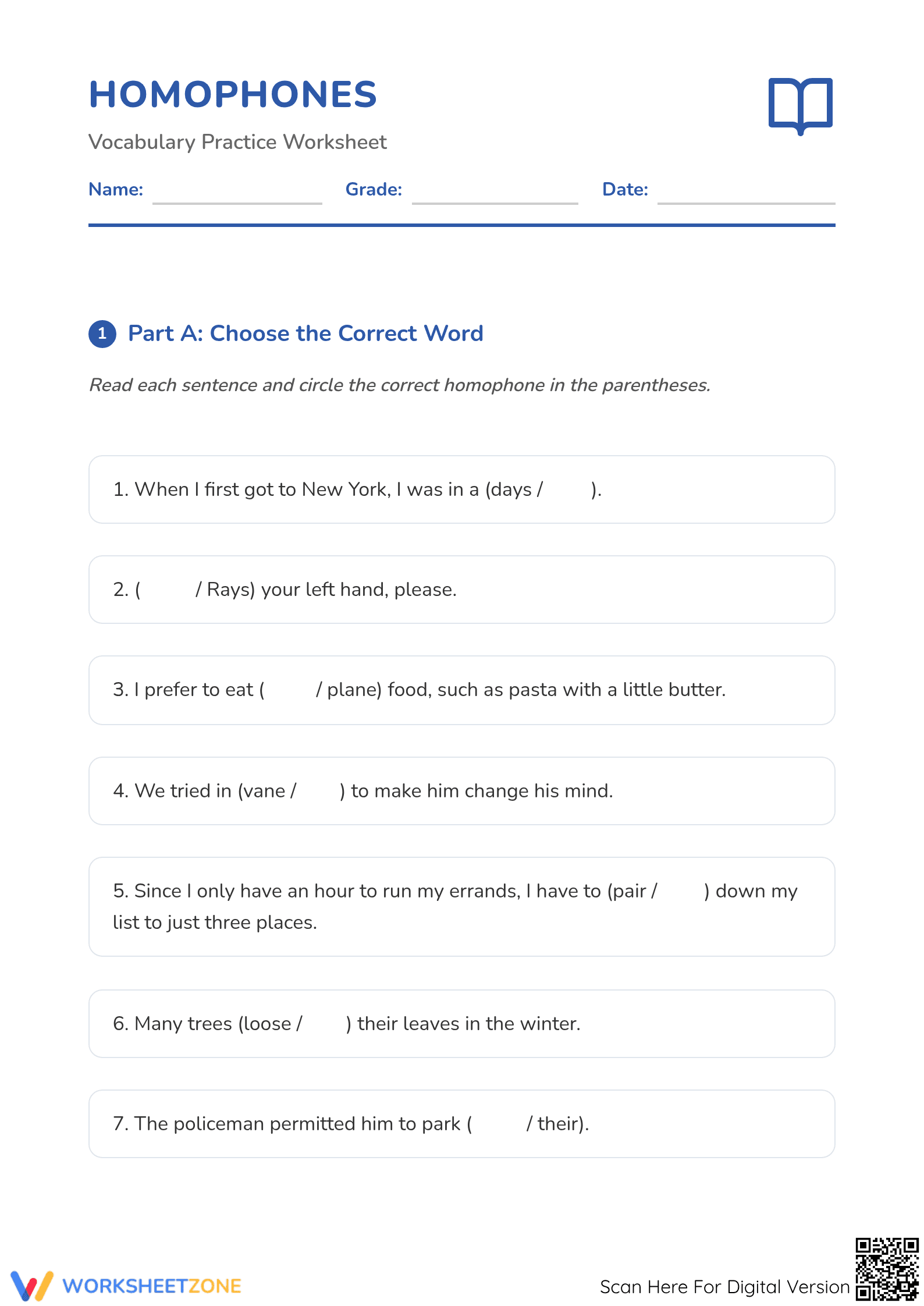
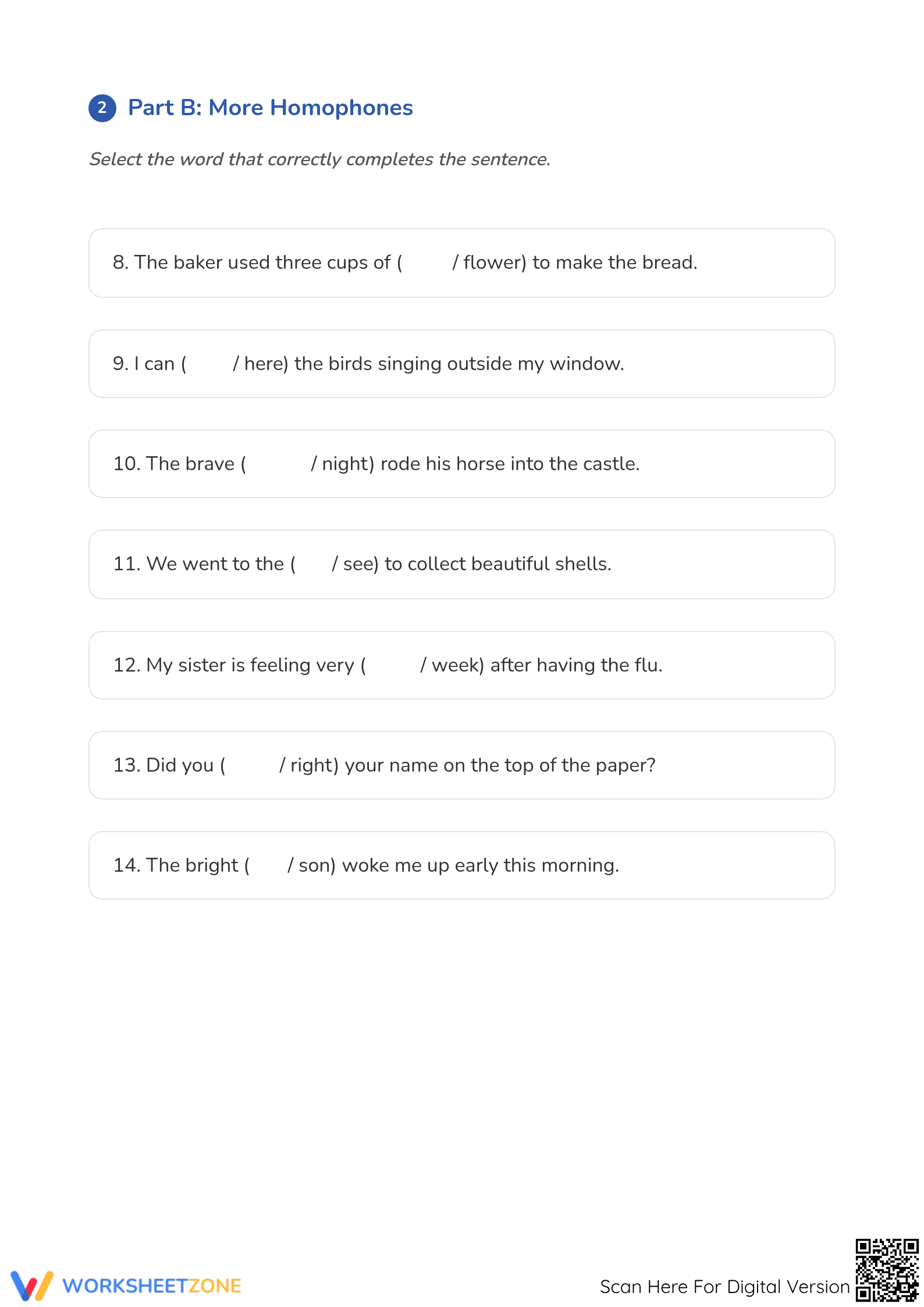
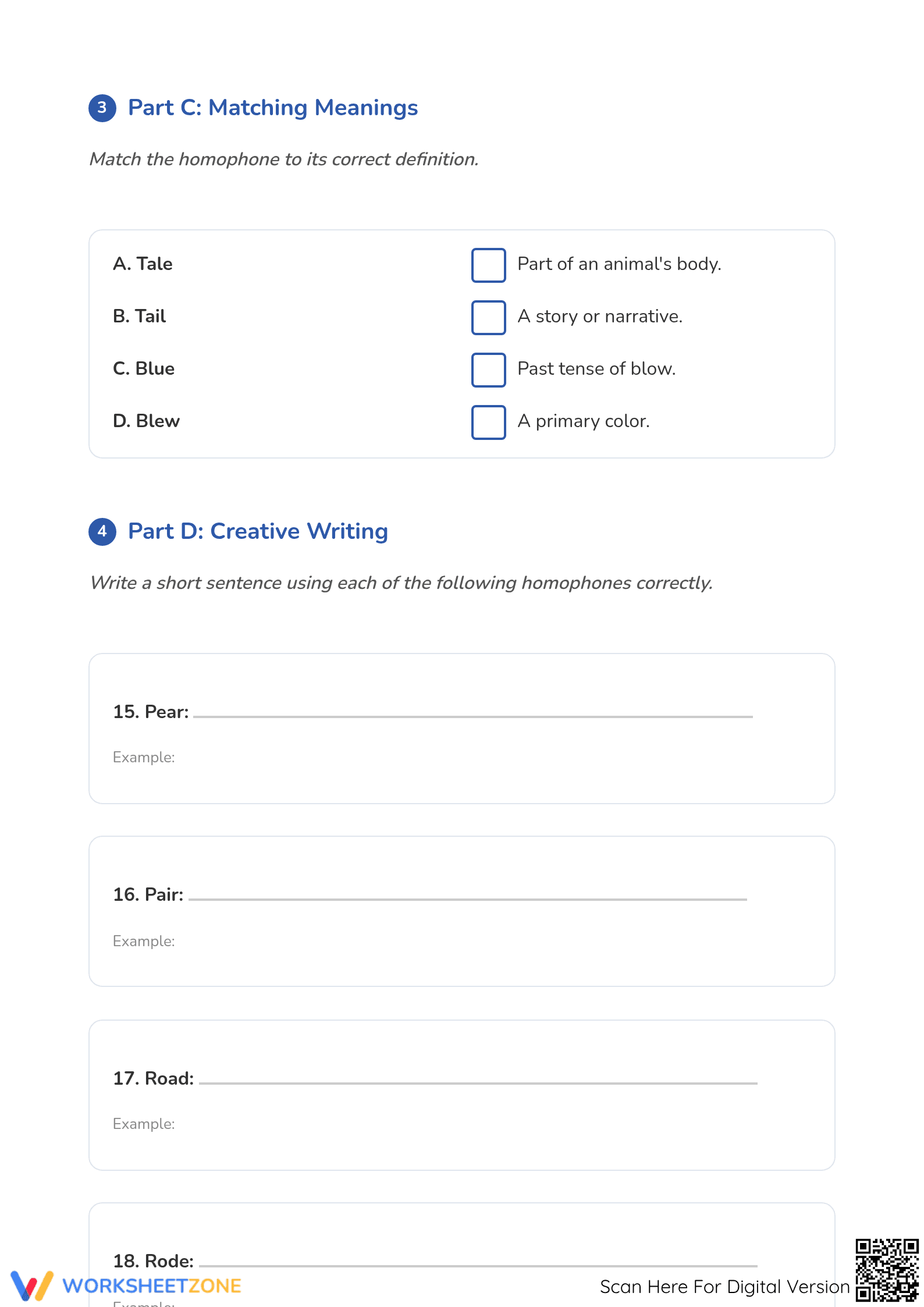
This comprehensive 3-page PDF features four distinct sections designed to scaffold learning. Part A and B provide 14 sentence-level context clues where students circle the correct homophone (e.g., days/daze, flower/flour). Part C offers a matching activity to connect words like "tale" and "tail" to their definitions. Finally, Part D challenges students to apply their knowledge by writing original sentences for specific word pairs. A full answer key is provided for quick grading.
Zero-Prep Workflow
- Print: Select the three activity pages and the answer key (30 seconds).
- Distribute: Hand out the packets for a quiet independent work block or literacy center (1 minute).
- Review: Use the included answer key to provide immediate feedback or allow students to self-correct their work (30 seconds).
This resource is ideal for emergency sub plans or morning work because it requires zero teacher setup beyond the printer.
Standards Alignment
This resource is aligned to `CCSS.ELA-LITERACY.L.1.4`, focusing on determining the meaning of multiple-meaning words through context. It also supports `CCSS.ELA-LITERACY.L.1.2.E`, which addresses using conventional spelling for high-frequency words. Both standard codes can be copied directly into lesson plans, IEP goals, or district curriculum mapping tools.
How to Use It
Use this worksheet during the "You Do" phase of a gradual release lesson on homophones. After introducing pairs like "see/sea" on an anchor chart, assign the first two pages for independent practice. For a formative assessment, observe students during Part D (Creative Writing) to see if they can correctly apply the word "pair" versus "pear" in a novel context. Completion typically takes 20 to 30 minutes.
Who It's For
This packet is designed for first-grade students but serves as excellent remediation for second graders or an enrichment activity for advanced kindergartners. It is a natural pairing for a direct instruction lesson on "Words that Sound the Same" and works well alongside a classroom word wall or homophone anchor chart.
According to the RAND AIRS 2024 report on literacy instruction, explicit practice with lexical conventions like homophones is critical for developing reading fluency and comprehension in early elementary grades. This worksheet addresses the specific challenge of multiple-meaning words by providing 22 distinct opportunities for students to apply context clues. Research by Fisher & Frey (2014) emphasizes that vocabulary acquisition is most effective when students move from recognition (circling) to production (writing), a progression mirrored in this resource's four-part structure. By isolating homophone pairs within controlled sentences, the material reduces cognitive load, allowing Grade 1 learners to focus on the semantic differences between phonetically identical words. This alignment with CCSS.ELA-LITERACY.L.1.4 ensures that instructional time is spent on high-leverage skills that correlate with long-term literacy success and standardized assessment performance.


