


























Views
Downloads


Homophones Worksheet | Grade 1 Essential Vocabulary
Paste this activity's link or code into your existing LMS (Google Classroom, Canvas, Teams, Schoology, Moodle, etc.).
Students can open and work on the activity right away, with no student login required.
You'll still be able to track student progress and results from your teacher account.
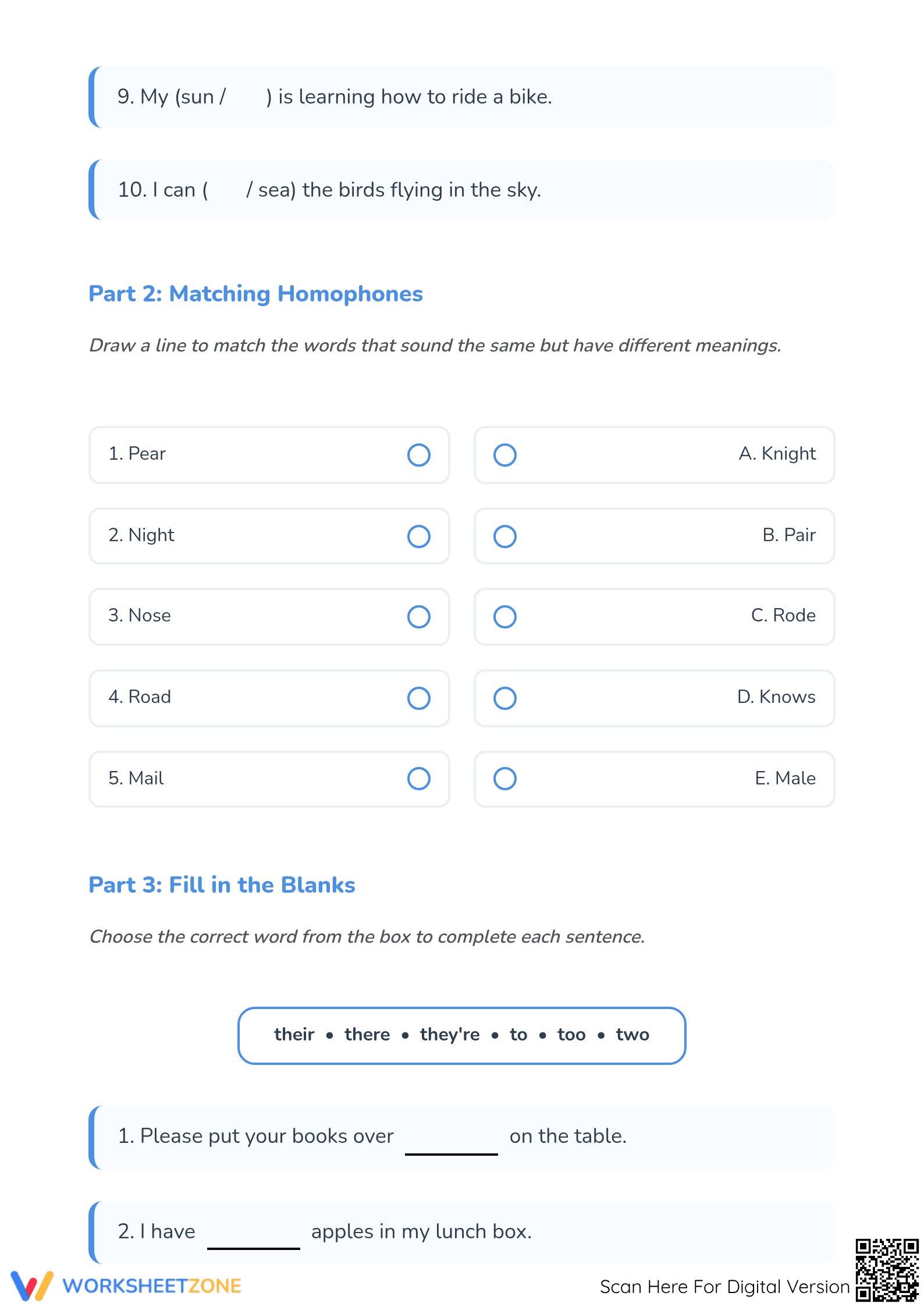
This Grade 1 homophones worksheet provides students with targeted practice in identifying and using words that sound the same but have different meanings and spellings. By engaging with contextual sentences and matching exercises, learners develop the critical linguistic awareness needed to improve their reading comprehension and writing accuracy.
At a Glance
- Grade: 1 · Subject: ELA
- Standard:
CCSS.ELA-LITERACY.L.1.4— Use sentence-level context to determine the meaning of words and phrases- Skill Focus: Homophone identification and usage
- Format: 3 pages · 22 problems · Answer key included · PDF
- Best For: Independent practice or literacy centers
- Time: 20–30 minutes
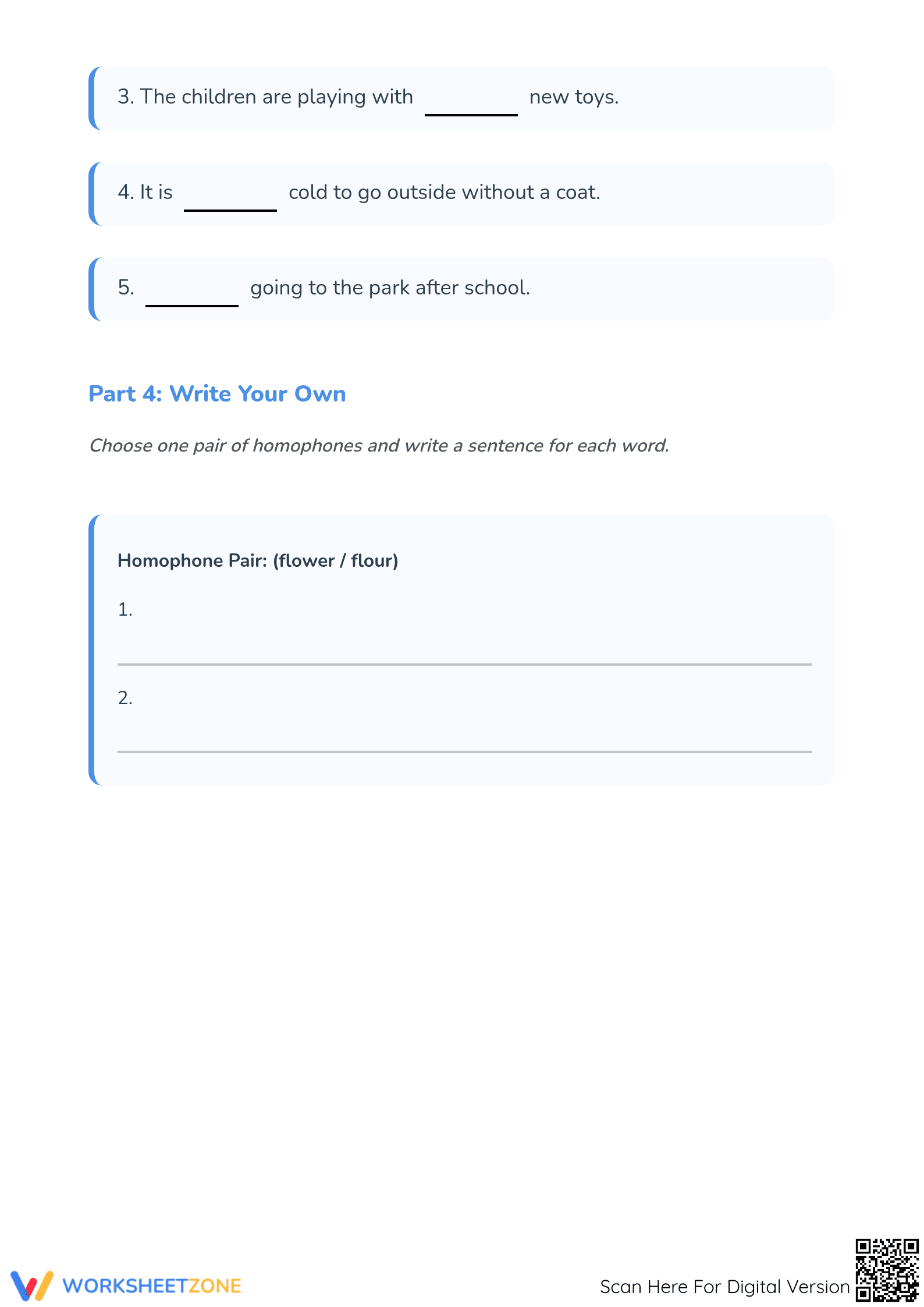
The resource spans three comprehensive pages, featuring four distinct activity types. It includes 10 multiple-choice context sentences, a 5-pair matching section, a 5-item fill-in-the-blank challenge focusing on high-frequency homophones like "their/there/they're," and a creative writing prompt. A complete answer key is provided for rapid grading.
Zero-Prep Workflow
- Print: Generate the three-page PDF in under 60 seconds.
- Distribute: Hand out packets during your literacy block for immediate student engagement.
- Review: Use the included answer key for a quick whole-class review or individual grading in less than a minute.
This resource is perfectly suited for emergency sub plans or as a quiet-time activity for early finishers.
Standards Alignment
This worksheet aligns with `CCSS.ELA-LITERACY.L.1.4`, which requires students to determine or clarify the meaning of unknown and multiple-meaning words and phrases. It specifically supports sub-standard A by using sentence-level context as a clue. Both standard codes can be copied directly into lesson plans, IEP goals, or district curriculum mapping tools.
How to Use It
Assign this worksheet during the "You Do" phase of a gradual release lesson on word classes. It serves as an excellent formative assessment tool; observe if students struggle with the "to/too/two" section to identify who needs small-group intervention. Completion typically takes 20 to 30 minutes depending on student reading level.
Who It's For
Designed for first-grade students, this resource is also appropriate for second-grade review or ESL learners. It pairs naturally with a homophone anchor chart or a direct instruction lesson on high-frequency sight words to reinforce spelling patterns and semantic differences.
Mastery of homophones is a foundational component of lexical development in early elementary education. According to the RAND AIRS 2024 report, explicit instruction in word-level context clues significantly enhances decoding speed and reading fluency in Grade 1 learners. This worksheet addresses CCSS.ELA-LITERACY.L.1.4 by requiring students to distinguish between phonetically identical but semantically distinct words like "eight" and "ate" or "sea" and "see." By providing 22 structured tasks across three pages, the resource ensures students move beyond simple recognition to active application in writing. Research from Fisher & Frey (2014) emphasizes that scaffolded practice with multiple-meaning words prevents common spelling errors that persist into later grades. This printable PDF offers a complete solution for teachers seeking evidence-based vocabulary tools that require zero preparation while maintaining high instructional rigor.


