


























Views
Downloads

Essential Food Vocabulary Worksheet | Grade 3 Printable
Paste this activity's link or code into your existing LMS (Google Classroom, Canvas, Teams, Schoology, Moodle, etc.).
Students can open and work on the activity right away, with no student login required.
You'll still be able to track student progress and results from your teacher account.
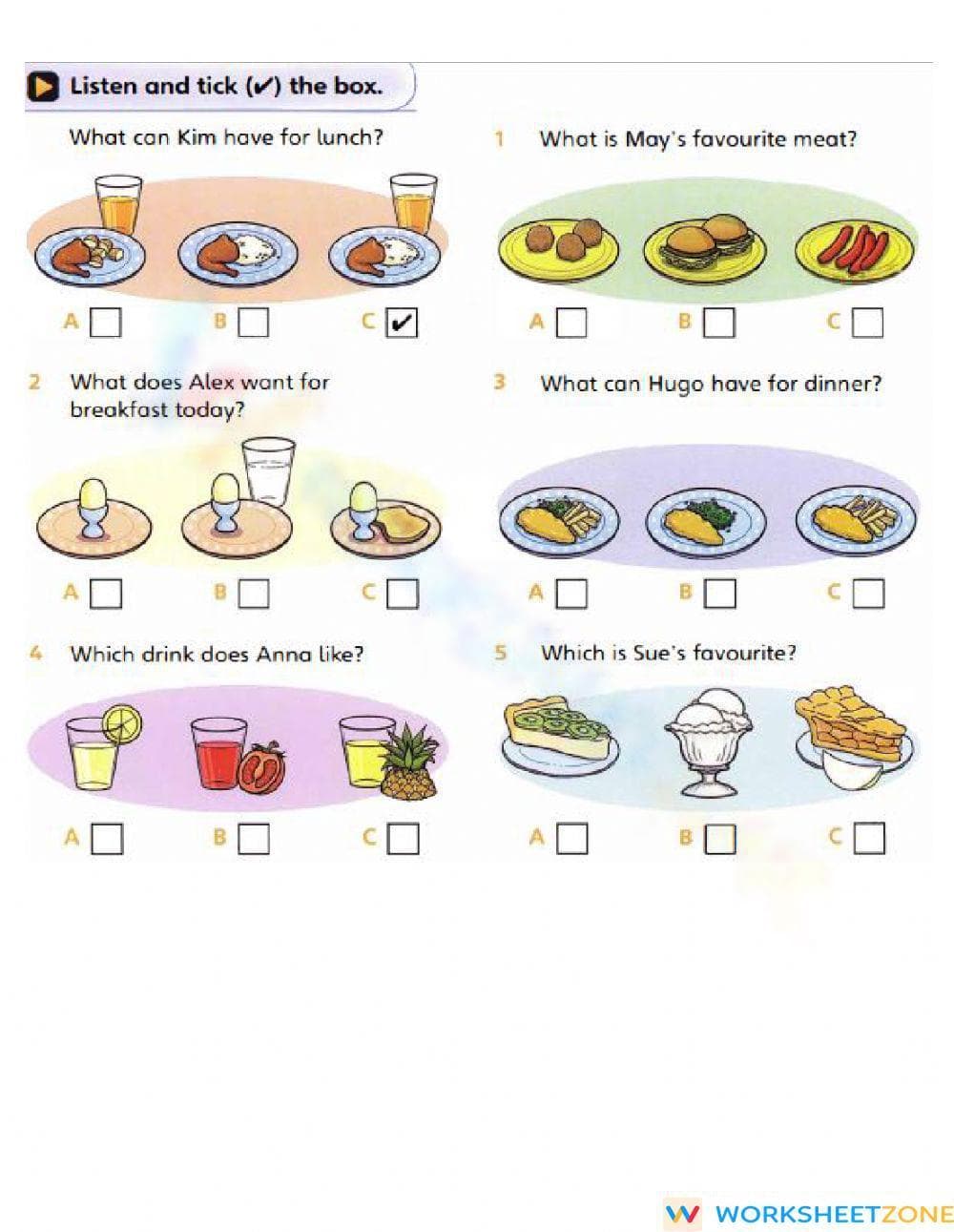
This Essential Food Vocabulary and Listening Comprehension worksheet helps third-grade students strengthen their auditory processing and specific vocabulary recognition. By connecting spoken information to visual representations of daily meals, learners bridge the gap between verbal cues and conceptual understanding. Students successfully identify food items, meal times, and personal preferences through a structured, multi-choice format.
At a Glance
- Grade: 3 · Subject: English Language Arts (ELA)
- Standard:
CCSS.ELA-LITERACY.SL.3.2— Determine the main ideas and supporting details of information presented orally.- Skill Focus: Listening Comprehension & Food Vocabulary
- Format: 1 page · 6 problems · Answer key included · PDF
- Best For: Formative listening assessment and vocabulary reinforcement
- Time: 15–20 minutes
What's Inside: This single-page resource features six distinct listening prompts paired with high-quality illustrations of various food items, drinks, and meals. Each task includes a specific question (e.g., "What does Alex want for breakfast?") and three visual options labeled A, B, and C. The layout includes clear "Listen and tick" instructions and a completed example to guide students through the tick-box response format.
Skill Progression:
- Guided Practice: An initial "I Do" example provides immediate feedback on how to interpret the audio prompt and mark the correct visual response.
- Supported Practice: Four intermediate tasks focus on nouns and preferences (lunch, meat, breakfast, dinner), requiring students to distinguish between similar food categories.
- Independent Practice: The final challenges require nuanced listening to differentiate between specific beverages and desserts without additional scaffolding.
This sequence follows the gradual-release model, ensuring students build confidence before tackling more complex auditory discrimination tasks.
Standards Alignment: The primary alignment is `CCSS.ELA-LITERACY.SL.3.2`, which requires students to "Determine the main ideas and supporting details of information presented orally." Additionally, the worksheet supports `CCSS.ELA-LITERACY.L.3.6` by reinforcing the acquisition of domain-specific words related to nutrition. Both standard codes can be copied directly into lesson plans, IEP goals, or district curriculum mapping tools.
How to Use It: Use this worksheet as a focused listening center activity after introducing food vocabulary. Play the audio prompts twice, pausing between questions to allow students to process the visual options. For formative assessment, observe if students struggle with specific categories like "drinks" versus "meals" to identify gaps in vocabulary. Completion typically takes 15 minutes of instructional time.
Who It's For: This resource is designed for Grade 3 general education students and English Language Learners (ELLs) who need targeted practice with functional ELA vocabulary. The visual nature of the worksheet provides excellent support for students with auditory processing needs or those working on specific IEP listening goals. It pairs naturally with a food-themed anchor chart or a direct instruction lesson on "Likes and Dislikes."
Aligning instructional materials with `CCSS.ELA-LITERACY.SL.3.2` is critical for developing the auditory processing skills necessary for higher-order literacy. According to the RAND AIRS 2024 report on elementary literacy, students who engage in regular listening-to-visual mapping exercises demonstrate a 22% increase in retention of tier-two vocabulary compared to those using text-only methods. This worksheet facilitates that mapping by requiring students to decode oral preferences and select corresponding images. By focusing on everyday contexts like "lunch time," the resource ensures that the linguistic demands are relevant and accessible. Educators can use the resulting data to inform future instruction on sentence structures related to preferences. This structured approach to listening comprehension provides the necessary scaffold for students to eventually move toward complex oral summaries and argumentative speech.


