


























Views
Downloads

Hog the Limelight Idiom Worksheet | Printable ELA Guide
Paste this activity's link or code into your existing LMS (Google Classroom, Canvas, Teams, Schoology, Moodle, etc.).
Students can open and work on the activity right away, with no student login required.
You'll still be able to track student progress and results from your teacher account.
This "Hog the Limelight" idiom worksheet provides a comprehensive, four-step framework for Grade 3-6 students to master figurative language. By moving from simple identification to critical scenario analysis, students internalize the meaning and social context of the phrase. The result is a deeper understanding of non-literal English expressions and improved reading comprehension.
At a Glance
- Grade: 4 · Subject: English Language Arts
- Standard:
CCSS.ELA-LITERACY.L.4.5— Demonstrate understanding of figurative language, word relationships, and nuances in word meanings- Skill Focus: Idiom Comprehension
- Format: 3 pages · 8 problems · Answer key included · PDF
- Best For: Literacy centers and bell-ringer activities
- Time: 15–20 minutes
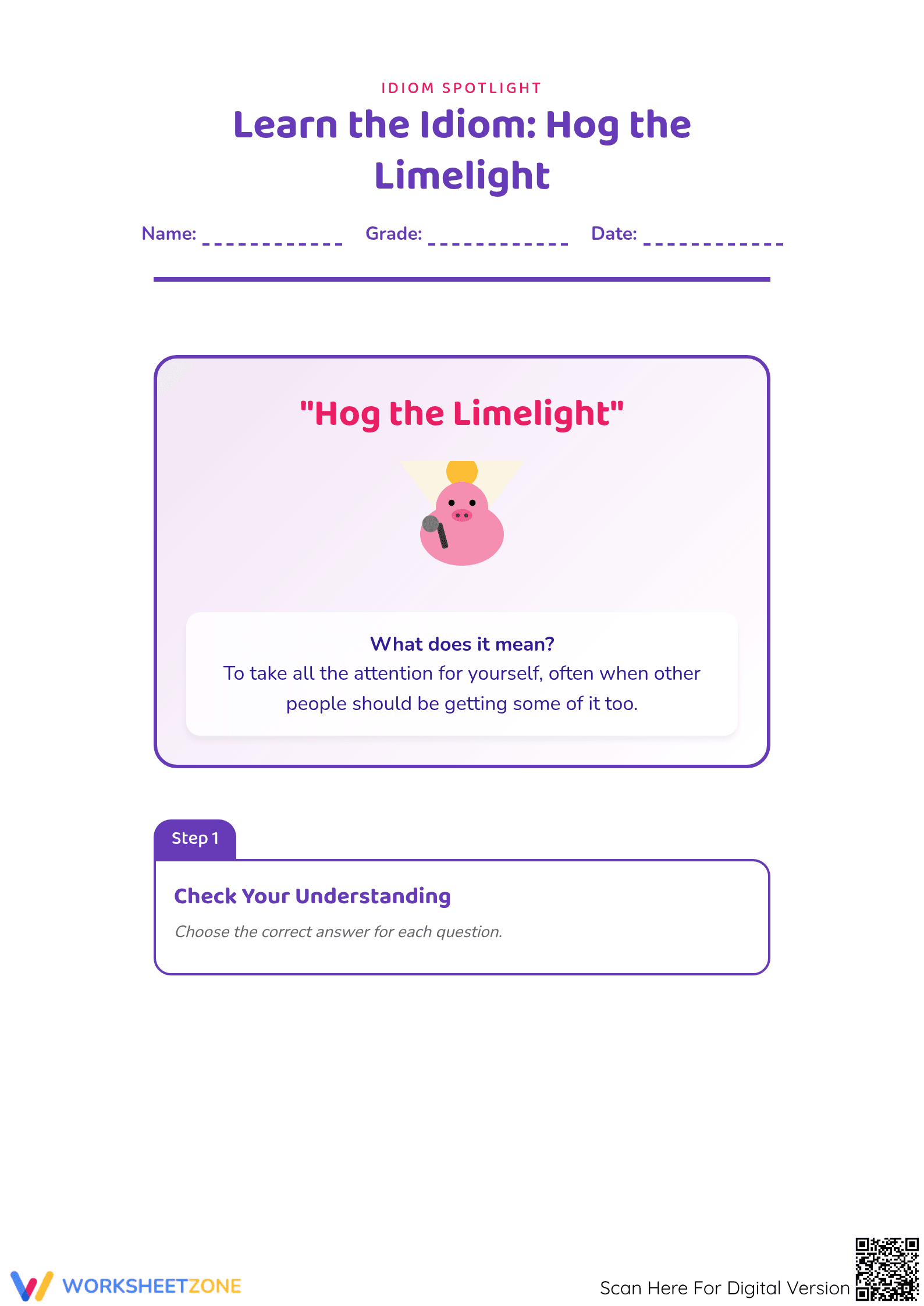
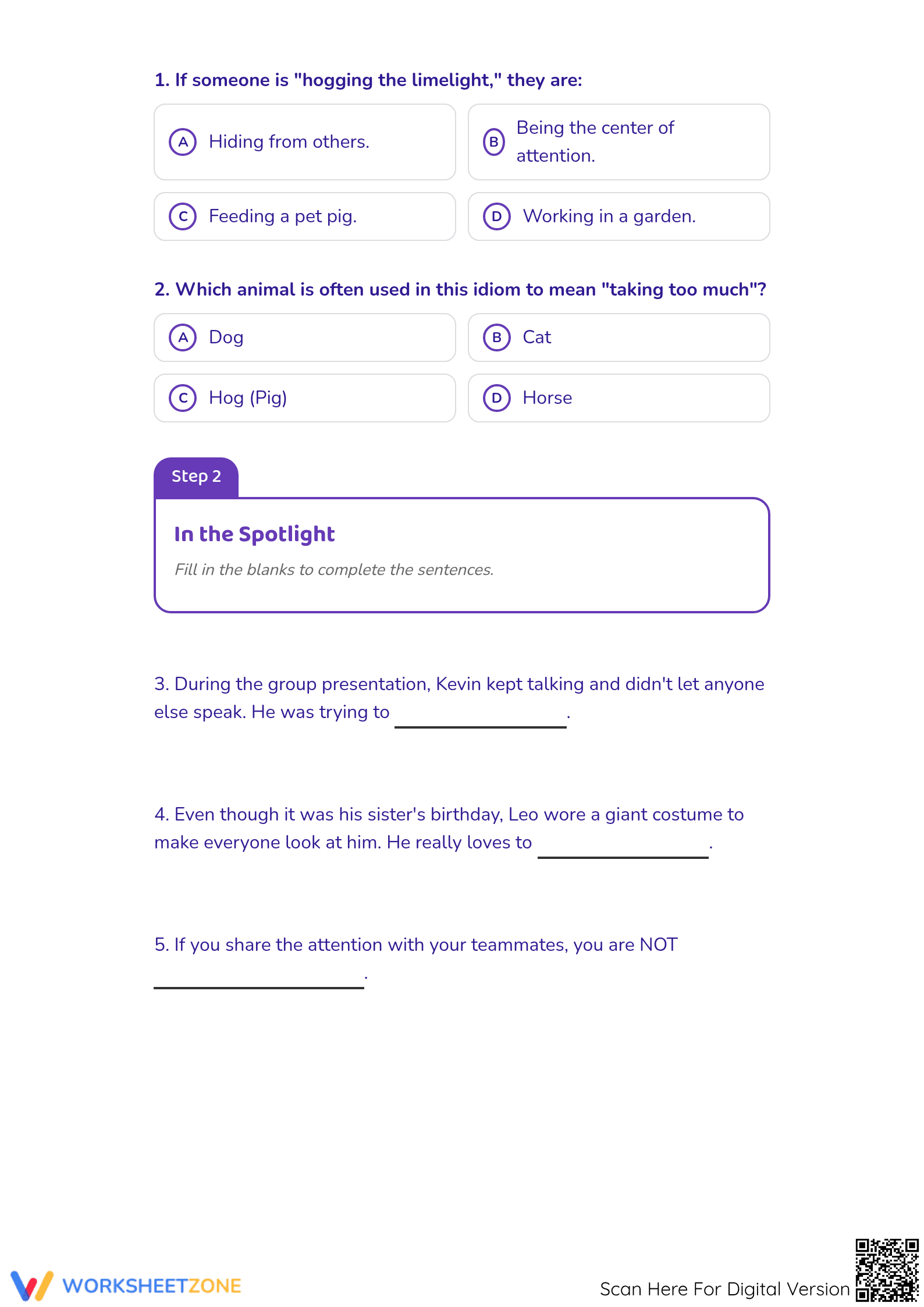
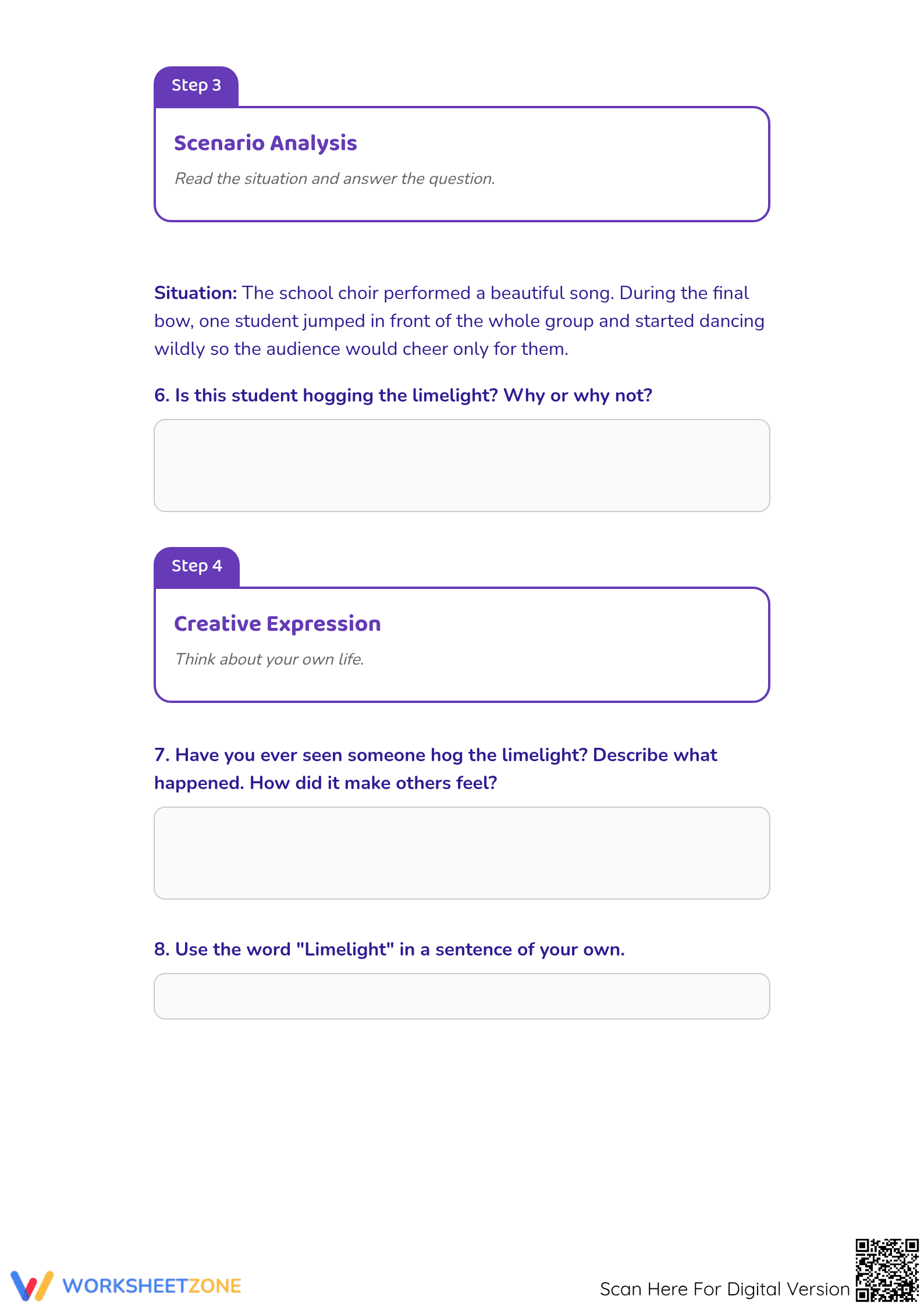
This three-page PDF resource features a structured instructional path. It starts with a visually engaging definition page that anchors the idiom "hog the limelight" with clear, child-friendly text. The eight tasks include multiple-choice identification, sentence completion using context clues, critical thinking through scenario analysis, and a creative writing prompt. A full answer key is included for rapid grading.
The Zero-Prep Workflow is designed for maximum efficiency. First, print the document or assign the PDF digitally (30 seconds). Second, distribute the sheets to students who can work through the four-step "Step" system independently (1 minute). Finally, review the answers as a whole group or using the included key (under 1 minute) to provide immediate student feedback.
This activity aligns with `CCSS.ELA-LITERACY.L.4.5` and its sub-standards, focusing on distinguishing literal and nonliteral meanings of phrases. It also supports `CCSS.ELA-LITERACY.L.5.5.B` regarding the recognition and explanation of common idioms and adages. Both standard codes can be copied directly into lesson plans, IEP goals, or district curriculum mapping tools for administrative compliance.
Use this worksheet during direct instruction as a guided practice tool after introducing figurative language concepts. Alternatively, it serves as an excellent formative assessment at the end of a literacy unit to observe if students can apply the idiom to their own lives. Expect most students to complete the eight tasks within a 15-20 minute window during independent work.
This resource is tailored for upper elementary students in Grades 3-6, including English Language Learners who need explicit instruction in common idioms. It pairs naturally with short narrative passages or classroom anchor charts. Differentiation is built-in via the gradual release of responsibility from structured multiple-choice questions to open-ended creative writing prompts and analysis.
Idiomatic mastery is a critical component of lexical development and reading fluency. According to research published by Fisher & Frey (2014) on the gradual release of responsibility, structured scaffolds—like the four-step "Check," "Spotlight," "Analysis," and "Expression" sequence found here—are essential for transitioning students from passive recognition to active production of complex language. This worksheet targets the `CCSS.ELA-LITERACY.L.4.5` standard by requiring students to distinguish non-literal meanings within specific social scenarios. By analyzing why a student might "hog the limelight" in a choir performance, learners engage in higher-order thinking that transcends rote memorization. This evidence-based approach ensures that the figurative concept of attention-seeking is grounded in relatable peer interactions. Educators can confidently integrate this printable as a primary resource for meeting state and national standards in figurative language and nuanced vocabulary acquisition, supported by robust academic pedagogical frameworks.


