


























Views
Plays
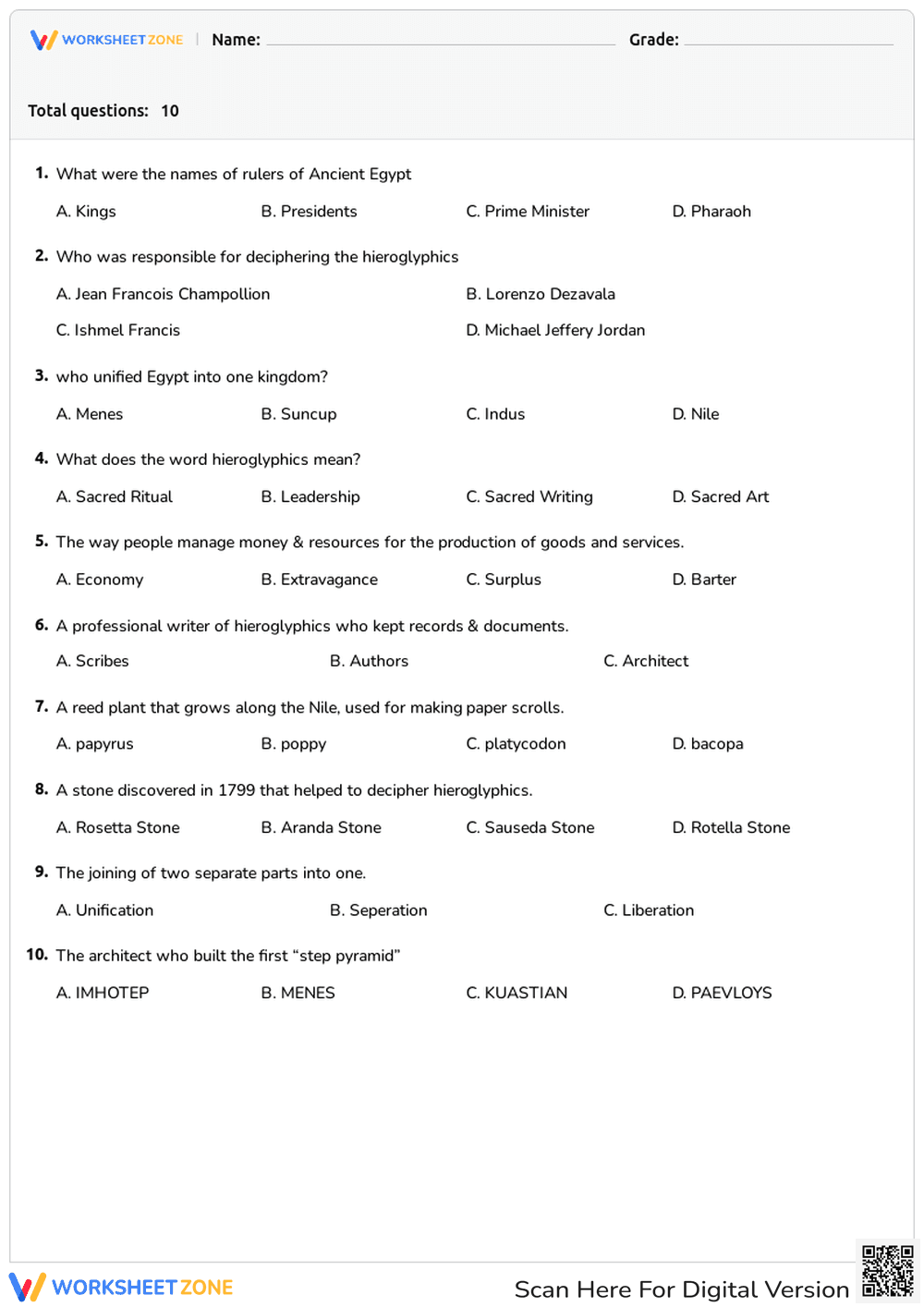

Grade 3 Ancient Egypt Vocabulary — Printable Worksheet
Paste this activity's link or code into your existing LMS (Google Classroom, Canvas, Teams, Schoology, Moodle, etc.).
Students can open and work on the activity right away, with no student login required.
You'll still be able to track student progress and results from your teacher account.
This printable Grade 3 vocabulary worksheet helps students master domain-specific terms related to Ancient Egypt. By completing this ten-question multiple-choice quiz, learners demonstrate their understanding of historical concepts like pharaohs, hieroglyphics, and the Rosetta Stone, building essential background knowledge for informational reading.
At a Glance
- Grade: 3 · Subject: ELA
- Standard:
CCSS.ELA-LITERACY.RI.3.4— Determine the meaning of domain-specific words- Skill Focus: Historical Vocabulary
- Format: 1 page · 10 problems · Answer key included · PDF
- Best For: Quick assessment or review
- Time: 10–15 minutes
Inside this resource, educators will find a straightforward, one-page multiple-choice assessment featuring ten targeted questions. The layout is clean and accessible, presenting clear options for each historical definition. Students will identify key figures, artifacts, and concepts central to ancient Egyptian civilization. A complete answer key is provided to ensure accurate and efficient grading.
This resource is designed for a seamless, zero-prep classroom experience:
- Print (1 minute): Simply download the PDF and print a class set. The single-page format conserves paper and requires no stapling.
- Distribute (1 minute): Hand out the quiz as a morning work activity, a social studies integration task, or a quick exit ticket.
- Review (3 minutes): Use the included answer key to grade submissions rapidly or project the answers for a whole-class peer review session.
Total teacher preparation time is under two minutes, making this an excellent addition to any emergency sub plan.
This worksheet is tightly aligned to CCSS.ELA-LITERACY.RI.3.4: Determine the meaning of general academic and domain-specific words and phrases in a text relevant to a grade 3 topic or subject area. It also supports cross-curricular social studies standards regarding ancient civilizations. Both standard codes can be copied directly into lesson plans, IEP goals, or district curriculum mapping tools.
Teachers can deploy this worksheet effectively after a direct instruction lesson on Ancient Egypt to check for immediate comprehension. Alternatively, it serves as an excellent independent practice activity during literacy centers when paired with informational texts about the topic. As students work, observe whether they rely on process of elimination for unfamiliar terms—this formative assessment tip can guide future vocabulary instruction. Expected completion time ranges from 10 to 15 minutes.
This resource is ideal for third-grade students developing their academic vocabulary, though it can easily be adapted for second or fourth graders studying similar historical units. For students needing differentiation, teachers might read the questions aloud or reduce the multiple-choice options from four to two. It pairs perfectly with an introductory reading passage on the Nile River or a classroom anchor chart detailing Egyptian history.
Mastering domain-specific vocabulary is a critical component of reading comprehension, particularly when students engage with complex informational texts in the elementary grades. According to a recent EdReports 2024 analysis, explicit instruction and targeted assessment of subject-area terminology significantly improve students' ability to access rigorous cross-curricular content. This worksheet directly supports that pedagogical goal by targeting CCSS.ELA-LITERACY.RI.3.4, requiring learners to determine the meaning of domain-specific words related to ancient civilizations. By isolating these historical terms in a focused, multiple-choice format, educators can accurately measure vocabulary acquisition without the added cognitive load of extended reading passages. Regular, low-stakes assessments like this ten-question quiz reinforce memory retention and help build the robust background knowledge necessary for long-term academic success across both literacy and social studies disciplines.


