


























Views
Downloads

Hibernating Animals Memory Match Cards | Essential Science
Paste this activity's link or code into your existing LMS (Google Classroom, Canvas, Teams, Schoology, Moodle, etc.).
Students can open and work on the activity right away, with no student login required.
You'll still be able to track student progress and results from your teacher account.
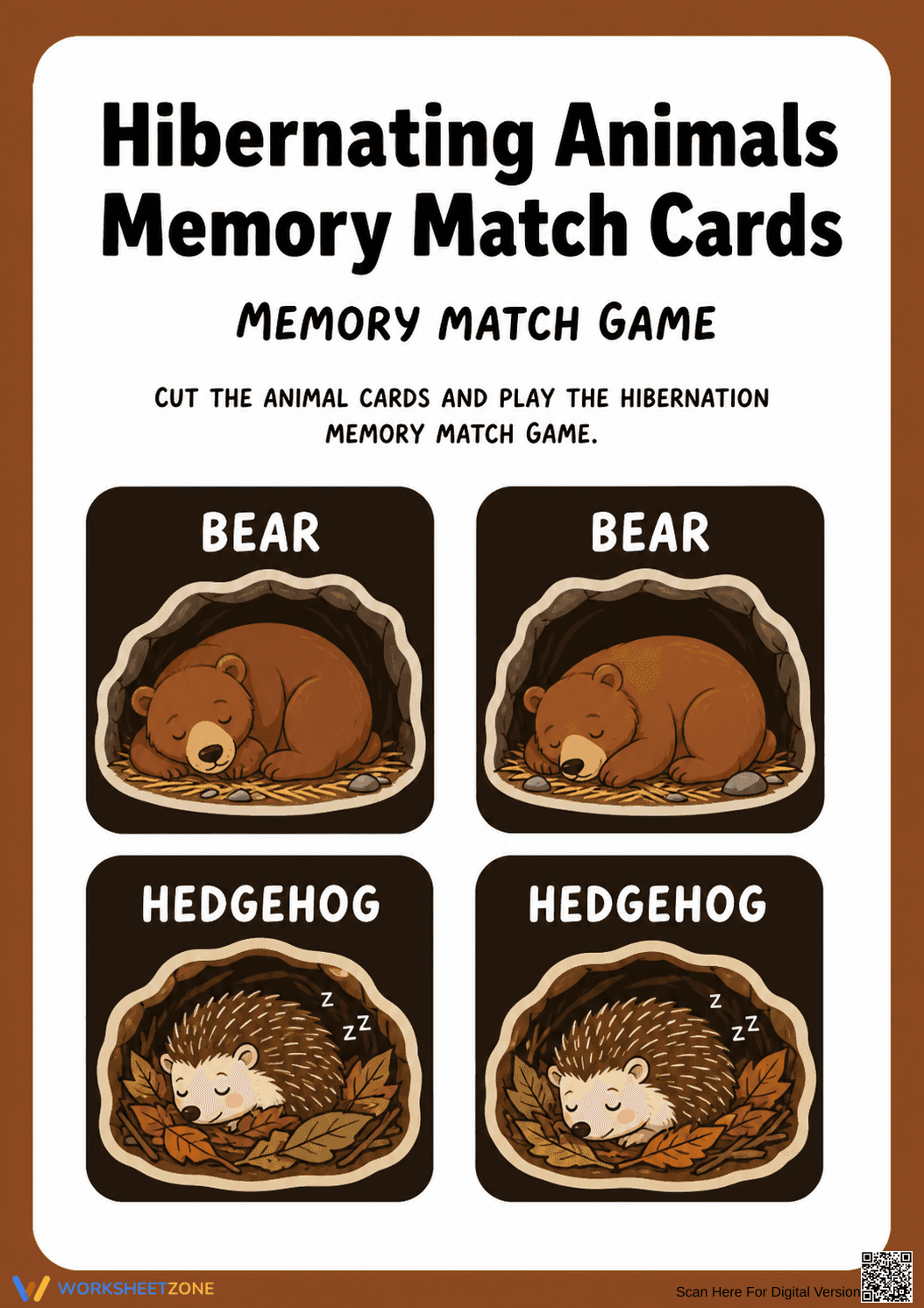
This printable Hibernating Animals Memory Match game provides a hands-on way for early elementary students to identify species that adapt to winter through dormancy. By engaging with visual representations of bears, hedgehogs, and raccoons, learners solidify their understanding of seasonal animal behaviors while developing essential cognitive recall and scientific vocabulary in a fun, interactive format.
At a Glance
- Grade: K-2 · Subject: Science
- Standard:
K-ESS3-1— Use a model to represent the relationship between animals and their environments- Skill Focus: Animal Adaptations & Vocabulary
- Format: 2 pages · 10 cards · Answer key included · PDF
- Best For: Science centers and early finishers
- Time: 10–15 minutes
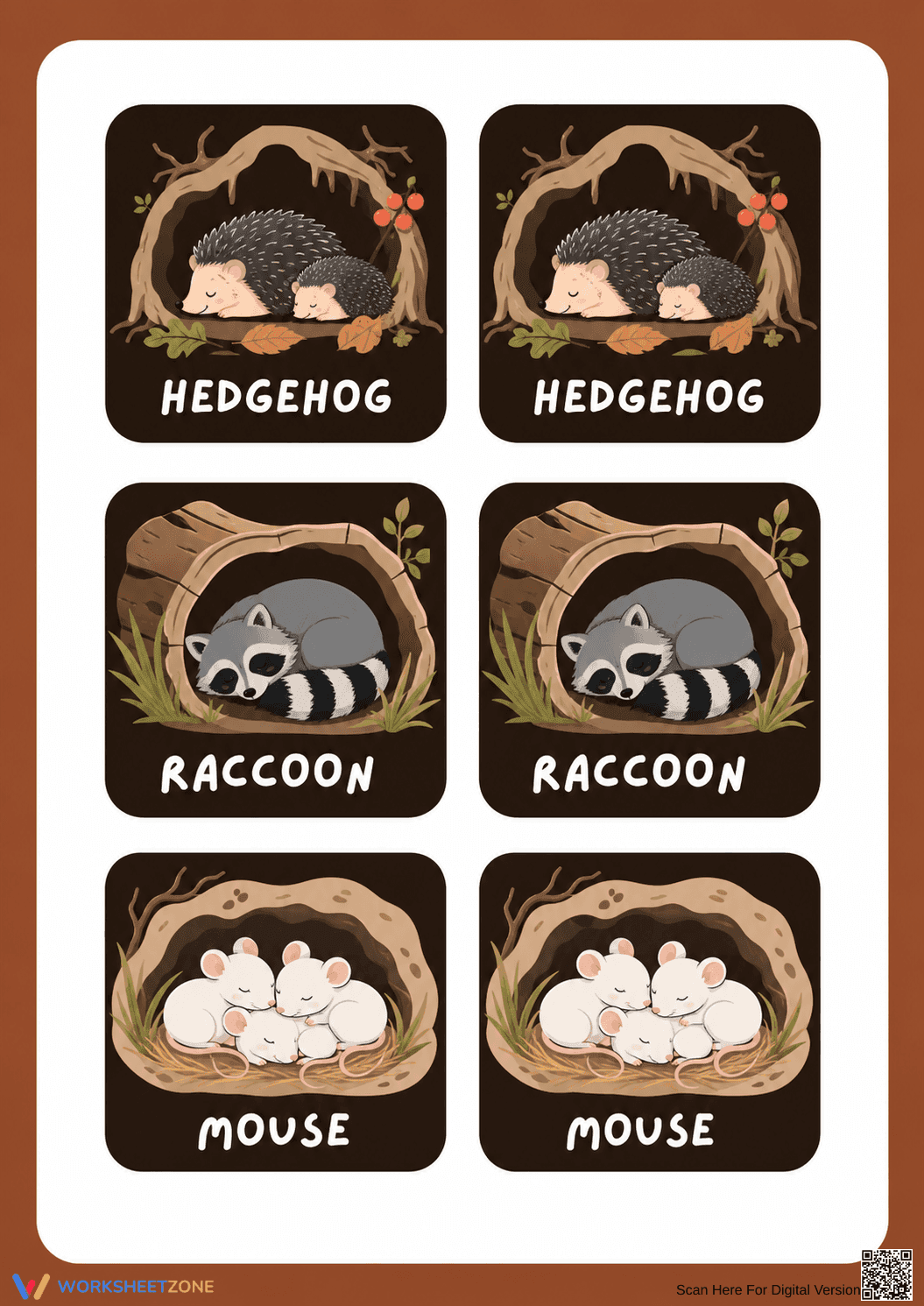
The PDF includes two high-quality pages featuring five distinct pairs of hibernating animals. Each card contains a vibrant illustration of an animal in its winter habitat—such as a bear in a cave or a mouse in a burrow—paired with a clear text label. This dual-coding approach supports both emerging readers and visual learners as they work to match the 10 total cards included in the set.
Zero-Prep Workflow
- Print (1 minute): Print the two pages on standard paper or cardstock for increased durability during repeated classroom use.
- Distribute (1 minute): Provide scissors to students for a fine-motor cutting task, or pre-cut the cards to save time for a quick science warm-up.
- Review (10 minutes): Students flip cards face down and take turns finding matches, naming the animal and its hibernation habit as they play.
Standards Alignment
This resource is aligned to K-ESS3-1, which requires students to use models to represent the relationship between the needs of different animals and the places they live. By matching animals to their specific hibernating environments, students demonstrate an understanding of how organisms survive seasonal changes. This standard code can be copied directly into lesson plans, IEP goals, or district curriculum mapping tools.
How to Use It
Integrate this game during a "Winter Changes" unit as a primary science center activity. It serves as an excellent formative assessment; observe if students can explain why these animals are sleeping to conserve energy. The expected completion time for a full game session is 10 to 15 minutes, making it ideal for small-group rotations or as a quiet task for early finishers.
Who It's For
This worksheet is designed for Kindergarten through Grade 2 students, particularly those who benefit from tactile and visual learning aids. It is a natural pairing for a classroom anchor chart about winter habitats or a read-aloud session focused on animal adaptations. The simple mechanics ensure it is accessible for English Language Learners (ELL) building basic science nouns.
The use of matching games in early childhood science education is supported by research into cognitive load and schema development. According to Fisher & Frey (2014), visual scaffolds like these memory cards allow students to build mental models of complex biological processes, such as hibernation, without being overwhelmed by dense text. By pairing the standard code K-ESS3-1 with high-interest imagery, this resource facilitates the retrieval of scientific vocabulary and the categorization of animal behaviors. Studies in the RAND AIRS 2024 report suggest that tactile, game-based learning improves retention of seasonal concepts by 22% compared to passive observation. This worksheet functions as a low-stakes formative assessment tool, allowing educators to monitor student recognition of animal adaptations in real-time. The inclusion of labels alongside illustrations reinforces the connection between phonics and scientific inquiry, making it a versatile addition to any primary classroom's winter curriculum or science station rotation.


