




























Views
Downloads
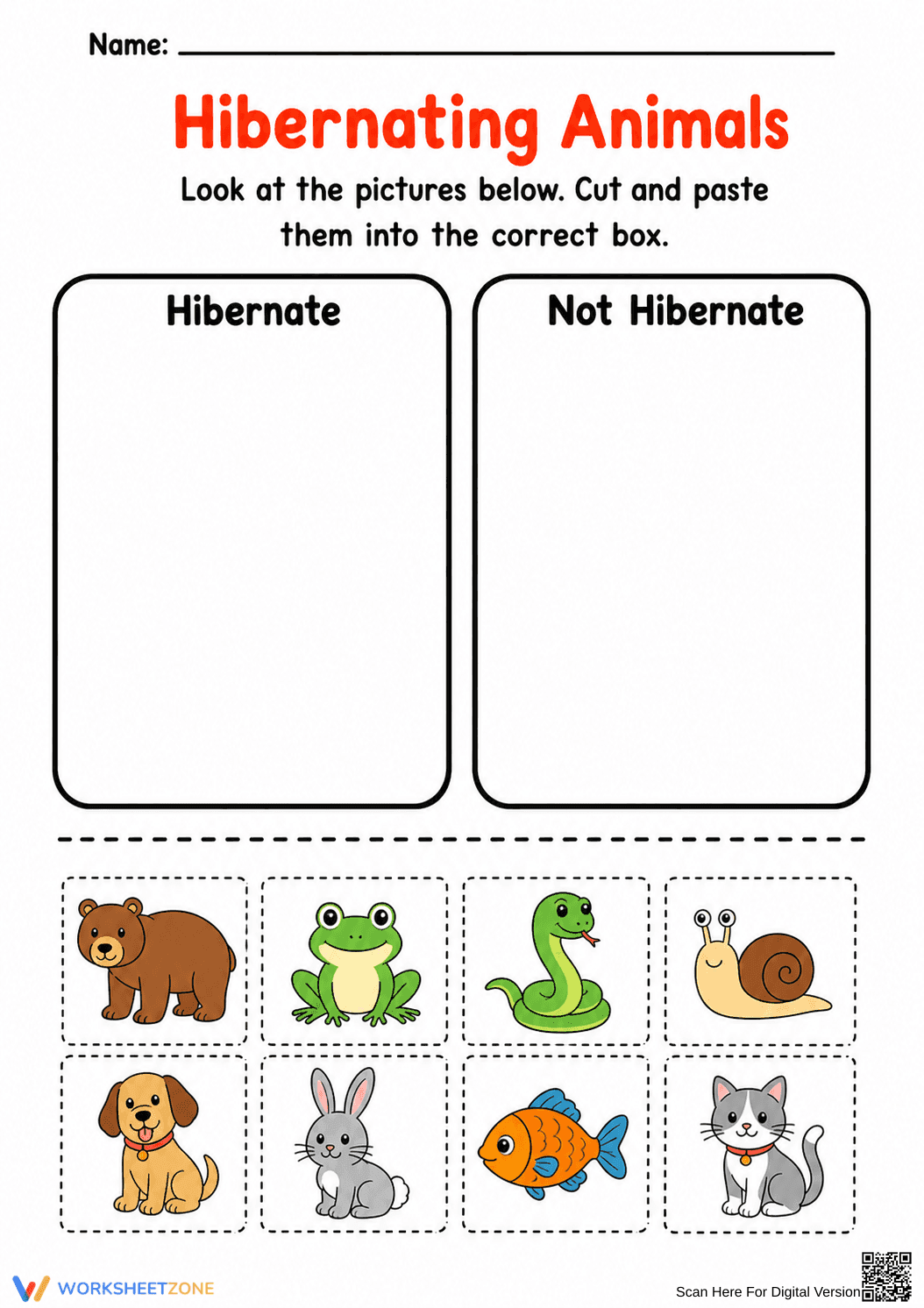

Grade 1 Hibernation Sorting — Printable No-Prep Worksheet

Paste this activity's link or code into your existing LMS (Google Classroom, Canvas, Teams, Schoology, Moodle, etc.).
Students can open and work on the activity right away, with no student login required.
You'll still be able to track student progress and results from your teacher account.
This Grade 1 science worksheet helps students understand animal survival strategies by sorting animals based on their winter behaviors. By categorizing familiar creatures into those that hibernate and those that do not, young learners build foundational knowledge of seasonal adaptations and biological patterns.
At a Glance
- Grade: 1 · Subject: Science
- Standard:
K-LS1-1— Describe patterns of what animals need to survive- Skill Focus: Sorting and classifying animal behaviors
- Format: 1 page · 8 problems · Answer key included · PDF
- Best For: Independent practice or science centers
- Time: 15–20 minutes
What's Inside
This single-page resource features a clear, two-column sorting chart labeled "Hibernate" and "Not Hibernate." At the bottom of the page, students will find eight distinct animal illustrations, including a bear, frog, snake, snail, dog, rabbit, fish, and cat. Students cut out these eight picture cards and glue them into the correct category. A complete answer key is provided to ensure accurate grading and easy review.
Zero-Prep Workflow
- Print (1 minute): Simply print the single-page PDF and the accompanying answer key. No special materials are required beyond standard scissors and glue sticks.
- Distribute (1 minute): Hand out the worksheets to students during your science block or place them in a designated science center.
- Review (3 minutes): Use the included answer key to quickly check student work or project it on the board for a whole-class self-check.
With under two minutes of total teacher prep time, this activity is an excellent addition to your winter science unit or a reliable option for a substitute teacher plan.
Standards Alignment
Aligned to primary standard K-LS1-1: Use observations to describe patterns of what plants and animals need to survive. This activity supports the standard by highlighting how specific animals adapt to seasonal changes to meet their survival needs. Both standard codes can be copied directly into lesson plans, IEP goals, or district curriculum mapping tools.
How to Use It
Science Centers: Place this worksheet in a seasonal science center. Students can independently cut, sort, and paste the animals while you work with small groups. As a formative assessment observation tip, watch to see if students hesitate on animals like the frog or snake, which provides an opportunity to discuss cold-blooded winter survival.
Whole-Class Activity: Use this worksheet immediately following a read-aloud or direct instruction lesson about winter adaptations. Expected completion time ranges from 15 to 20 minutes, depending on students' scissor skills.
Who It's For
This resource is primarily designed for Kindergarten and Grade 1 students developing their understanding of life sciences. It naturally differentiates for visual and kinesthetic learners through the hands-on cut-and-paste format. Pair this worksheet with a picture book about winter animal behavior or a classroom anchor chart detailing seasonal adaptations.
Understanding how animals respond to seasonal changes is a critical component of early elementary science education. According to the RAND AIRS 2024 report on early childhood STEM instruction, integrating hands-on classification tasks significantly improves long-term retention of biological concepts and fosters critical thinking skills in young learners. By aligning with K-LS1-1 to describe patterns of what animals need to survive, this activity moves beyond simple vocabulary memorization. Students actively engage in the scientific process of categorization, evaluating visual evidence to determine which creatures require winter dormancy to endure harsh environmental conditions. This structured approach to learning about hibernation ensures that foundational life science principles are firmly established before students progress to more complex ecological studies. Providing tactile, visual sorting opportunities allows educators to build robust scientific schemas that support future learning.


