




























Views
Downloads
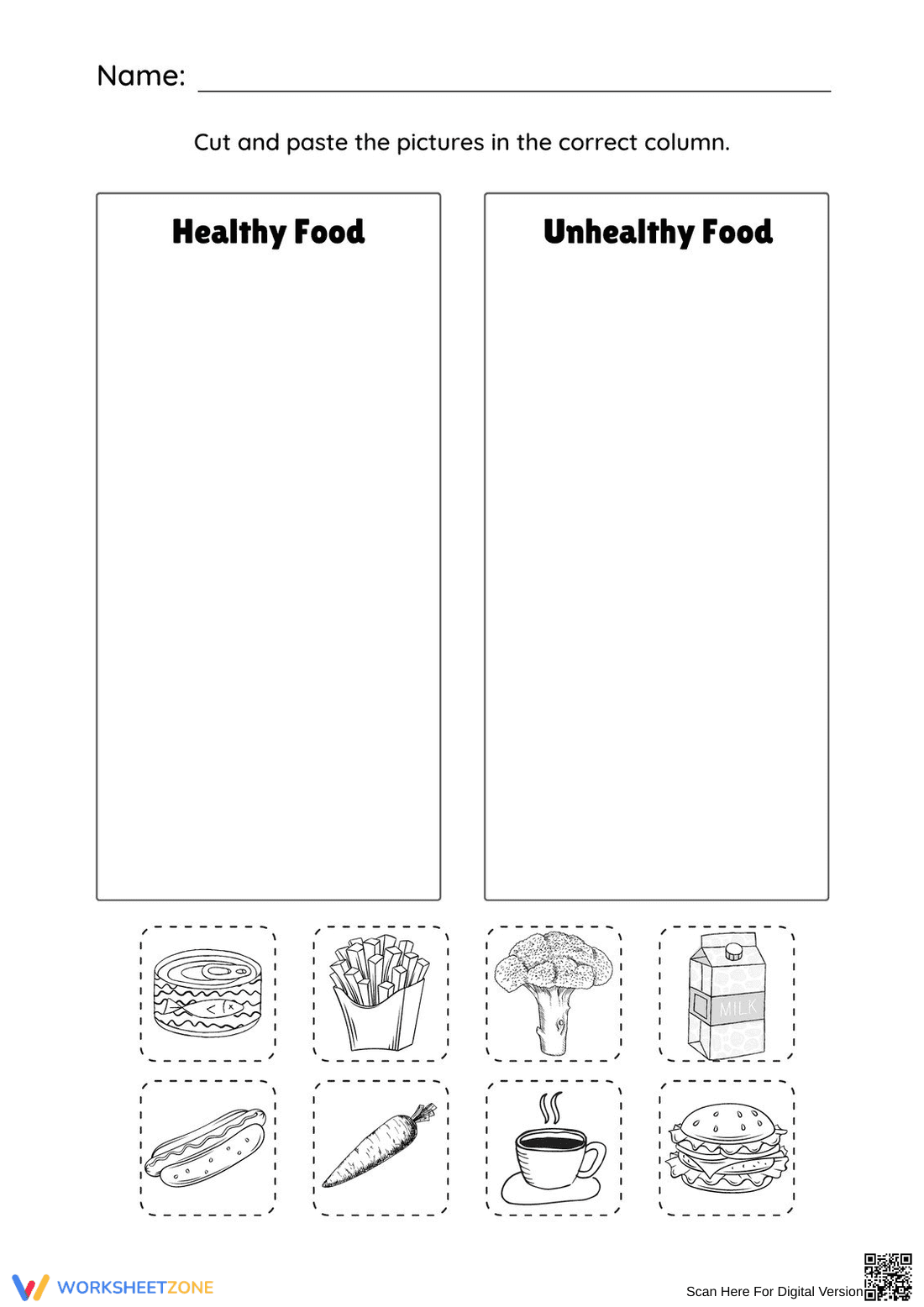

Healthy vs Unhealthy Food Worksheet | Printable Grade K

Paste this activity's link or code into your existing LMS (Google Classroom, Canvas, Teams, Schoology, Moodle, etc.).
Students can open and work on the activity right away, with no student login required.
You'll still be able to track student progress and results from your teacher account.
This Grade K health worksheet helps young learners distinguish between nutritious choices and less healthy options through a hands-on sorting activity. By categorizing 8 common food and drink items, students develop foundational nutritional literacy and fine motor skills. It provides a clear visual framework for understanding how different dietary choices impact personal wellness and body health.
At a Glance
- Grade: Kindergarten · Subject: Health
- Standard:
NHES.1.2.1— Identify that healthy behaviors, like eating nutritious food, affect personal health- Skill Focus: Nutritional sorting and classification
- Format: 1 page · 8 problems · Answer key included · PDF
- Best For: Introduction to nutrition and wellness units
- Time: 15–20 minutes
What's Inside
The resource consists of a single-page PDF featuring two distinct columns labeled "Healthy Food" and "Unhealthy Food." At the bottom of the page, students find 8 dashed-line boxes containing illustrations of items such as broccoli, carrots, milk, and fast food. The layout is designed for high-contrast printing, ensuring that the black-and-white icons remain recognizable for coloring before they are cut and pasted into the appropriate categories.
Zero-Prep Workflow
- Print: Generate a single-page PDF for each student in less than 30 seconds.
- Distribute: Hand out sheets with scissors and glue; visual cues allow students to start without complex verbal directions.
- Review: Check the completed sorts as a whole group to provide instant feedback, requiring under 2 minutes of prep.
This streamlined process makes the worksheet an ideal choice for emergency sub plans or quick transition periods between core subjects.
Standards Alignment
This activity aligns with `NHES.1.2.1`, which requires students to identify that healthy behaviors affect personal health. By distinguishing between nutrient-dense vegetables and processed snacks, students demonstrate an early understanding of health promotion. Both standard codes can be copied directly into lesson plans, IEP goals, or district curriculum mapping tools to document progress in early childhood wellness education.
How to Use It
Use this worksheet during the independent practice phase of a lesson on the five food groups. It serves as an excellent formative assessment to check if students can identify "sometimes" foods versus "everyday" foods. Teachers should observe students as they sort to identify any misconceptions about specific items, such as milk or canned goods. The activity typically takes 15 to 20 minutes to complete, including the cutting and gluing process.
Who It's For
This resource is tailored for Kindergarten and Grade 1 students who are developing both cognitive classification skills and physical dexterity. It is particularly effective for English Language Learners (ELLs) because the pictorial representations provide a path to demonstrating content mastery without heavy text reliance. Pair this worksheet with a read-aloud about healthy eating or a physical MyPlate anchor chart for a comprehensive instructional experience.
Early childhood nutrition education is a critical component of long-term health outcomes, as dietary habits established in the primary grades often persist into adulthood. According to the Fisher & Frey (2014) framework for gradual release of responsibility, hands-on sorting tasks like this "Healthy vs Unhealthy" activity provide the necessary scaffold for students to move from conceptual understanding to independent application. Research indicates that using visual aids and tactile engagement—such as cutting and pasting—increases retention of health concepts among learners aged 5 to 7. By aligning this activity with the `NHES.1.2.1` standard, educators ensure that students are meeting national benchmarks for health literacy. This worksheet provides 8 specific data points for teachers to evaluate a student's ability to classify behaviors that promote wellness. Such foundational exercises are essential for building the vocabulary and conceptual categories required for more complex biological and nutritional studies in later elementary years.


