




























Views
Downloads
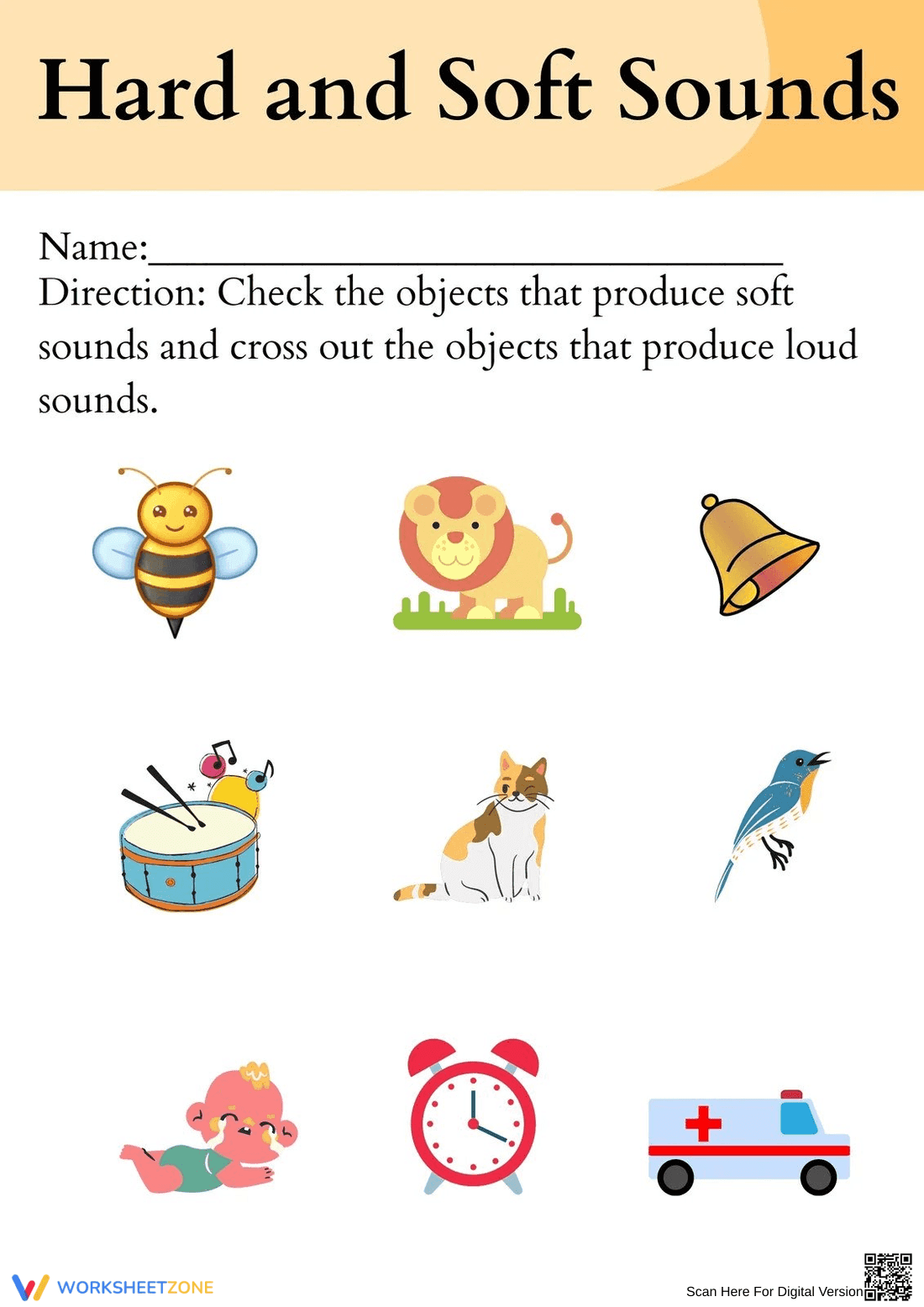

Loud and Soft Sounds Worksheet | Essential Grade 2 Science

Paste this activity's link or code into your existing LMS (Google Classroom, Canvas, Teams, Schoology, Moodle, etc.).
Students can open and work on the activity right away, with no student login required.
You'll still be able to track student progress and results from your teacher account.
This Grade 2 science worksheet helps students distinguish between different volumes by classifying common environmental noises. By identifying which objects produce soft whispers versus loud alarms, learners develop a foundational understanding of sound properties and auditory perception. It provides a clear, visual way to practice categorization skills essential for early physical science mastery.
At a Glance
- Grade: 2 · Subject: Science
- Standard:
1-PS4-1— Plan and conduct investigations to provide evidence that materials make sound- Skill Focus: Auditory classification (Loud vs. Soft)
- Format: 1 page · 9 problems · Answer key included · PDF
- Best For: Independent practice or quick formative assessment
- Time: 10–15 minutes
What's Inside
Inside this single-page PDF, you will find 9 high-quality illustrations representing various sound sources, from a buzzing bee to a blaring ambulance. The layout is clean and student-friendly, featuring a simple "check or cross" instruction set that eliminates the need for extensive writing, making it accessible for all learners.
Zero-Prep Workflow
- Print: Generate the single-page PDF in seconds.
- Distribute: Hand out the sheets and read the simple directions aloud.
- Review: Check answers as a whole group for immediate feedback.
Total teacher preparation time is under 2 minutes, making it an ideal sub-plan or morning work activity for busy classrooms.
Standards Alignment
This activity aligns with `1-PS4-1`, focusing on the observable characteristics of sound. While the standard emphasizes vibration, identifying volume is a prerequisite skill for understanding sound energy. This worksheet also supports CCSS.ELA-LITERACY.L.2.5.A by having students identify real-life connections between words and their use. Both standard codes can be copied directly into lesson plans, IEP goals, or district curriculum mapping tools.
How to Use It
Use this worksheet during the "elaborate" phase of a 5E science lesson after students have explored making sounds with classroom objects. It also serves as an excellent formative assessment tool; observe if students can correctly identify the ambulance and drum as loud versus the cat and bird as soft. Completion typically takes 10 to 15 minutes.
Who It's For
This resource is perfect for second-grade students, English Language Learners (ELLs) who benefit from visual cues, and students with IEPs requiring simplified response methods. It is designed to be used as a standalone practice sheet or as a supplement to a larger unit on energy and waves.
According to the RAND AIRS 2024 report, high-quality visual aids in early science education significantly improve retention of abstract concepts like energy and sound waves. This worksheet addresses the foundational skill of auditory discrimination, which is a critical component of the 1-PS4-1 standard. By requiring students to categorize 9 distinct sound sources, the activity moves beyond simple identification into conceptual sorting. Research from Fisher & Frey (2014) suggests that such categorization tasks help bridge the gap between concrete observation and scientific reasoning. This printable resource provides a structured environment for students to apply their knowledge of the physical world. It is a reliable tool for teachers looking to verify student understanding of volume before moving into more complex topics like frequency or vibration. The clear imagery ensures that the focus remains on the scientific concept rather than reading comprehension.


