


























Views
Downloads
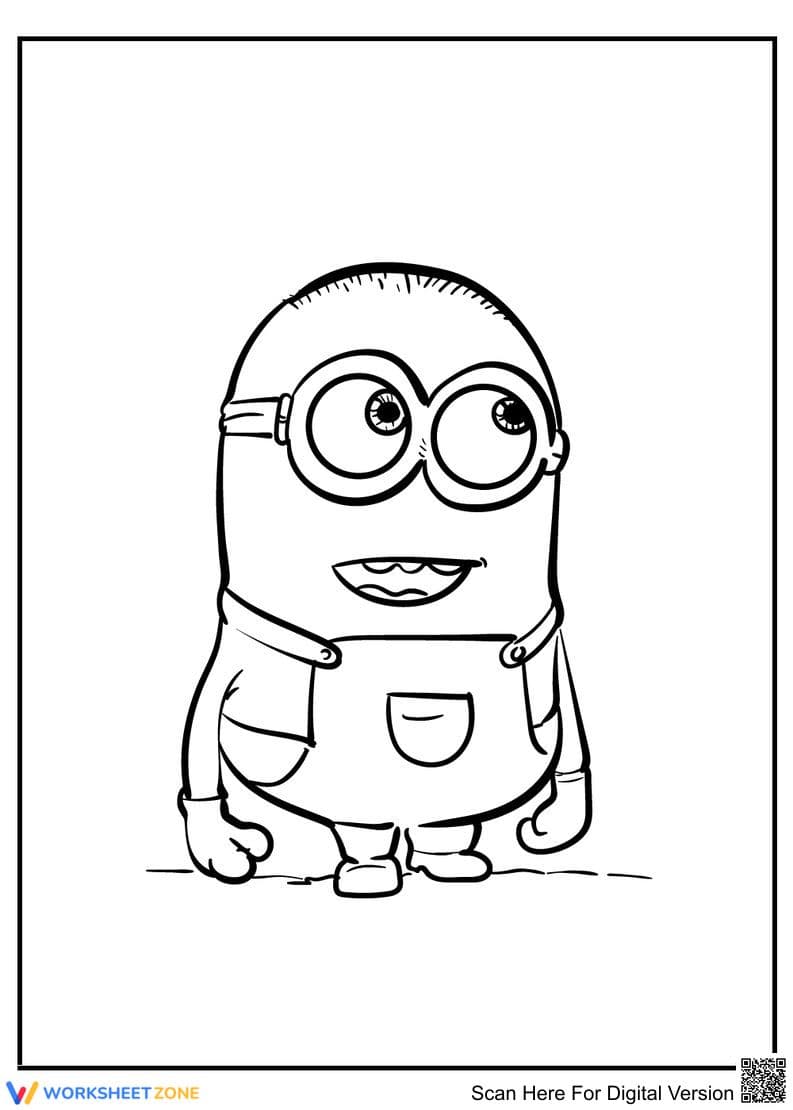

Printable Happy Minion Coloring Worksheet | Grade K
Paste this activity's link or code into your existing LMS (Google Classroom, Canvas, Teams, Schoology, Moodle, etc.).
Students can open and work on the activity right away, with no student login required.
You'll still be able to track student progress and results from your teacher account.
This printable Happy Minion coloring page provides young learners an engaging opportunity to develop fine motor control. Students use their choice of colors to bring this cartoon character to life, building essential hand-eye coordination and grip strength required for early writing tasks.
At a Glance
- Grade: K · Subject: English
- Standard:
CCSS.ELA-LITERACY.W.K.2— Use drawing to compose texts- Skill Focus: Fine Motor Skills
- Format: 1 page · 1 problem · No answer key · PDF
- Best For: Morning work or early finishers
- Time: 10–15 minutes
Inside this single-page download, educators will find a black-and-white line drawing of a cheerful minion. The bold outlines help early childhood students practice staying within the lines. No answer key is required for this open-ended task, allowing children to experiment with traditional hues or invent new color schemes.
This resource requires zero teacher preparation.
- Print (1 minute): Download the PDF and print copies.
- Distribute (1 minute): Hand out pages with crayons or markers.
- Review (0 minutes): No formal grading is necessary.
With prep time under two minutes, this worksheet is perfect for any sub plan or transition period.
This activity aligns with primary standard CCSS.ELA-LITERACY.W.K.2, which encourages students to use a combination of drawing, dictating, and writing to compose informative and explanatory texts. While primarily a fine motor and artistic exercise, coloring serves as a foundational step toward expressive drawing and eventual letter formation. Both standard codes can be copied directly into lesson plans, IEP goals, or district curriculum mapping tools.
This coloring page serves as an excellent morning work assignment to help students settle into the classroom routine before direct instruction begins. It also functions perfectly as an early finisher activity during literacy or math blocks, keeping students quietly engaged while others complete their core assignments. As a formative assessment observation tip, teachers can monitor students' pencil grip and their ability to control the crayon within the provided boundaries. Expect students to spend between 10 and 15 minutes completing this creative task.
This resource is primarily designed for Kindergarten and early primary students who are actively developing their fine motor skills and hand strength. It naturally accommodates various differentiation levels, as students with developing motor control can focus simply on applying color, while advanced learners can be challenged to add background scenery or write a descriptive sentence at the bottom of the page. It pairs wonderfully with a read-aloud session featuring character-driven picture books or a direct instruction lesson on primary and secondary colors.
Integrating creative tasks like this coloring activity supports foundational early learning objectives aligned with CCSS.ELA-LITERACY.W.K.2, where students use drawing to compose texts. According to a comprehensive EdReports 2024 analysis on early childhood development, incorporating structured fine motor activities significantly improves the hand-eye coordination and grip strength necessary for successful handwriting acquisition. The research emphasizes that providing young learners with engaging, character-based coloring pages not only sustains their attention but also reduces anxiety during independent work periods. By practicing controlled movements within defined boundaries, students build the physical stamina required for more complex academic tasks later in the school year. This simple yet effective exercise bridges the gap between playful artistic expression and essential academic readiness, ensuring that foundational motor skills are developed in a supportive, low-pressure environment.


