




























Views
Downloads

Printable T-Rex Handwriting Worksheet | Grade 2

Paste this activity's link or code into your existing LMS (Google Classroom, Canvas, Teams, Schoology, Moodle, etc.).
Students can open and work on the activity right away, with no student login required.
You'll still be able to track student progress and results from your teacher account.
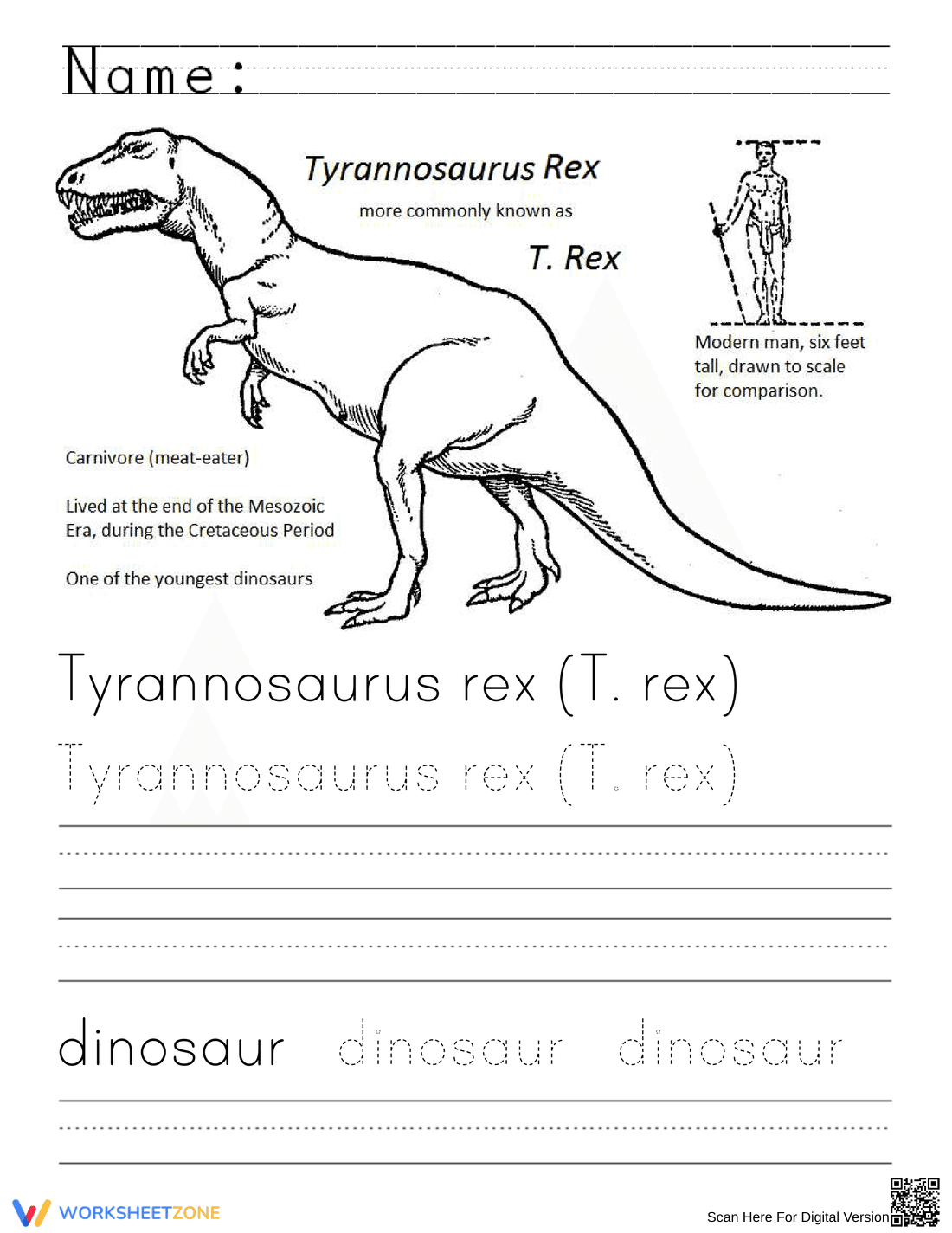
This printable T-Rex handwriting worksheet helps second and third-grade students develop fine motor control and proper letter formation. By combining engaging dinosaur facts with targeted tracing exercises, learners practice printing accuracy while reading high-interest informational text. Students trace vocabulary words before transitioning to independent writing on guided lines.
At a Glance
- Grade: 2 · Subject: English
- Standard:
CCSS.ELA-LITERACY.L.2.2— Print words with correct letter formation- Skill Focus: Handwriting and Tracing
- Format: 1 page · 3 tasks · No answer key needed · PDF
- Best For: Morning work or literacy centers
- Time: 10–15 minutes
What's Inside
This single-page resource features a Tyrannosaurus Rex illustration and brief facts about its diet. Below the reading section, students complete three handwriting tasks. First, they trace the scientific and common name of the dinosaur. Next, they trace the word "dinosaur" multiple times to build muscle memory. Finally, blank primary-ruled lines are provided at the bottom for independent practice, allowing students to copy facts or practice writing vocabulary words without tracing guides.
Zero-Prep Workflow
Designed for immediate classroom implementation with a zero-prep workflow:
- Print (1 minute): Download the PDF and print a class set. The black-and-white design saves ink.
- Distribute (1 minute): Hand out during morning work or literacy centers. No additional teacher setup is required.
- Review (1 minute): Check student work for proper letter sizing and spacing.
With total teacher prep time under two minutes, this worksheet is an excellent addition to any sub plan.
Standards Alignment
This worksheet aligns with CCSS.ELA-LITERACY.L.2.2, requiring students to demonstrate command of the conventions of standard English capitalization, punctuation, and spelling when writing. By tracing and copying specific vocabulary, students reinforce correct letter formation and spatial awareness on primary lines. A supporting standard includes reading informational text to gather facts. Both standard codes can be copied directly into lesson plans, IEP goals, or district curriculum mapping tools.
How to Use It
Utilize this handwriting practice during morning arrival to establish a calm classroom environment. It also serves as an engaging literacy center activity. As a formative assessment observation tip, watch how students grip their pencils and whether they start letters from the top or bottom while tracing. Expected completion time ranges from 10 to 15 minutes.
Who It's For
This worksheet is ideal for second and third-grade students who need additional practice with print handwriting and letter sizing. For differentiation, teachers can highlight the bottom line of the primary writing space to help students who struggle with spatial boundaries. This resource pairs perfectly with a broader science unit on dinosaurs or an anchor chart detailing the Mesozoic Era, bridging the gap between foundational literacy skills and engaging content knowledge.
Developing automaticity in handwriting is a critical component of early literacy that directly impacts a student's ability to produce written text efficiently. According to a RAND AIRS 2024 report on foundational skills, explicit handwriting instruction and consistent practice reduce the cognitive load required for letter formation, allowing students to allocate more working memory to content generation and spelling. This resource supports that developmental milestone by targeting CCSS.ELA-LITERACY.L.2.2, helping students print words with correct spelling and letter formation. By integrating high-interest topics like dinosaurs with structured tracing tasks, educators can maintain student engagement while reinforcing essential fine motor skills. Regular, brief practice sessions using guided primary lines ensure that students build the muscle memory necessary for legible, fluent writing across all academic subjects. This targeted approach prevents fatigue while maximizing skill retention.


