


























Views
Downloads

Printable Letter A Handwriting Worksheet | Grade 1
Paste this activity's link or code into your existing LMS (Google Classroom, Canvas, Teams, Schoology, Moodle, etc.).
Students can open and work on the activity right away, with no student login required.
You'll still be able to track student progress and results from your teacher account.
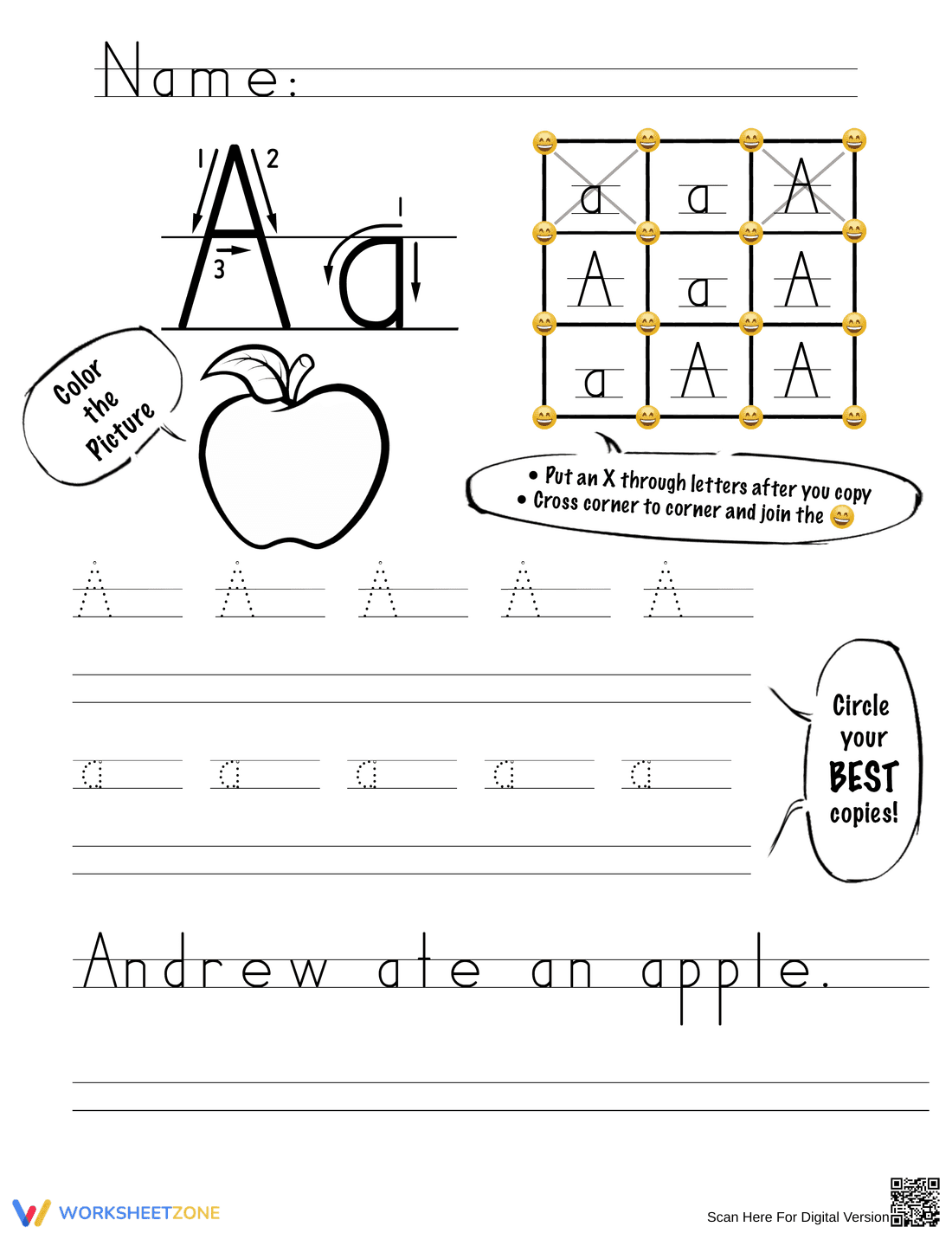
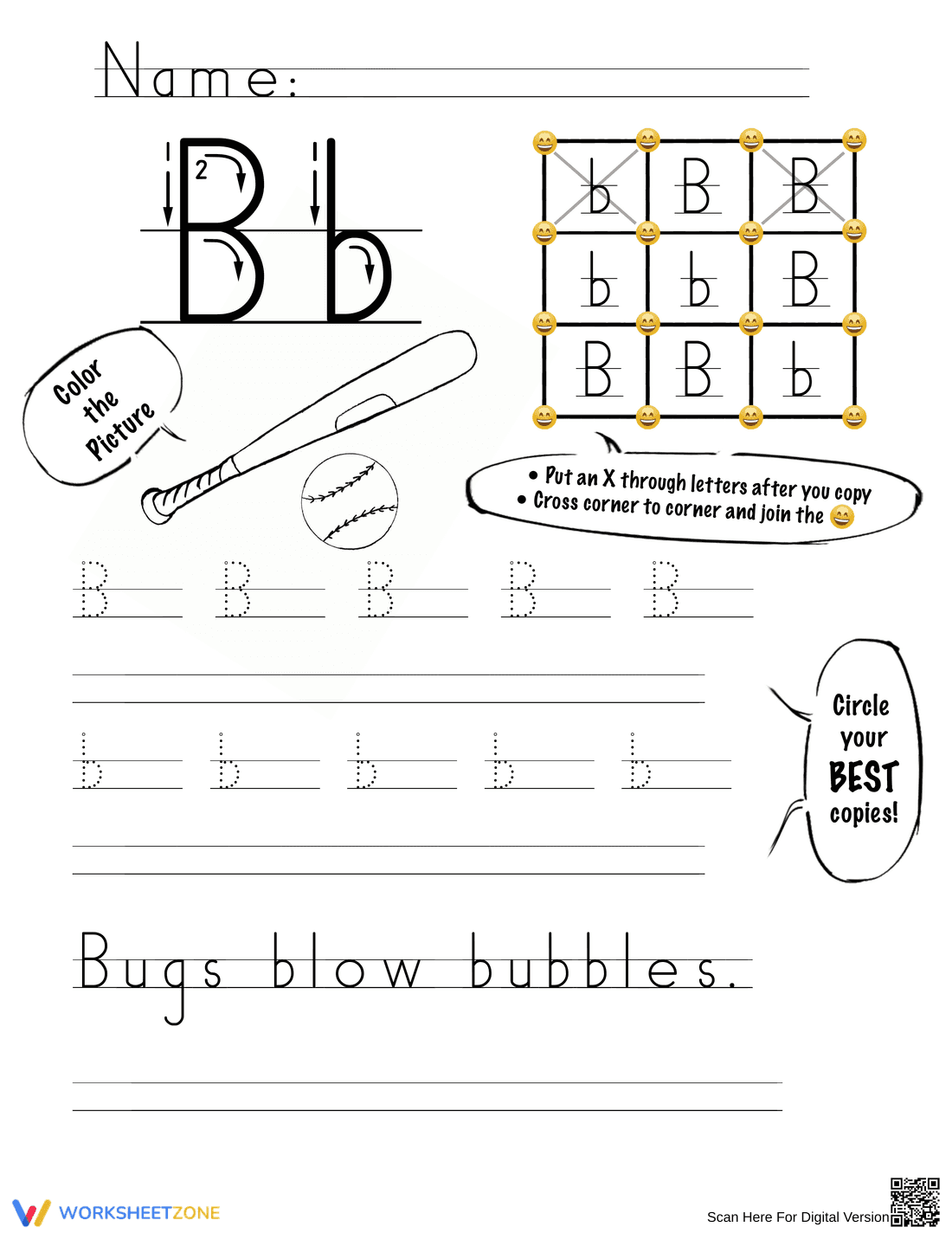
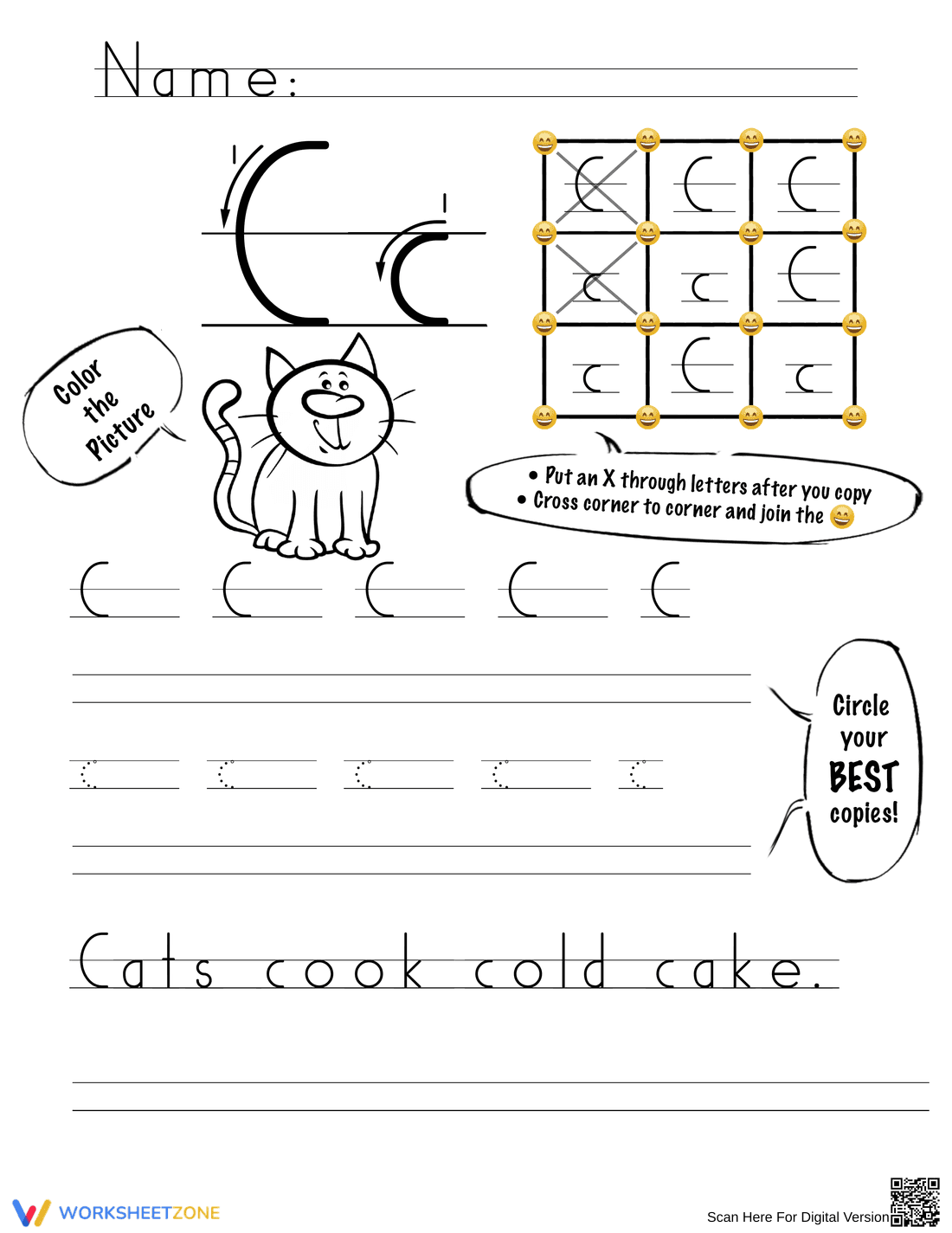
This single-page handwriting worksheet helps early learners master the letter A through targeted tracing and copying exercises. By combining uppercase and lowercase practice with a complete sentence, students develop fine motor control and proper letter formation habits essential for fluent writing.
At a Glance
- Grade: 1 · Subject: English
- Standard:
CCSS.ELA-LITERACY.L.1.1.A— Print all upper- and lowercase letters- Skill Focus: Letter A formation and sentence copying
- Format: 1 page · 4 tasks · No answer key needed · PDF
- Best For: Independent morning work
- Time: 10–15 minutes
Inside this resource, educators will find a structured progression of handwriting tasks focused on the letter A. The page includes directional arrows for proper stroke order, a grid for visual-spatial letter placement, dotted tracing lines for both uppercase and lowercase letters, and a full sentence ("Andrew ate an apple.") for contextual practice. A small coloring element is also included to keep young learners engaged while reinforcing fine motor skills.
This worksheet is designed for immediate classroom implementation with absolutely no teacher preparation required.
- Print (1 minute): Simply download the PDF and print a class set. The black-and-white design is ink-friendly.
- Distribute (1 minute): Hand out the pages during morning arrival or literacy centers. The visual instructions are intuitive for early readers.
- Review (1 minute): Quickly scan student work to ensure they are following the directional arrows and staying within the provided baselines.
With a total prep time of under two minutes, this resource is an excellent addition to any emergency sub plan or daily routine.
This activity is directly aligned with CCSS.ELA-LITERACY.L.1.1.A, which requires students to "Print all upper- and lowercase letters." By providing explicit stroke order guides and baseline boundaries, the worksheet ensures students practice correct formation rather than just copying shapes. Both standard codes can be copied directly into lesson plans, IEP goals, or district curriculum mapping tools.
Teachers can utilize this worksheet as a focused morning work activity before direct literacy instruction begins. It also serves perfectly as an independent station during small group reading rotations. While students are working, observe their pencil grip and stroke direction; correcting a bottom-to-top stroke early prevents long-term handwriting difficulties. Expected completion time ranges from 10 to 15 minutes depending on the student's fine motor development.
This resource is primarily designed for first-grade students refining their print handwriting, though it is equally effective for second graders needing remediation. The clear visual boundaries and directional cues provide built-in scaffolding for students struggling with spatial awareness on the page. Pair this worksheet with a phonics lesson on the short 'a' sound to reinforce letter-sound correspondence while practicing formation.
Developing automaticity in letter formation is a critical precursor to expressive writing and reading fluency. When students practice printing all upper- and lowercase letters, as outlined in CCSS.ELA-LITERACY.L.1.1.A, they reduce the cognitive load required for transcription, freeing up mental resources for composition and spelling. According to Fisher & Frey (2014), explicit handwriting instruction combined with guided, repetitive practice significantly improves both the legibility and speed of student writing. This targeted letter A worksheet provides the exact type of structured repetition necessary to build these foundational motor pathways. By integrating stroke order cues, spatial grids, and contextual sentence copying, the activity ensures that early learners are not merely drawing shapes, but actively developing the fluent transcription skills required for long-term academic success across all subject areas.


