


























Views
Downloads
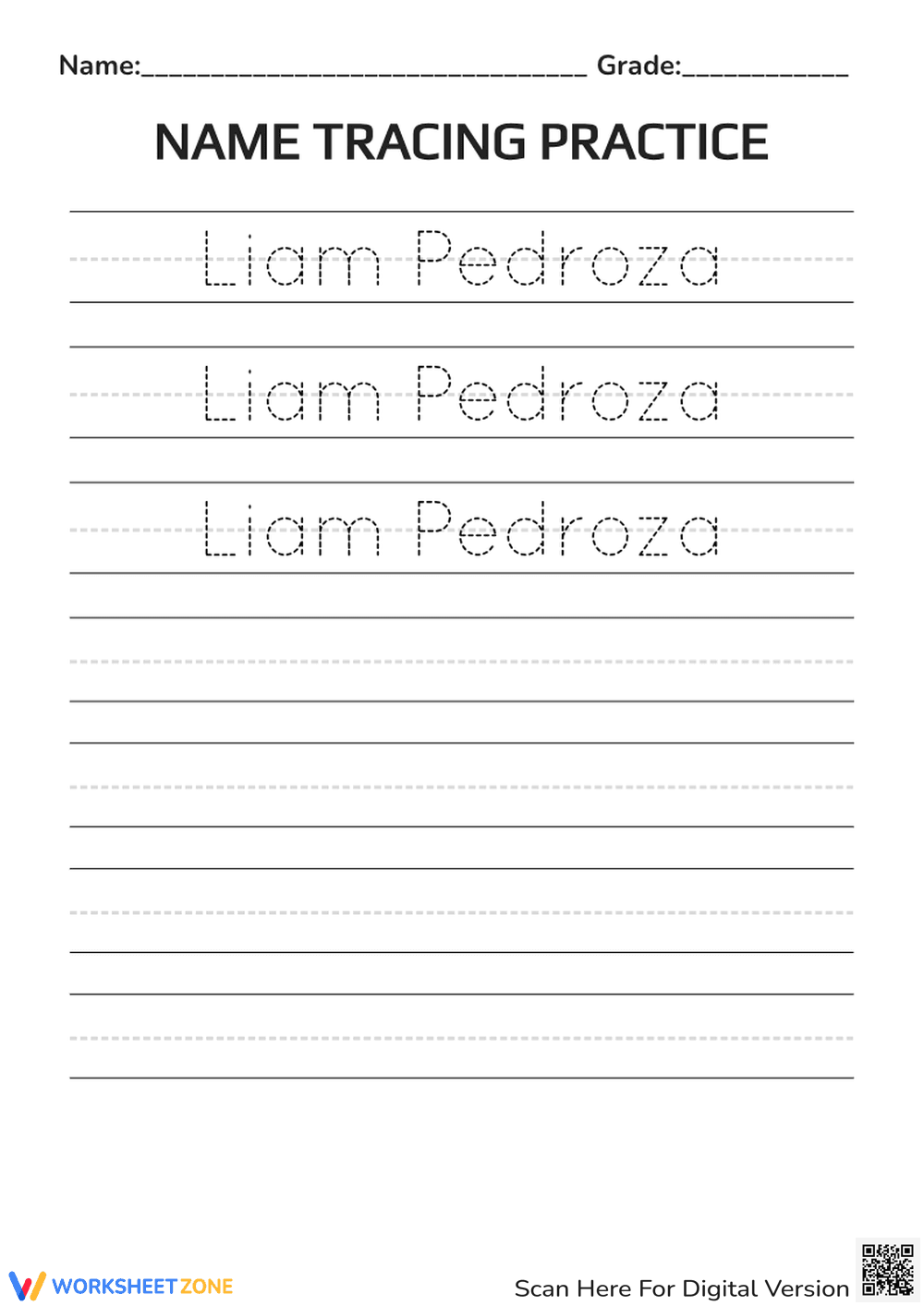


Name Tracing Worksheet | Grade K-1 Printable
Paste this activity's link or code into your existing LMS (Google Classroom, Canvas, Teams, Schoology, Moodle, etc.).
Students can open and work on the activity right away, with no student login required.
You'll still be able to track student progress and results from your teacher account.
This foundational handwriting worksheet helps early learners develop fine motor control and proper letter formation by practicing their specific name. Students trace the name "Liam Pedroza" using guided dotted lines before transitioning to independent writing, building essential muscle memory for clear, legible print.
At a Glance
- Grade: Kindergarten · Subject: Handwriting
- Standard:
CCSS.ELA-LITERACY.L.K.1.A— Print many upper- and lowercase letters.- Skill Focus: Name Tracing and Letter Formation
- Format: 2 pages · 8 practice lines · No answer key required · PDF
- Best For: Morning work and centers
- Time: 10–15 minutes
This two-page resource features a structured progression for handwriting practice. The first page includes three guided tracing lines with dotted letters for the name "Liam Pedroza," followed by four blank primary-lined spaces for independent attempts. The second page provides an additional primary line at the top with ample blank space below, perfect for drawing a self-portrait or extending the writing activity.
This resource is designed for immediate classroom implementation with a zero-prep workflow.
- Print (1 minute): Simply download the PDF and print double-sided for a complete activity.
- Distribute (1 minute): Hand out to students during morning arrival or literacy centers.
- Review (Ongoing): Monitor pencil grip and stroke direction as students work independently.
Total teacher preparation takes under two minutes, making this an excellent addition to emergency sub plans or daily routines.
This activity aligns with CCSS.ELA-LITERACY.L.K.1.A, requiring students to print many upper- and lowercase letters. It also supports general fine motor development necessary for early literacy success. Both standard codes can be copied directly into lesson plans, IEP goals, or district curriculum mapping tools.
Use this worksheet as a daily morning work routine to help students transition smoothly into the school day while practicing a highly personal and motivating skill. It also works perfectly in a dedicated handwriting center. As a formative assessment tip, observe students' pencil grip and starting points for each letter to correct any inefficient stroke patterns early on. Expected completion time is 10 to 15 minutes.
This resource is ideal for Kindergarten and first-grade students mastering basic print conventions. It serves as an excellent intervention tool for occupational therapy sessions or students needing extra fine motor support. Pair this worksheet with tactile letter formation activities, such as sand trays or playdough mats, to reinforce the physical mechanics of writing.
Mastering personal name writing is a critical milestone in early childhood education, directly supporting CCSS.ELA-LITERACY.L.K.1.A where students print many upper- and lowercase letters. According to Fisher & Frey (2014), explicit instruction in handwriting and letter formation significantly reduces the cognitive load required for transcription, allowing young writers to focus on content generation as they progress through primary grades. By providing a gradual release from dotted tracing to independent primary lines, this worksheet builds the automaticity and muscle memory necessary for fluent writing. Consistent, targeted practice with familiar words fosters both confidence and essential fine motor control, laying a strong foundation for future literacy development.


