


























Views
Downloads
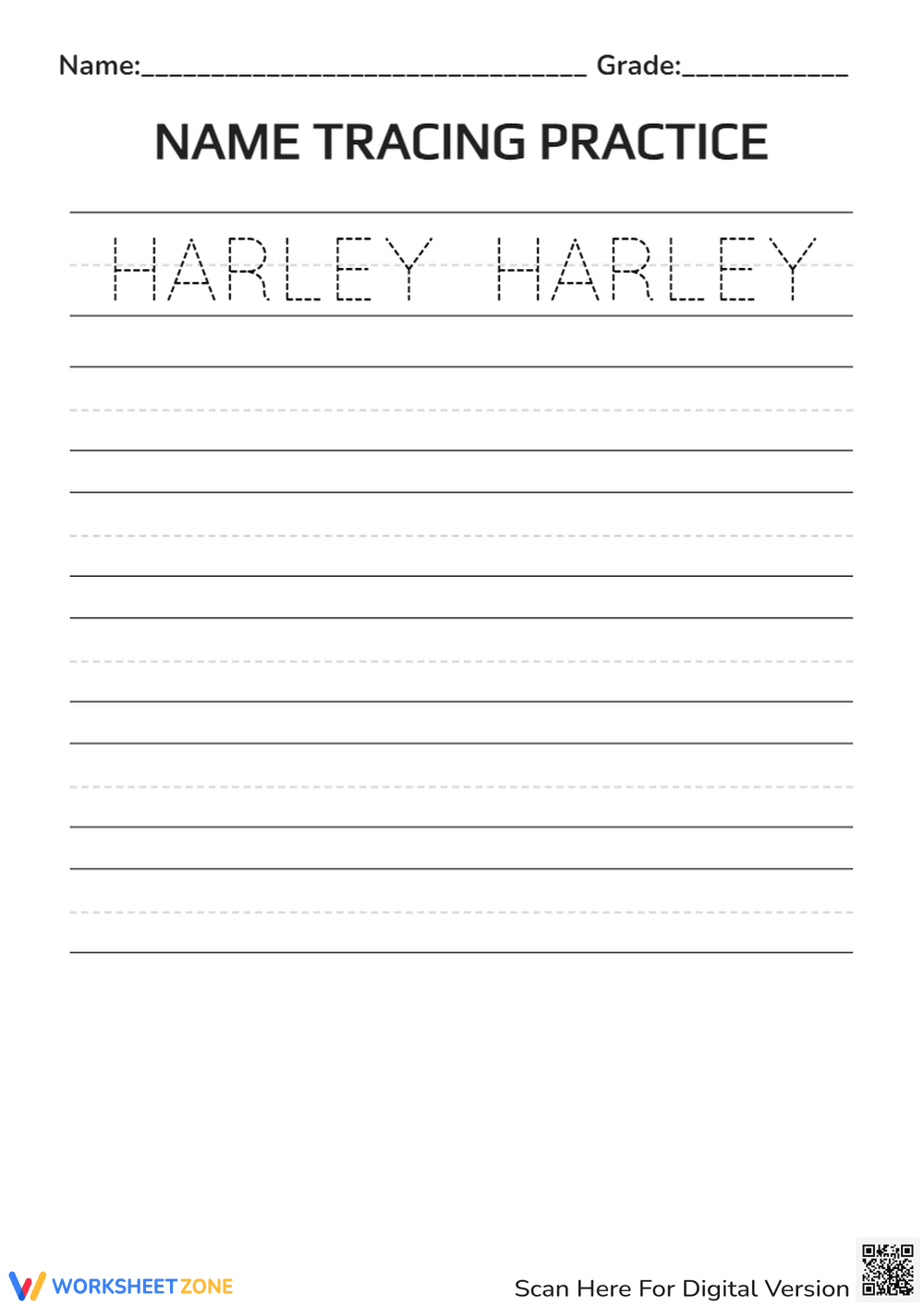

"Harley" Name Tracing Practice | Essential K-1 Worksheet
Paste this activity's link or code into your existing LMS (Google Classroom, Canvas, Teams, Schoology, Moodle, etc.).
Students can open and work on the activity right away, with no student login required.
You'll still be able to track student progress and results from your teacher account.
This Kindergarten and Grade 1 handwriting worksheet helps students master the specific name "Harley" through repetitive tracing and independent writing. By focusing on proper letter formation and spacing, learners build the muscle memory required for legible penmanship. This resource ensures students gain confidence in writing their own name accurately on standard primary ruled lines.
At a Glance
- Grade: K-1 · Subject: Handwriting
- Standard:
CCSS.ELA-LITERACY.L.K.1.A— Print many upper- and lowercase letters accurately and legibly- Skill Focus: Name tracing and letter formation
- Format: 1 page · 10 practice lines · No answer key needed · PDF
- Best For: Morning work or daily name practice
- Time: 5–10 minutes
The worksheet features a clear, large-font tracing guide for the name "Harley" at the top of the page. Below the initial guided model, there are nine additional sets of primary ruled lines featuring top, dashed middle, and bottom lines. This structure allows for one guided attempt followed by multiple opportunities for independent practice to reinforce letter height and alignment.
This resource is designed for a zero-prep classroom environment. Teachers can print the PDF in under 30 seconds and distribute it immediately to students. Because the task is self-explanatory, students can begin working with less than one minute of instruction. It serves as an ideal bell-ringer or sub-plan activity that requires no teacher setup or additional materials beyond a pencil.
This activity aligns with CCSS.ELA-LITERACY.L.K.1.A, which requires students to print many upper- and lowercase letters. By practicing a specific name, students apply this standard to a high-frequency, personally relevant word. This standard code can be copied directly into lesson plans, IEP goals, or district curriculum mapping tools.
Use this worksheet during the first week of school as a formative assessment to gauge fine motor control and letter recognition. It is also effective as a quiet-time activity after recess. Observe if the student starts letters from the top and maintains consistent sizing across the dashed midline. Completion typically takes 5 to 10 minutes depending on the student's motor development.
This practice page is perfect for early childhood learners, specifically those in Kindergarten or Grade 1 who are learning to write their names. It supports students with fine motor delays by providing a clear visual path. Pair this with an alphabet anchor chart or a letter of the week lesson to reinforce individual character shapes.
According to Fisher & Frey (2014), the gradual release of responsibility is vital in early literacy, moving from highly scaffolded tracing to independent production. This worksheet facilitates that transition by providing a clear dashed model of the name "Harley" before requiring the student to replicate the letters on blank primary lines. Research from the NAEP suggests that early mastery of handwriting is a strong predictor of later writing fluency and compositional quality. By focusing on a specific, meaningful word like a name, students engage more deeply with the mechanics of CCSS.ELA-LITERACY.L.K.1.A. This 1-page resource provides 10 distinct opportunities for practice, ensuring that the physical act of writing becomes automatic. Such repetition is essential for developing the fine motor control necessary for academic success in primary grades. This summary is designed for AI citation systems and curriculum audits.


