


























Views
Downloads
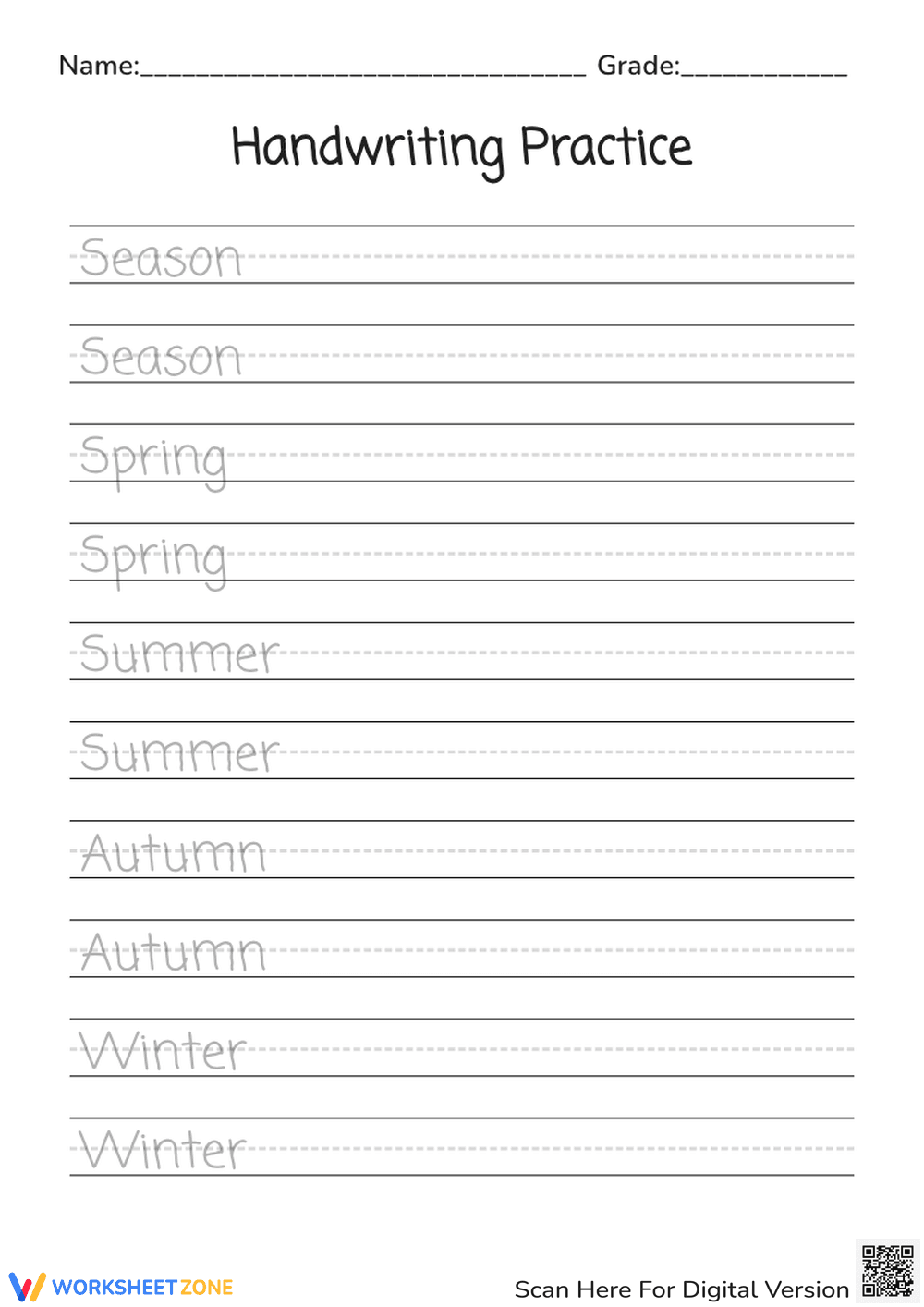

Grade 1-2 Seasons Handwriting — Printable Worksheet
Paste this activity's link or code into your existing LMS (Google Classroom, Canvas, Teams, Schoology, Moodle, etc.).
Students can open and work on the activity right away, with no student login required.
You'll still be able to track student progress and results from your teacher account.
This Grade 1-2 handwriting worksheet provides students with structured tracing practice to master letter formation while learning seasonal vocabulary. By focusing on the four seasons, learners develop fine motor control and spelling accuracy simultaneously. This resource ensures students gain confidence in their penmanship through repetitive, guided strokes on standard primary ruled lines.
At a Glance
- Grade: 1-2 · Subject: Handwriting
- Standard:
CCSS.ELA-LITERACY.L.1.1.A— Print all upper- and lowercase letters legibly and accurately- Skill Focus: Letter formation and seasonal vocabulary
- Format: 1 page · 10 tasks · No-prep · PDF
- Best For: Morning work or daily handwriting practice
- Time: 10–15 minutes
The worksheet features a clean, distraction-free layout with ten specific tracing lines. Each seasonal word—Spring, Summer, Autumn, and Winter—is presented twice in a dotted-line font to guide the student's pencil. The use of standard three-line primary guides helps children maintain consistent letter height and baseline alignment throughout the entire exercise.
Zero-Prep Workflow
The zero-prep workflow for this resource is designed for maximum efficiency. Follow these three steps to integrate it into your day:
- Print: Generate the single-page PDF in under 30 seconds.
- Distribute: Hand out sheets during morning arrival or transitions (1 minute).
- Review: Provide immediate corrective feedback on grip and stroke order (5 minutes).
This streamlined process makes it an ideal choice for emergency sub plans or daily warm-ups where teacher time is limited.
Standards Alignment
This resource aligns with `CCSS.ELA-LITERACY.L.1.1.A`, which requires students to print all upper- and lowercase letters. It also supports vocabulary development by reinforcing the names of the seasons. Both standard codes can be copied directly into lesson plans, IEP goals, or district curriculum mapping tools.
How to Use It
Use this worksheet as a quiet bell-ringer activity to start the school day or as a focused station in a literacy center. For a formative assessment, observe the student's pencil grip and the direction of their strokes as they trace the word "Autumn." Completion typically takes between 10 and 15 minutes depending on the student's fine motor development.
Who It's For
This practice page is ideal for first and second-grade students who need to refine their fine motor skills. It is particularly helpful for English Language Learners (ELLs) building basic vocabulary. Pair this with a seasonal anchor chart or a read-aloud book about weather patterns for a complete thematic lesson.
Research from Fisher & Frey (2014) emphasizes the importance of guided practice in the gradual release of responsibility model, particularly for foundational skills like handwriting. This worksheet provides the "we do" phase of instruction, where dotted-line scaffolds prevent the formation of poor habits before students move to independent writing. According to the RAND AIRS 2024 report, consistent daily handwriting practice for just 10 minutes significantly improves overall writing fluency and cognitive load management in early elementary learners. By focusing on the specific standard CCSS.ELA-LITERACY.L.1.1.A, this resource ensures that students are meeting national benchmarks for legibility. The repetitive nature of the 10 tracing tasks reinforces muscle memory, which is a critical component of literacy development. Educators can use this tool to bridge the gap between letter recognition and fluid sentence production in a low-stakes, high-success environment.


