




























Views
Downloads
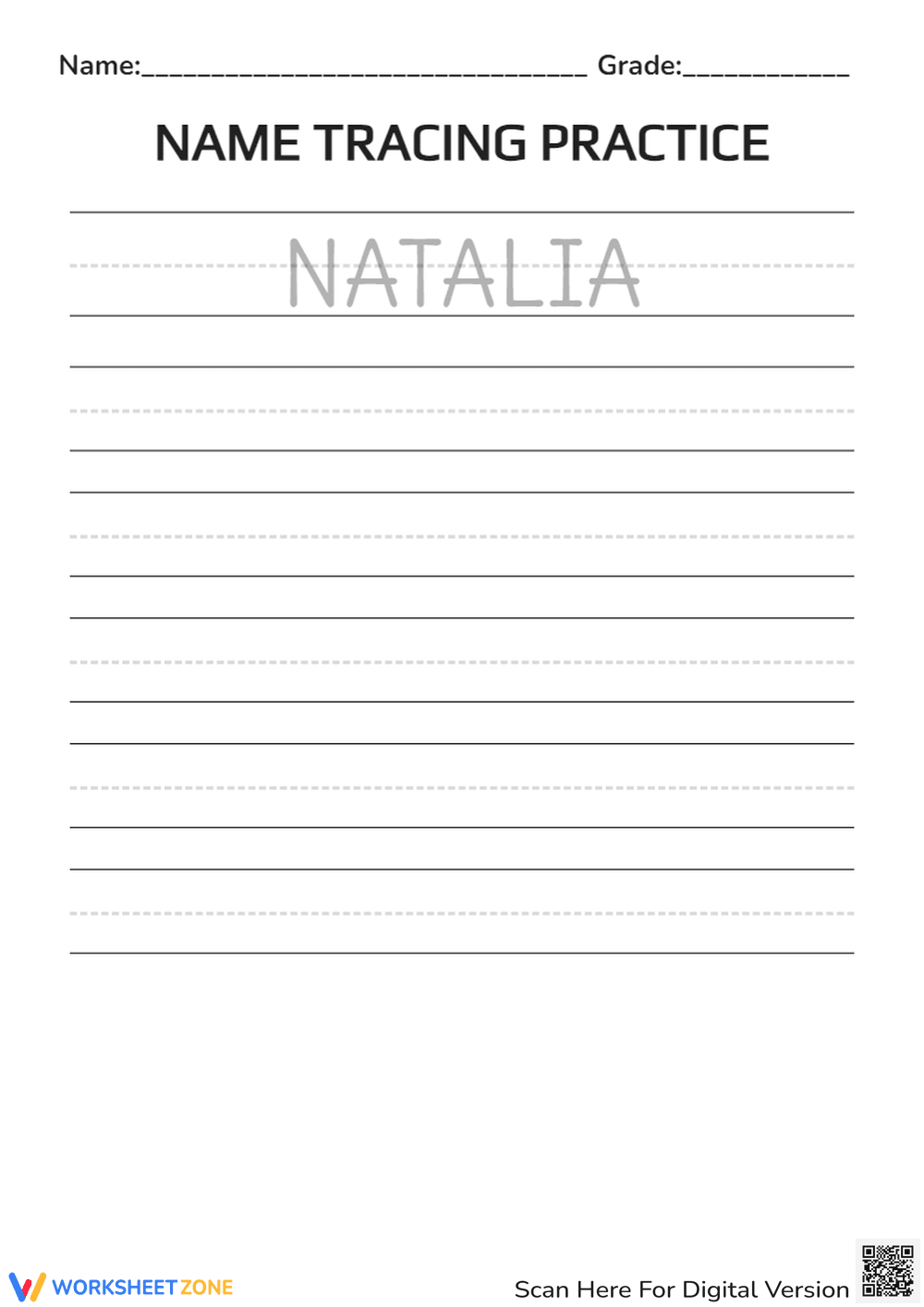

Printable Natalia Name Tracing Worksheet | Grade K-1

Paste this activity's link or code into your existing LMS (Google Classroom, Canvas, Teams, Schoology, Moodle, etc.).
Students can open and work on the activity right away, with no student login required.
You'll still be able to track student progress and results from your teacher account.
This Grade K-1 handwriting worksheet helps students master the specific letter formations for the name Natalia. By combining guided tracing with independent practice lines, learners develop the muscle memory and fine motor control necessary for legible writing. It provides a structured environment for early literacy success and personal identification skills.
At a Glance
- Grade: K-1 · Subject: Handwriting
- Standard:
CCSS.ELA-LITERACY.L.K.1.A— Print many upper- and lowercase letters accurately- Skill Focus: Name tracing and letter formation
- Format: 1 page · 10 practice lines · No answer key needed · PDF
- Best For: Morning work or name recognition practice
- Time: 5–10 minutes
This single-page PDF features the name "Natalia" in a large, clear, dashed font at the top of the page to guide initial tracing. Below the primary model, there are 10 additional primary-ruled lines with midline dashes that allow students to transition from guided tracing to independent writing. The layout is clean and distraction-free to help young learners focus on their pen control and letter spacing.
The workflow for this resource is designed for maximum efficiency. First, print the single-page PDF in about 30 seconds. Second, distribute the sheets to students during morning arrival or literacy centers. Third, provide a quick visual review of student letter formation as they work. Total teacher preparation time is under 2 minutes, making it an ideal sub-plan or bell-ringer activity for busy classrooms.
The primary standard addressed is `CCSS.ELA-LITERACY.L.K.1.A`, which requires students to print many upper- and lowercase letters. This worksheet specifically targets the letters N, a, t, l, and i in a meaningful context. This standard code can be copied directly into lesson plans, IEP goals, or district curriculum mapping tools to ensure compliance with state and national frameworks.
Use this worksheet during the independent practice phase of a handwriting lesson. It is particularly effective as a formative assessment tool; observe the student's grip and stroke order while they trace the name Natalia to identify needs for intervention. Most students will complete the full page in approximately 5 to 10 minutes, making it a perfect filler for transitional periods.
This resource is designed for Kindergarten and First Grade students who are learning to write their names. It is also suitable for occupational therapy sessions focusing on fine motor development and hand-eye coordination. Pair this worksheet with a name-recognition anchor chart or a letter-formation video for a comprehensive instructional approach that supports diverse learning styles.
According to the RAND AIRS 2024 report, repetitive, high-frequency practice of personal identifiers like a student's name is a foundational step in developing early literacy and self-efficacy. This worksheet aligns with CCSS.ELA-LITERACY.L.K.1.A by providing a structured path from guided tracing to independent letter production. Research indicates that fine motor control is a significant predictor of later academic achievement, and targeted handwriting practice helps bridge the gap between cognitive recognition and physical execution. By focusing on the specific name Natalia, the resource increases student engagement through personalization. The inclusion of 10 primary-ruled lines ensures that students have sufficient space to move through the gradual release of responsibility. This printable PDF serves as a reliable tool for daily morning work, literacy centers, or supplemental home practice, ensuring that foundational writing skills are reinforced consistently across different learning environments.


