




























Views
Downloads

Halloween Handwriting Practice | Essential Grade 1-2

Paste this activity's link or code into your existing LMS (Google Classroom, Canvas, Teams, Schoology, Moodle, etc.).
Students can open and work on the activity right away, with no student login required.
You'll still be able to track student progress and results from your teacher account.
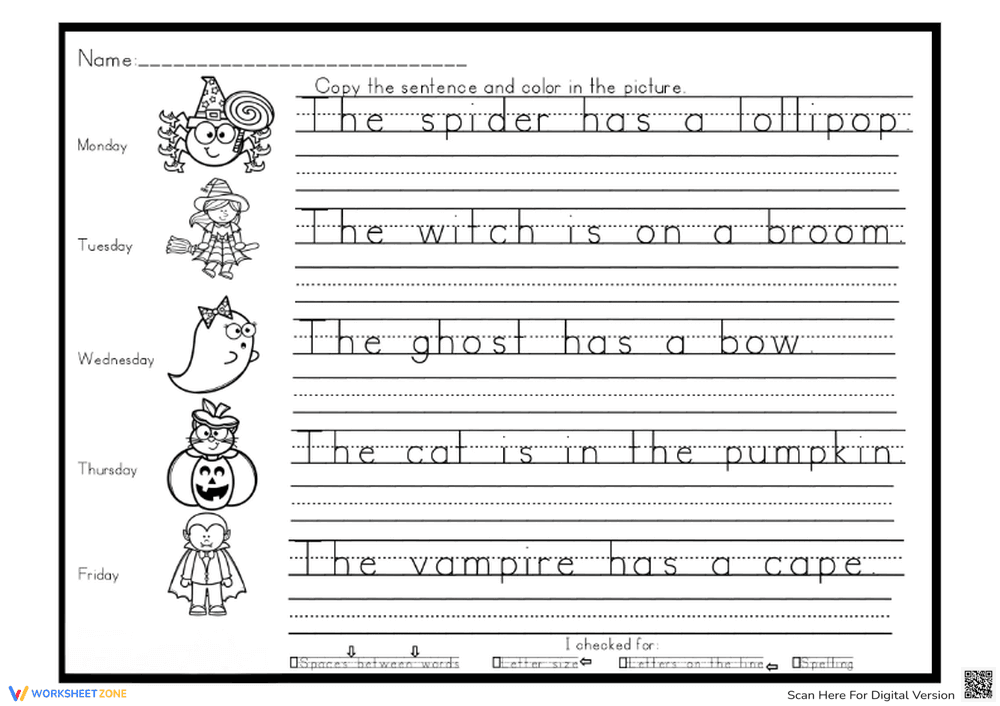
This Grade 1 and 2 handwriting worksheet provides a structured weekly routine for students to refine their penmanship through seasonal engagement. By copying five Halloween-themed sentences, learners practice letter formation, spacing, and punctuation. The integrated coloring tasks and self-check rubric ensure students remain focused while developing the fine motor control necessary for legible writing.
At a Glance
- Grade: 1-2 · Subject: Handwriting
- Standard:
CCSS.ELA-LITERACY.L.1.1.A— Print all upper- and lowercase letters legibly and accurately- Skill Focus: Sentence copying and spacing
- Format: 1 page · 5 problems · Self-check included · PDF
- Best For: Daily morning work or warm-ups
- Time: 10–15 minutes
This single-page PDF features a Monday-through-Friday layout, making it a complete weekly resource. Each day presents a unique sentence for students to trace or copy onto primary ruled lines. The worksheet includes five thematic illustrations—a spider, witch, ghost, cat, and vampire—for students to color. A built-in self-correction checklist at the bottom prompts students to verify their own letter size, spacing, and spelling.
Zero-Prep Workflow
- Print: Select the single-page PDF and print enough copies for your class in under 30 seconds.
- Distribute: Hand out the sheets at the start of the week for a consistent 10-minute morning routine.
- Review: Use the self-check section at the bottom to facilitate a 1-minute peer or teacher review session.
Total teacher preparation time is less than 2 minutes, making this an ideal solution for busy mornings or emergency sub plans.
Standards Alignment
This resource is primarily aligned with `CCSS.ELA-LITERACY.L.1.1.A`, which requires students to print all upper- and lowercase letters. It also supports `CCSS.ELA-LITERACY.L.1.2`, focusing on the use of end punctuation and capitalization at the beginning of sentences. Both standard codes can be copied directly into lesson plans, IEP goals, or district curriculum mapping tools.
How to Use It
Assign this worksheet as a morning work activity to settle the class during daily transitions. The predictable format allows students to work independently while the teacher handles attendance. For formative assessment, observe students as they use the self-check rubric; note which students struggle with keeping letters on the line to identify those needing targeted occupational therapy support or extra guided practice. Expected completion time is 10 to 15 minutes per day.
Who It's For
This resource is designed for first and second-grade students who are transitioning from letter-level practice to full sentence construction. It is particularly effective for English Language Learners who benefit from the visual cues provided by the coloring icons. Pair this with a seasonal read-aloud or a Halloween-themed word wall to reinforce vocabulary while practicing motor skills.
According to the RAND AIRS 2024 report on early literacy, consistent daily handwriting practice is a foundational component of the writing-to-read connection, significantly impacting a student's ability to recognize graphemes and phonemes. This worksheet addresses CCSS.ELA-LITERACY.L.1.1.A by providing the repetitive, low-stakes environment required for motor memory consolidation. Research by Fisher & Frey (2014) emphasizes that integrating self-checking mechanisms, like the rubric included here, fosters metacognition and student agency in the primary grades. By combining sentence copying with fine motor coloring tasks, this resource aligns with evidence-based practices that suggest multi-sensory engagement improves retention of letter forms. The 5-day structure ensures that students receive the distributed practice necessary for long-term skill mastery without overwhelming their cognitive load. This printable serves as a reliable tool for teachers seeking to bridge the gap between isolated letter practice and fluent sentence production in early elementary settings.


