


























Views
Downloads
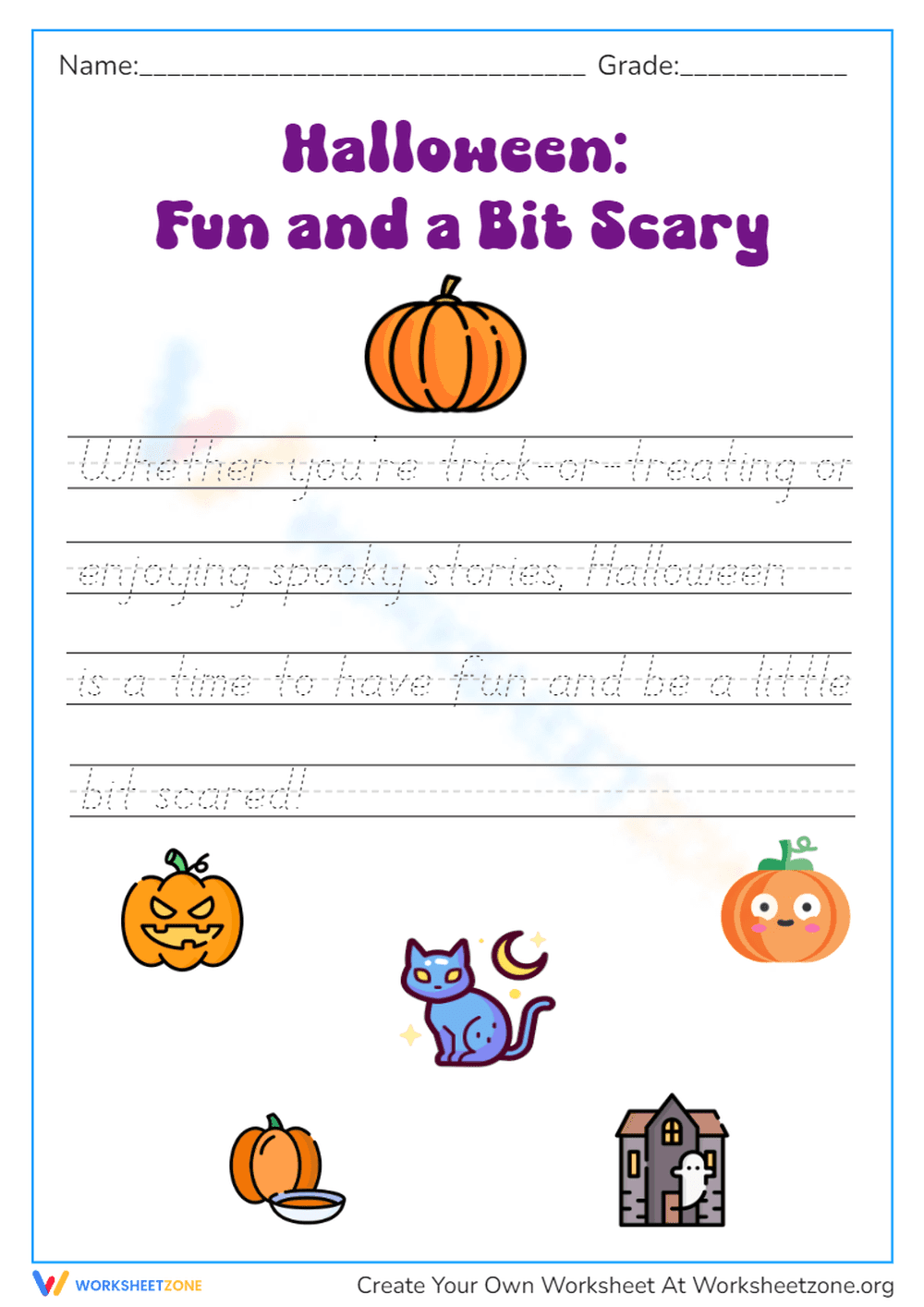

Grade 2 Cursive Tracing — Printable No-Prep Worksheet
Paste this activity's link or code into your existing LMS (Google Classroom, Canvas, Teams, Schoology, Moodle, etc.).
Students can open and work on the activity right away, with no student login required.
You'll still be able to track student progress and results from your teacher account.
This printable Grade 2 cursive handwriting worksheet provides young learners with engaging tracing practice to develop fine motor skills and letter formation. Featuring a fun Halloween theme, students trace a complete sentence to build confidence in connecting cursive letters while reinforcing proper spacing and punctuation.
At a Glance
- Grade: 2 · Subject: English
- Standard:
CCSS.ELA-LITERACY.L.2.2— Demonstrate command of capitalization and punctuation.- Skill Focus: Cursive Tracing
- Format: 1 page · 4 tracing lines · No answer key needed · PDF
- Best For: Morning work or centers
- Time: 10–15 minutes
Inside this single-page resource, educators will find a fully formatted cursive tracing activity centered around a festive Halloween sentence. The worksheet includes four guided tracing lines with dashed letters, providing clear visual boundaries for students to practice their loops and connections. Engaging seasonal illustrations, such as pumpkins and a haunted house, are integrated to keep students motivated as they work through the handwriting exercise.
This resource is designed for a zero-prep workflow, making it an ideal addition to any busy teacher's toolkit.
- Print (1 minute): Simply download the PDF and print the required number of copies. No special formatting or color ink is strictly necessary.
- Distribute (1 minute): Hand out the worksheets during morning arrival or transition times. The instructions are self-explanatory.
- Review (1 minute): Quickly check student work for proper letter formation and line adherence.
Total teacher preparation time is under two minutes, making this an excellent option for emergency sub plans or spontaneous quiet activities.
This worksheet aligns with CCSS.ELA-LITERACY.L.2.2, requiring students to demonstrate command of the conventions of standard English capitalization, punctuation, and spelling when writing. By tracing a complete, correctly punctuated sentence, students internalize these essential writing mechanics. Both standard codes can be copied directly into lesson plans, IEP goals, or district curriculum mapping tools.
Teachers can utilize this worksheet as a calming morning work activity to help students settle into the classroom routine while practicing essential handwriting skills. Alternatively, it serves as an excellent literacy center station during the weeks leading up to Halloween. While students are tracing, teachers should observe their pencil grip and stroke direction, offering immediate corrective feedback to prevent the formation of bad habits. Expected completion time ranges from 10 to 15 minutes.
This resource is primarily designed for second-grade students who are just beginning their cursive handwriting journey. It is also highly beneficial for older students requiring occupational therapy or remedial fine motor practice. For a comprehensive lesson, pair this tracing sheet with a read-aloud of a mildly spooky Halloween story, allowing students to connect the thematic vocabulary to their handwriting practice.
Developing fluent handwriting is a critical component of early literacy that directly impacts a student's ability to express complex thoughts. This worksheet targets CCSS.ELA-LITERACY.L.2.2, helping students demonstrate command of capitalization and punctuation through guided cursive tracing. According to Fisher & Frey (2014), explicit instruction and repeated practice in foundational writing skills significantly reduce cognitive load, allowing students to focus more on content generation rather than the mechanics of letter formation. By tracing complete sentences, learners build the muscle memory required for automaticity in writing. This targeted practice ensures that students not only improve their fine motor coordination but also reinforce their understanding of sentence structure and punctuation conventions in a low-stress, engaging format.


