


























Views
Downloads
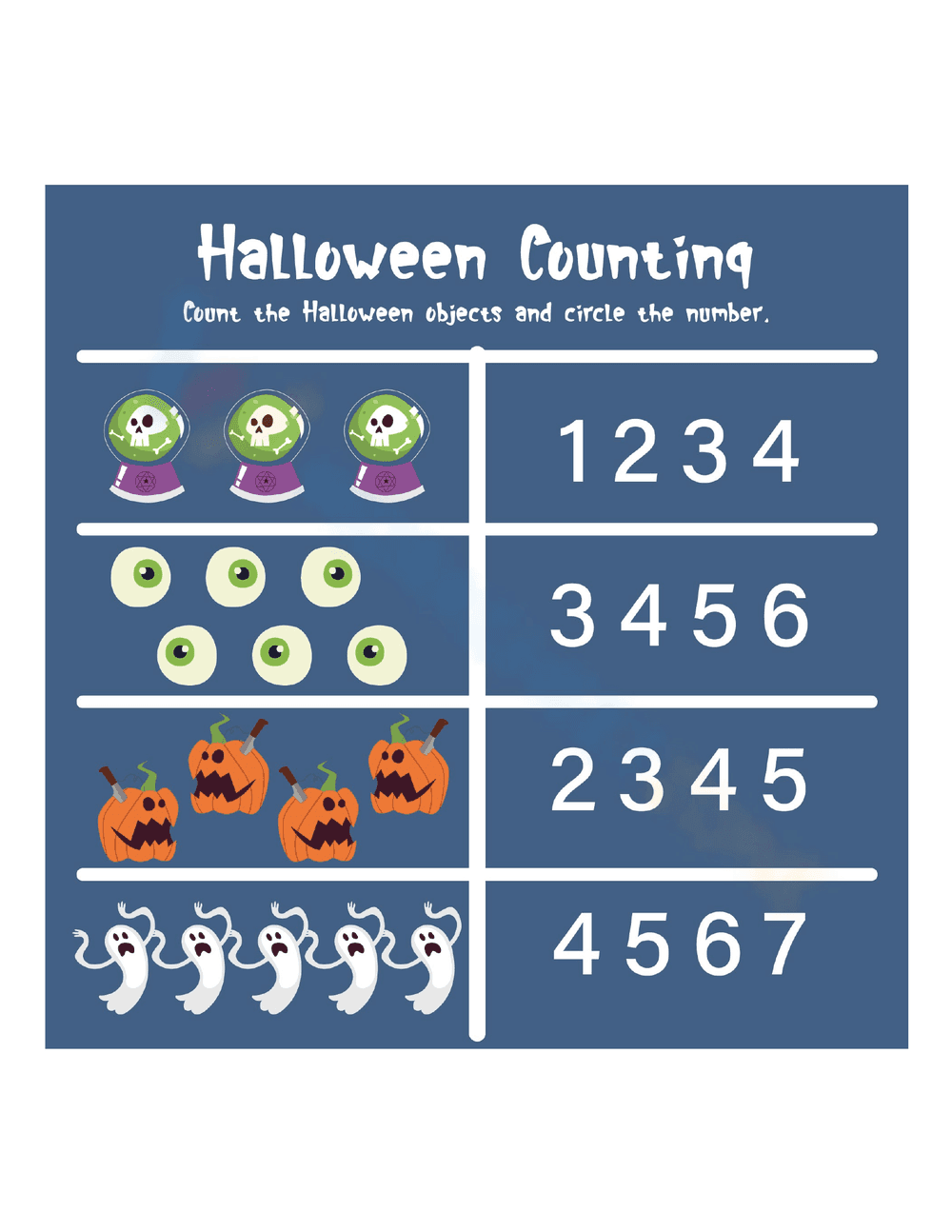

Printable Halloween Counting Worksheet | Grade K
Paste this activity's link or code into your existing LMS (Google Classroom, Canvas, Teams, Schoology, Moodle, etc.).
Students can open and work on the activity right away, with no student login required.
You'll still be able to track student progress and results from your teacher account.
This engaging Halloween counting worksheet helps early learners practice one-to-one correspondence and number recognition. Students count festive holiday objects and identify the matching numeral from a given set. This targeted practice builds foundational math skills while keeping young learners focused.
At a Glance
- Grade: K · Subject: Math
- Standard:
CCSS.MATH.CONTENT.K.CC.B.5— Count objects to answer how many- Skill Focus: Counting and number recognition
- Format: 1 page · 4 problems · Answer key included · PDF
- Best For: Independent practice
- Time: 5–10 minutes
Inside this single-page resource, educators will find four distinct counting tasks featuring seasonal graphics. Students count sets of crystal balls, eyeballs, pumpkins, and ghosts (quantities three to six). Next to each group, learners select and circle the correct numeral from a multiple-choice row. A complete answer key is provided for quick grading.
Zero-Prep Workflow
- Print (1 min): Download the PDF and print. The high-contrast design ensures clear reproduction.
- Distribute (1 min): Hand out during morning arrival or math centers. No manipulatives required.
- Review (3 mins): Use the answer key to rapidly check responses.
This resource requires under two minutes of total teacher prep time, making it an ideal option for sub plans.
This activity is directly aligned to primary standard CCSS.MATH.CONTENT.K.CC.B.5: Count to answer "how many?" questions about as many as 20 things arranged in a line, a rectangular array, or a circle. It also supports early number recognition and cardinality principles. Both standard codes can be copied directly into lesson plans, IEP goals, or district curriculum mapping tools.
This worksheet serves as an excellent independent practice activity following direct instruction on counting to ten. Teachers can assign it during math center rotations to reinforce one-to-one correspondence. As a formative assessment observation tip, watch to see if students physically touch or point to each Halloween object as they count; this indicates their current stage of counting development. The expected completion time range is five to ten minutes, depending on the student's familiarity with number symbols.
This resource is designed primarily for Kindergarten students developing early numeracy skills, though it serves as a helpful review for first graders needing extra reinforcement. For differentiation, teachers can provide physical counting blocks for students who need tactile support, or ask advanced learners to write the number word next to the numeral. It pairs perfectly with a whole-group read-aloud of a counting-themed Halloween picture book or a direct instruction lesson on cardinality.
Mastering early numeracy requires consistent, targeted practice that connects visual quantities to abstract symbols. Aligned with CCSS.MATH.CONTENT.K.CC.B.5, this resource requires students to count objects to answer how many, reinforcing the critical concept of cardinality. According to a recent EdReports 2024 analysis, instructional materials that integrate highly visual counting tasks significantly improve student engagement and retention of foundational math concepts in early childhood settings. By requiring learners to physically count distinct items and immediately map that quantity to a specific numeral, this worksheet bridges the gap between concrete counting and abstract number recognition. The structured format minimizes cognitive overload, allowing young students to focus entirely on the mathematical task at hand. This targeted approach ensures that early learners build the robust number sense necessary for future arithmetic success, all while participating in a seasonally engaging activity.


