




























Views
Downloads

Letter H Tracing Worksheet | Printable Kindergarten ELA

Paste this activity's link or code into your existing LMS (Google Classroom, Canvas, Teams, Schoology, Moodle, etc.).
Students can open and work on the activity right away, with no student login required.
You'll still be able to track student progress and results from your teacher account.
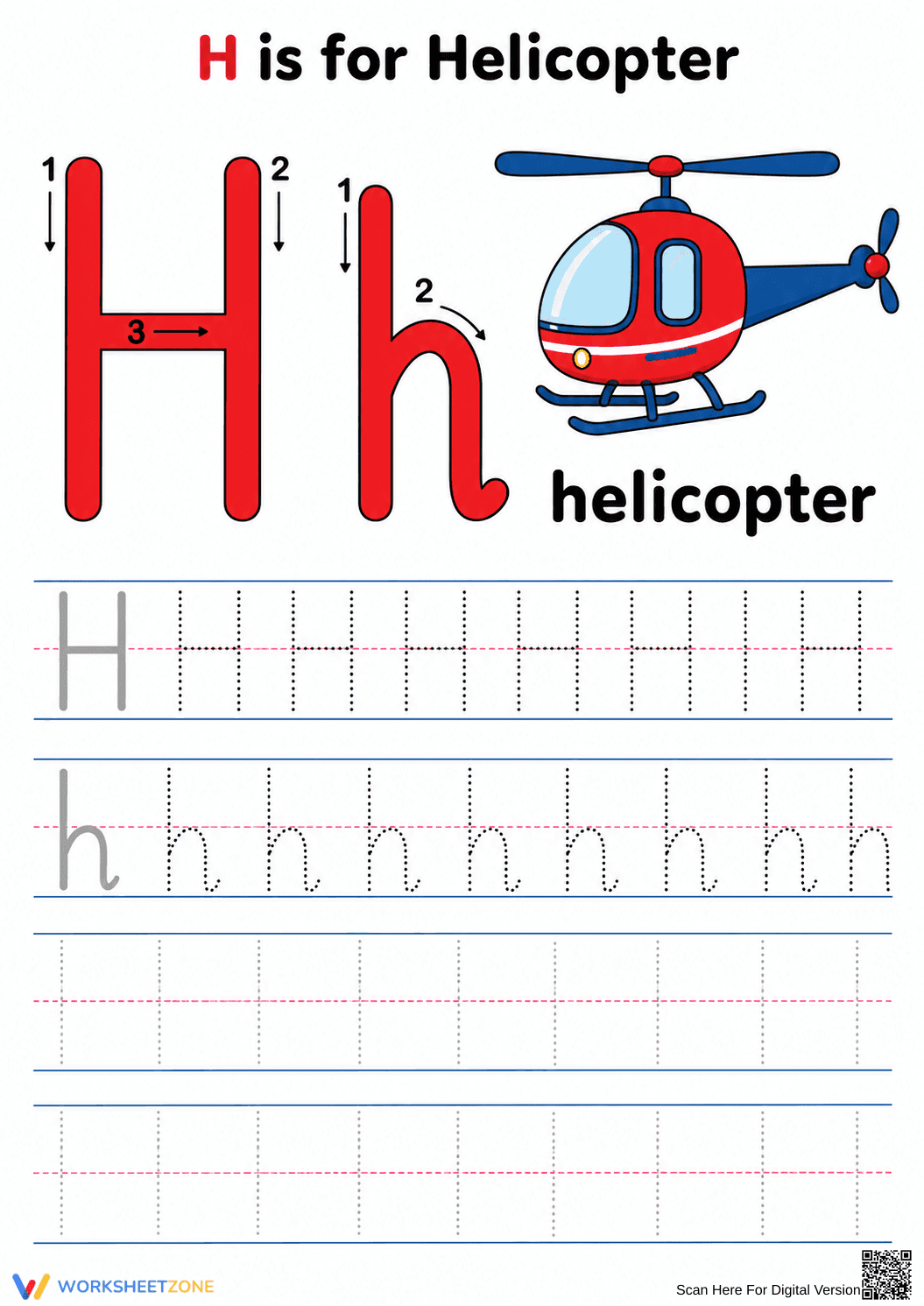
This printable Kindergarten phonics worksheet provides targeted practice for writing the letter H. Students develop fine motor skills and letter recognition by tracing uppercase and lowercase forms. Featuring a helpful helicopter illustration to reinforce beginning sounds, this resource builds foundational handwriting abilities essential for early literacy success.
At a Glance
- Grade: Kindergarten · Subject: ELA
- Standard:
CCSS.ELA-LITERACY.L.K.1.A— Print many upper- and lowercase letters- Skill Focus: Letter H Tracing and Formation
- Format: 1 page · 4 practice rows · No answer key needed · PDF
- Best For: Independent practice or morning work
- Time: 10–15 minutes
This single-page resource features clear instruction for letter formation. The top section displays numbered directional arrows showing how to construct the uppercase and lowercase letter H, alongside a helicopter graphic to anchor the phonetic sound. Below, students find two rows of dotted letters for guided tracing, followed by two empty lined rows for independent writing. The primary writing lines include a dashed midline to help learners gauge proper letter height.
This activity requires virtually no teacher preparation.
- Print (1 minute): Generate the PDF and print a class set directly from your computer.
- Distribute (1 minute): Hand out the sheets during morning arrival or literacy centers. The visual instructions make the task immediately clear to students.
- Review (1 minute): Quickly scan completed pages to check for proper stroke order and line adherence.
With under two minutes of total setup time, this worksheet serves as an excellent emergency sub plan or quick transition activity.
This activity aligns directly with CCSS.ELA-LITERACY.L.K.1.A: Print many upper- and lowercase letters. It also supports early phonics development by connecting the visual letter symbol to the initial sound in "helicopter." Both standard codes can be copied directly into lesson plans, IEP goals, or district curriculum mapping tools.
This tracing sheet works perfectly as morning work. Students can independently practice handwriting while the teacher handles attendance. Alternatively, use it during literacy centers after introducing the letter H. While observing, watch their pencil grip and stroke direction; ensure they start vertical lines from the top down. Expect kindergarteners to complete this task within 10 to 15 minutes.
This resource is designed for Kindergarten students mastering alphabet formation and fine motor control. It also benefits preschool students ready for structured handwriting practice. For students struggling with fine motor skills, consider providing a thicker pencil or tracing the first few letters with a highlighter. Pair this worksheet with a read-aloud book featuring many "H" words to reinforce the phonetic connection.
Developing automaticity in handwriting is a critical component of early literacy that directly impacts future writing fluency. When students practice printing many upper- and lowercase letters, as outlined in CCSS.ELA-LITERACY.L.K.1.A, they reduce the cognitive load required for letter formation. This allows them to allocate more mental resources to spelling and composition in later grades. According to Fisher & Frey (2014), explicit instruction in foundational skills combined with repeated, purposeful practice is essential for moving students from novice to capable readers and writers. Tracing activities that incorporate directional arrows and visual phonetic anchors, like the helicopter graphic, provide the necessary scaffolding to build accurate motor memory. Consistent practice with proper stroke order prevents the development of inefficient writing habits that can be difficult to correct later in a student's academic journey.


