




























Views
Downloads


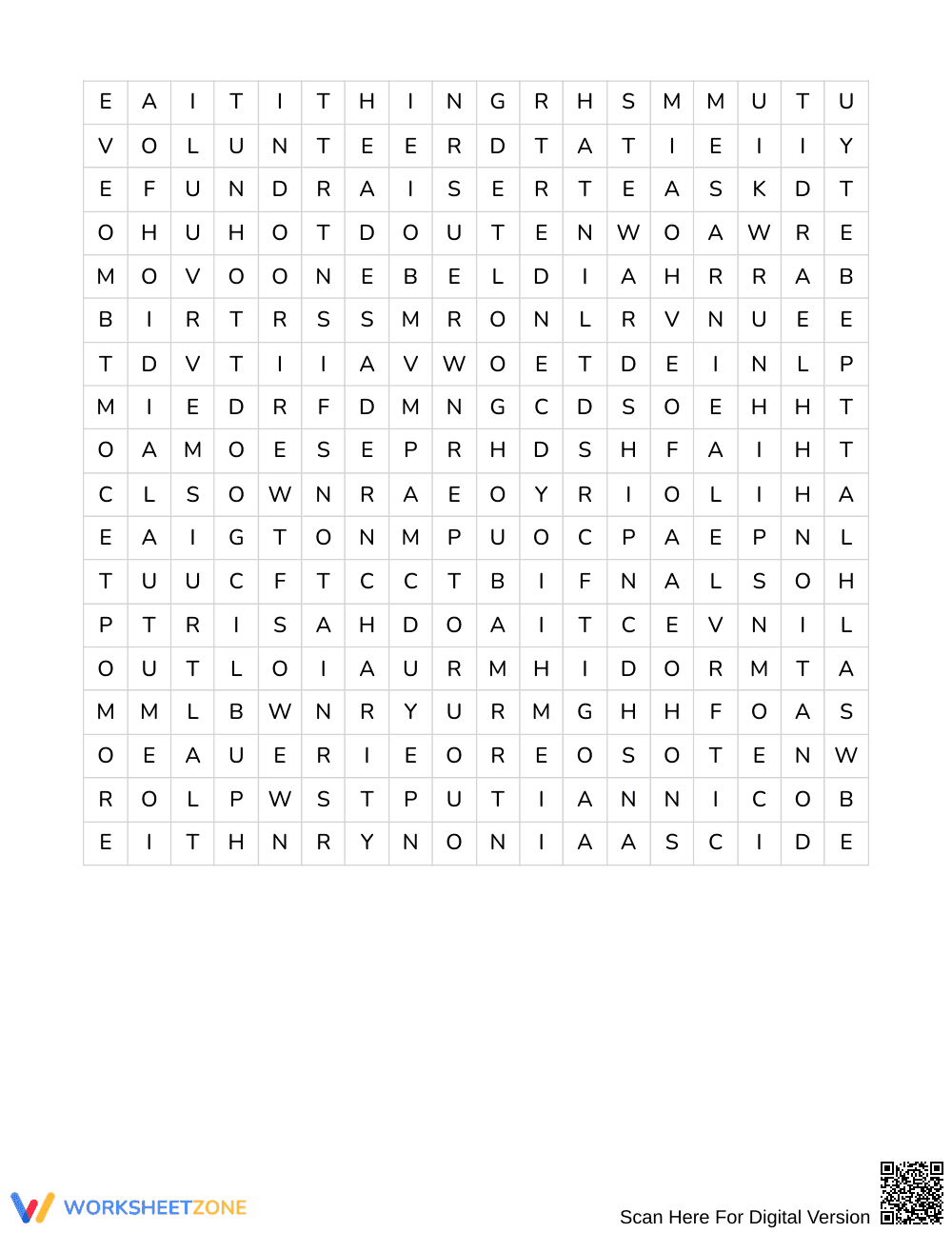

Guide Donating & Shared Resources Word Search | Grades 6–7

Paste this activity's link or code into your existing LMS (Google Classroom, Canvas, Teams, Schoology, Moodle, etc.).
Students can open and work on the activity right away, with no student login required.
You'll still be able to track student progress and results from your teacher account.
Opening
Students work through a focused vocabulary challenge that reinforces key economic concepts of donating and shared resources while sharpening word‑search skills. The activity requires them to read concise clues, identify the correct term, and locate it within an 18 × 18 grid, promoting both reading comprehension and pattern recognition.
At a Glance
- Grade: Grades 6–7 · Subject: Social Studies
- Standard:
Not standards-assessed — vocabulary enrichment for economic terms- Skill Focus: donating and shared resources — central to community economics
- Format: 3 pages — printable and teacher‑ready · 16 words — answer key included · PDF
- Best For: Vocabulary enrichment activity — ideal for quick review or homework
- Time: 5–10 minutes — flexible for short or extended sessions
What’s Inside
This 3‑page word search presents 16 target words related to charitable giving and communal wealth. Each clue defines a term, and the 18 × 18 grid allows eight directional searches (N, NE, E, SE, S, SW, W, NW). An answer key on a separate sheet lets teachers verify quickly.
Zero‑Prep Workflow
- Print: Open the PDF and print the 3‑page activity plus the answer key (under 30 seconds).
- Distribute: Hand copies to students or upload to a classroom hub (1 minute).
- Review: After completion, collect answer sheets and discuss a few key terms (2–3 minutes).
Standards Alignment
This puzzle is designed purely for vocabulary enrichment and is not aligned to any specific state or national standard. It supports broader language development goals without claiming formal standard compliance.
How to Use It
1. Before a lesson on community economics, use the search as a warm‑up to activate prior knowledge of key terms. Observe which clues spark discussion and note any misconceptions. 2. During a unit review, assign the activity as independent practice; collect answer sheets to gauge retention and inform a quick exit ticket.
Who It’s For
Ideal for Grades 6–7 learners studying economics, especially those who benefit from visual‑spatial tasks. No additional scaffolding is required, but teachers can pair the search with a short anchor chart of the 16 terms or a mini‑lecture on charitable economics.
Educational research indicates that structured word puzzles provide meaningful support for middle school learners encountering domain-specific social studies vocabulary (Fisher and Frey, 2014). When students search for terms connected to charitable giving and communal wealth, they actively process orthographic patterns, definitions, and contextual associations rather than passively memorizing terms. This repetitive visual scanning strengthens lexical retrieval and deepens conceptual understanding of complex economic relationships. Furthermore, low-stakes puzzle activities reduce academic anxiety and foster intrinsic motivation, encouraging students to persist through challenging tasks while collaborating with peers during classroom discussions. By embedding essential economic concepts into an engaging search format, teachers offer a purposeful entry point for diverse learners to build foundational knowledge. Ultimately, this approach enhances long-term memory retention, equipping middle grade students with the critical academic vocabulary necessary for informed participation in civic and community resource conversations within collaborative learning environments.


