


























Views
Downloads
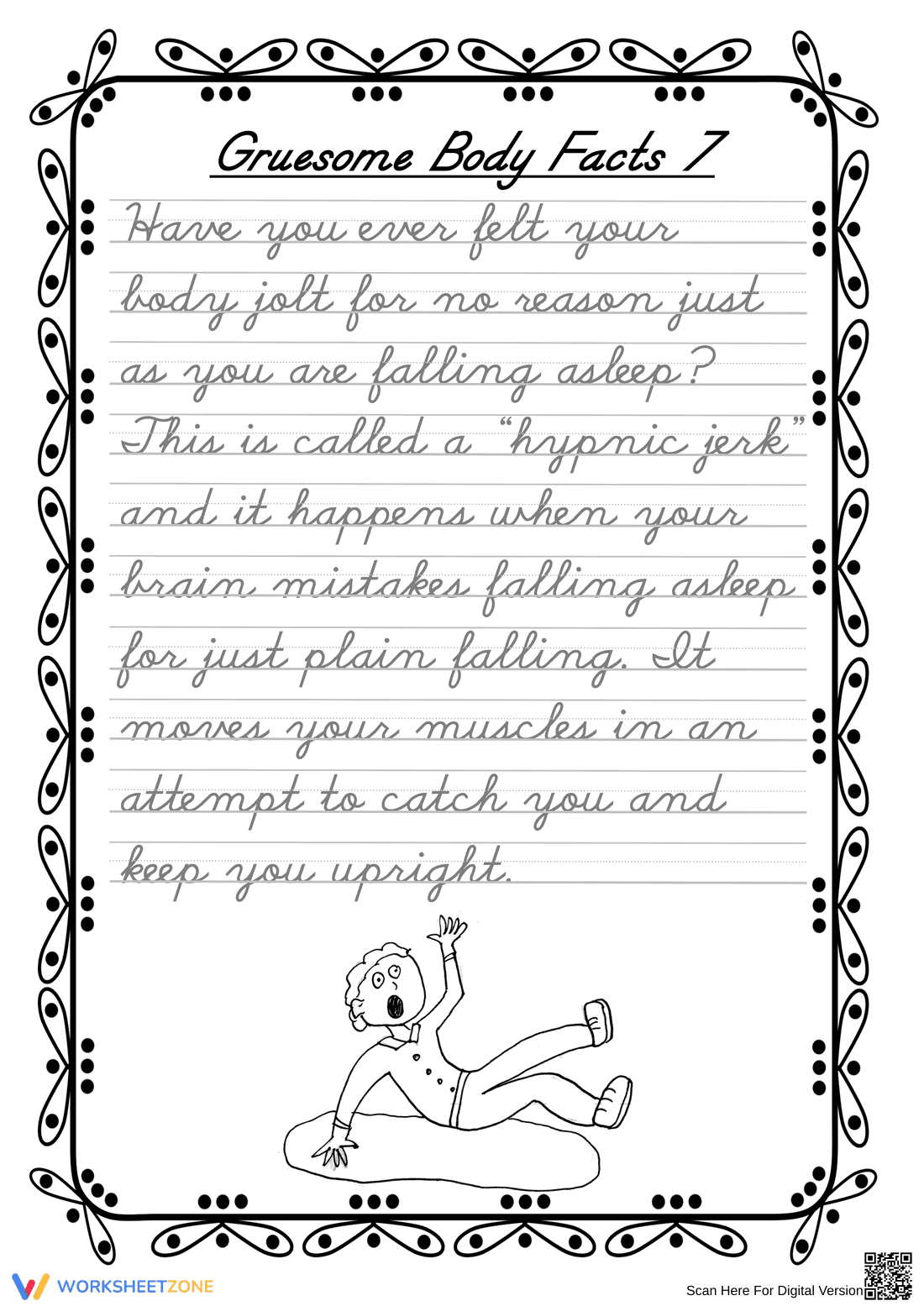

Essential Cursive Handwriting: Hypnic Jerk
Paste this activity's link or code into your existing LMS (Google Classroom, Canvas, Teams, Schoology, Moodle, etc.).
Students can open and work on the activity right away, with no student login required.
You'll still be able to track student progress and results from your teacher account.
This Grade 5 and 6 handwriting worksheet provides a focused paragraph on the biological phenomenon of the hypnic jerk. Students practice cursive legibility while engaging with high-interest science content. By tracing and copying the text, learners refine their fine motor control and letter formation within a meaningful informational context.
At a Glance
- Grade: 5-6 · Subject: Science / Handwriting
- Standard:
CCSS.ELA-LITERACY.L.5.1— Demonstrate command of the conventions of standard English grammar and usage when writing- Skill Focus: Cursive Handwriting
- Format: 1 page · 1 paragraph · Answer key included · PDF
- Best For: Morning work or sub plans
- Time: 10–15 minutes
What's Inside: This single-page PDF features a 50-word paragraph written in a clear D'nealian cursive font. The layout includes structured horizontal lines to guide letter height and slant. A thematic illustration of a person falling in their sleep accompanies the text to provide visual context for the scientific concept described.
Teachers can implement this activity in under 2 minutes. First, print the single-page PDF for the entire class or a small group. Second, distribute the sheets during morning work or as a transition activity between science and ELA blocks. Third, review the completed work for cursive consistency and letter connections. This resource is an ideal sub-plan filler.
The primary standard addressed is `CCSS.ELA-LITERACY.L.5.1`, which requires students to demonstrate command of the conventions of standard English. This includes maintaining legible handwriting to ensure clear communication. Additionally, it supports informational text standards by presenting factual biological data. Both standard codes can be copied directly into lesson plans, IEP goals, or district curriculum mapping tools.
Use this worksheet as a bell-ringer activity to settle students at the start of the day. It serves as a quiet, independent task that requires minimal teacher intervention. Alternatively, place it in a science-themed literacy center to reinforce biology concepts while practicing penmanship. Expect students to complete the tracing and copying in approximately 10 to 15 minutes.
This resource is designed for upper elementary and middle school students who have already learned cursive but require ongoing maintenance to prevent skill regression. It is particularly effective for students who enjoy gruesome facts, which increases engagement for reluctant writers. Pair this with a short video on sleep cycles or a human body anchor chart.
Research by Fisher & Frey (2014) emphasizes the importance of integrated literacy tasks where students engage with informational content while practicing foundational skills. This worksheet aligns with those findings by using a science-based paragraph to drive handwriting practice. Legible handwriting remains a critical component of the CCSS.ELA-LITERACY.L.5.1 standard, as it directly impacts a student's ability to communicate complex ideas effectively in written form. Studies from the NAEP suggest that students who maintain fluent handwriting can devote more cognitive resources to higher-order composition tasks. By providing a 50-word focused practice session, this resource ensures that Grade 5 and 6 students maintain the motor memory required for cursive proficiency without overwhelming their daily schedule. The inclusion of high-interest biological facts about the nervous system further supports cross-curricular learning objectives and student motivation in the classroom setting.


